
The phrase SMART KPIs is used so routinely in management circles that it has almost lost its meaning. Ask a room of ten managers whether their team has SMART KPIs and you will get ten confident nods. Probe deeper, and you will find that roughly half of them have metrics that are specific in name only, targets that were set by copying last year’s numbers and adding a percentage, and deadlines that exist on paper but carry no real operational weight.
This is not a knowledge problem. Most people in business are familiar with the SMART acronym. It is an application problem. Knowing that a KPI should be Specific, Measurable, Achievable, Relevant, and Time-bound is one thing. Knowing exactly how to build one that meets all five criteria in a way that genuinely drives team performance is another challenge entirely.
This article works through that challenge in detail. It takes each element of the SMART framework seriously, examines where teams commonly go wrong, and provides a practical process for developing KPIs that actually do what they are supposed to do — align individual effort with organizational strategy and make progress visible.
"Setting a goal is not the main thing. It is deciding how you will go about achieving it and staying with that plan." Tom Landry
Why Most KPIs Fail Before They Start
Before examining the SMART framework, it is worth understanding the systemic reasons why KPIs so frequently underperform. The first is that they are created top-down without sufficient input from the people who will be measured by them. When a team does not understand why a particular KPI exists or how it connects to outcomes they care about, compliance is superficial, and the data quality suffers accordingly.
The second problem is that KPIs are often set in isolation from strategy. A marketing team might track social media engagement because it feels important and the data is easily available, not because anyone has established a reliable connection between engagement metrics and revenue or customer acquisition. Activity becomes an impact substitute.
Third, the setting process is too often treated as an annual event rather than an ongoing discipline. KPIs set in January based on assumptions that are no longer valid by March create misalignment and, eventually, cynicism. Teams learn that KPIs are a bureaucratic exercise rather than a meaningful tool.
The SMART Framework: What Each Element Actually Means
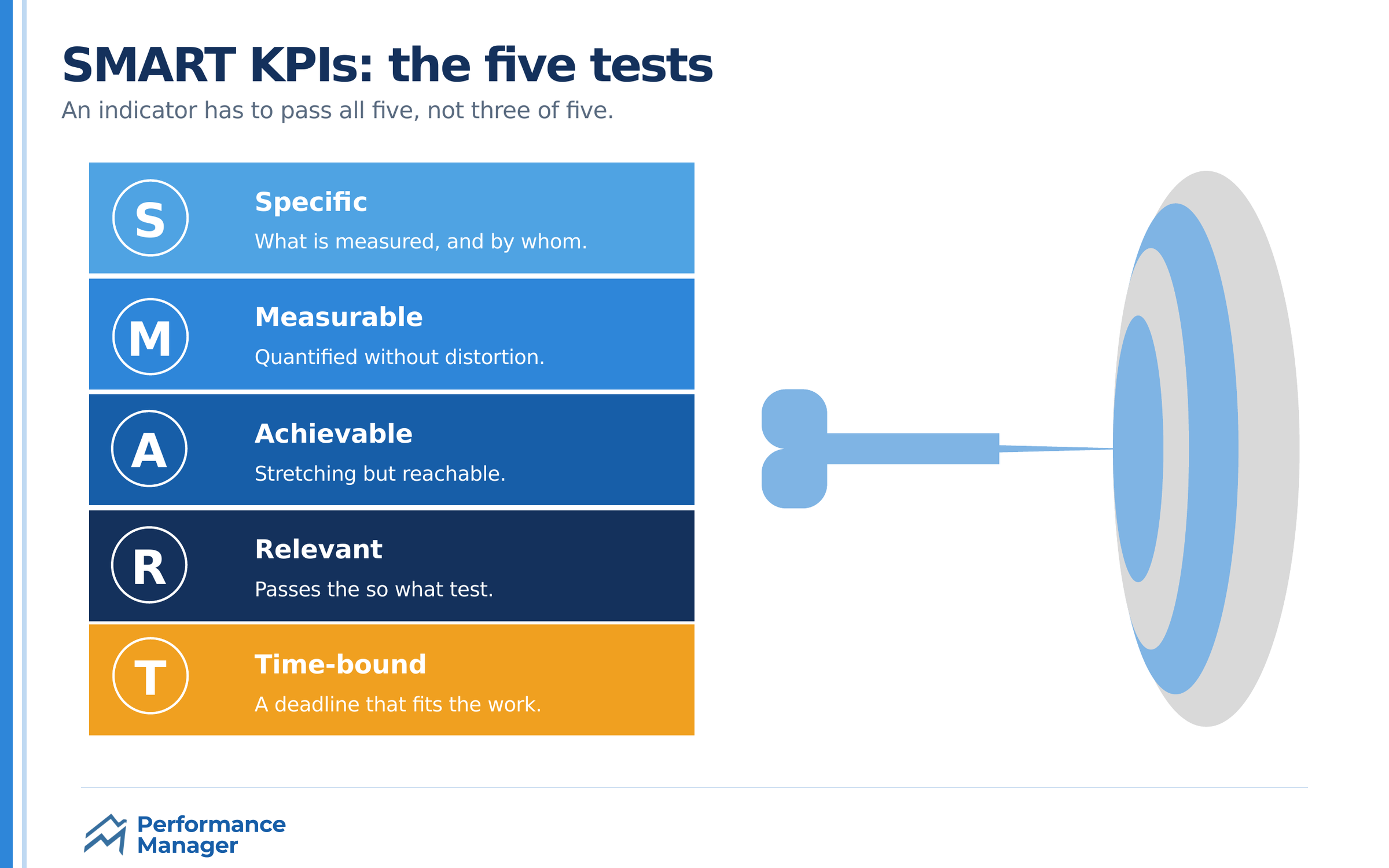
Here is the SMART table as a reference before we dig into each element:
S | M | A | R | T |
Specific | Measurable | Achievable | Relevant | Time-bound |
Clear & unambiguous | Quantifiable target | Realistic given resources | Aligned to strategy | Has a deadline |
S-Specific: The Art of Narrow Precision
A specific KPI defines exactly what is being measured, by whom, and in what context. The enemy of specificity is vagueness; goals like improve customer service " and “ increase team productivity, are aspirations, not indicators.
Specificity requires that you answer at least three questions for any KPI you create. What exactly will be measured?
Who owns the measurement?
What boundaries define the scope?
A customer service team moving from a KPI named response time to average first-response time on inbound support tickets, tracked weekly by the Support Team Lead, has introduced the kind of specificity that makes the indicator actionable.
One useful test: read the KPI to a colleague who was not involved in its creation. If they cannot immediately understand what success looks like, the indicator is not yet specific enough. Specificity should eliminate ambiguity, not just reduce it.
M-Measurable: Quantification Without Distortion
Measurability is where many organizations think they are strong because they have numbers everywhere. But having a number is not the same as having a meaningful measurement. The critical question is not can we quantify this, but does quantifying it in this particular way accurately reflect the reality we care about?
Consider employee productivity. You could measure output per hour, tasks completed per week, or project delivery rate. Each of these tells a different story. A team that delivers projects on time but does so by cutting corners on quality has a high delivery rate but a deteriorating underlying performance. The measurement needs to capture what matters, and often, that requires composite indicators rather than single metrics.
Data collection integrity also falls under measurability. If the measurement process itself is unreliable, inconsistent, or gameable, the KPI loses its value regardless of how clearly it is defined. The measurement infrastructure- who collects data, when, using what tools, and what verification needs to be specified alongside the indicator itself.
A-Achievable: The Goldilocks Challenge
Setting the right target level is one of the most underappreciated skills in KPI design. Targets that are too easy produce complacency; teams hit them without stretching, and the organization learns nothing about its true capacity. Targets that are too ambitious produce either gaming behaviours, manipulating the data to appear successful, or demoralization, where people stop trying because success seems impossible.
The research on goal-setting is reasonably detailed on this point. Goals that require genuine effort but are within reach given available resources, skills, and time tend to produce the best performance. Psychologist Edwin Locke’s work on goal-setting theory established that specific, challenging goals consistently outperform vague or easy ones, but challenging goals must remain within the bounds of what is realistically achievable.
Achievability assessment requires honest calibration against current baselines, available resources, historical performance trends, and external factors. A sales team that achieved 15% growth last year in a booming market is not necessarily capable of replicating that in a contraction. The context matters, and ignoring it produces targets that undermine rather than motivate.
R-Relevant: The Strategic Alignment Test
Relevance is the criterion that connects individual KPIs to the larger strategic picture. A KPI can be specific, measurable, and achievable and still be irrelevant if it does not meaningfully contribute to what the organization is trying to accomplish.
The relevance test is simple: ask, " So what? If this KPI is achieved, what does that mean for the team, the department, and the organization? If the answer is vague or indirect, the KPI is probably measuring something convenient rather than something that matters.
Relevance also has a temporal dimension. A KPI that was relevant twelve months ago may be misaligned today if the strategic priorities have shifted. Organizations that review KPI relevance annually at best are operating with indicators that have quietly become misleading. Quarterly relevance reviews, linked to strategic planning cycles, reduce this risk significantly.
T -Time-bound: Deadlines as Design Choices
A KPI without a time frame is a wish. The time-bound element of SMART is often treated as the simplest: just add a date. But the choice of time frame is actually a significant design decision with real consequences.
Short measurement windows (weekly, monthly) create accountability and enable rapid course correction, but they can also encourage short-term thinking. A sales team measured on monthly revenue might close easy deals quickly while deprioritizing larger, longer-term opportunities. Longer windows allow for more strategic behaviour but reduce the frequency of feedback.
The right time frame depends on the nature of the activity being measured and the decision-making cycle of the team. Operational KPIs that drive daily or weekly decisions need short cycles. Strategic KPIs that track capacity-building or market positioning need longer time horizons. A well-designed KPI framework often includes both, with different review cadences for different types of indicators.
A Step-by-Step Process for Building SMART KPIs
Theory aside, here is a practical process that teams can follow when creating new KPIs or auditing existing ones.
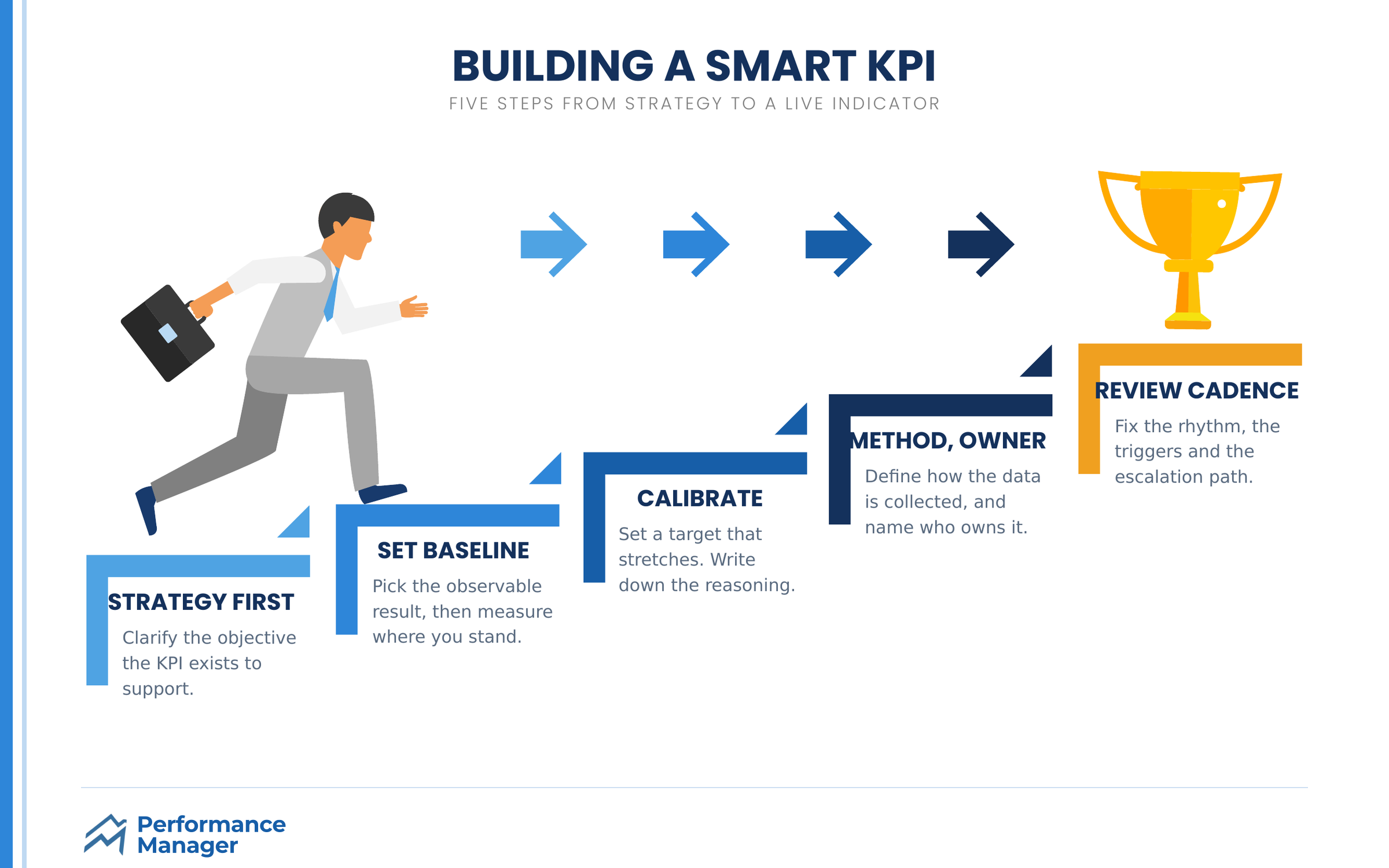
Start with strategy. Before any metric is discussed, clarify the strategic objective the KPI is meant to support. What is the team trying to achieve, and why does it matter to the organization?
Identify the measurable outcome. What is the most direct, observable indicator of progress toward that objective? Avoid activity metrics unless they have a validated causal link to the outcome.
Establish the current baseline. You cannot set a meaningful target without knowing where you currently stand. Invest in baseline measurement even if the data is imperfect.
Set the target through calibration. Review historical performance, industry benchmarks, and team capacity. Set a target that is challenging but grounded in reality. Document the reasoning behind the number.
Define the measurement methodology. Specify exactly how data will be collected, by whom, at what frequency, and through what tools or systems. Identify any risks to data integrity and mitigate them.
Assign ownership. Every KPI needs a named owner who is accountable not just for hitting the target but for ensuring the measurement is accurate and the data is reviewed on schedule.
Set the review cadence. Decide how often the KPI will be formally reviewed, what triggers an off-cycle review, and what the escalation path looks like if the indicator falls significantly off track.
The Difference Between KPIs and Tasks
A persistent confusion in team-level KPI design is the blurring of KPIs and tasks. A task is something you do. A KPI measures the result of what you do or the cumulative effect of many things you do over time. Complete the customer survey by Friday is a task; Net Promoter Score, measured quarterly, is a KPI.
When teams conflate the two, they end up with KPIs that track whether activities were completed rather than whether those activities produced meaningful outcomes. This creates a perverse dynamic: the KPI system rewards execution regardless of impact. Teams can check every box and still fail to deliver the underlying objective.
The discipline of separating output measurement from outcome measurement is fundamental to well-designed KPI frameworks. Both have their place, but they serve different functions and should be managed accordingly.
Involving the Team in KPI Creation
One of the most robust findings in organizational behaviour research is that people perform better when they have had a genuine role in setting the goals they are measured against. This is not simply about buy-in; it reflects the fact that front-line team members often have insights about operational realities, practical constraints, and data quality issues that managers do not.
A participatory KPI-setting process does not mean goals are set by committee or that teams are free to set easy targets. It means that the people being measured are consulted on what is realistic, what the data can reliably support, and whether the proposed indicator actually reflects the work they do. This input almost always improves the quality of the KPI, and it builds the understanding needed for the indicator to be used well.
Reviewing and Retiring KPIs
SMART KPI creation is not a one-time event. As business conditions evolve, previously relevant indicators can become obsolete, misleading, or counterproductive. A KPI that drives excellent behaviour in one strategic context can become a constraint when the strategy shifts.
Organizations need explicit processes for retiring KPIs that have served their purpose or that are no longer aligned with current priorities. The psychological resistance to retiring metrics is real; there is often an implicit assumption that removing a metric signals that performance no longer matters. The opposite framing is more productive: retiring an outdated KPI is an act of strategic discipline, not negligence.
Final Thoughts: KPIs as Conversations, Not Commands
The most effective KPI frameworks are not static scorecards handed down from leadership. They are living tools that provoke ongoing conversations about what matters, why performance is trending in a particular direction, and what can be done differently. The number on the dashboard is a starting point for inquiry, not an end in itself.
When a team has genuinely SMART KPI indicators that are precise, reliable, realistic, strategically grounded, and time-defined, those conversations become substantive. There is real information to work with. Decisions can be grounded in evidence. Progress can be celebrated meaningfully. And when something is not working, the clarity of the indicator makes diagnosis faster and intervention more targeted.
That is the real value of the SMART framework, properly applied: not compliance with a checklist, but the creation of measurement tools that actually help teams think clearly about their work.