
In our work reviewing clients' strategy plans across sectors, we have encountered documents that include a vision statement and a list of activities but leave the difficult choices unresolved. Management knows what it wants to achieve. Less clear is why the organisation should succeed, which opportunities deserve its resources, and what it is prepared to stop doing.
For an executive, the practical test is whether the strategy helps when two attractive investments compete for the same money. If both can be justified by reference to growth, customer service and efficiency, the document needs to say more. Which customers matter most? What will persuade them to choose the organisation? How will serving them generate an acceptable return?
A strategy should give management a basis for making those decisions.
Hambrick and Fredrickson make this point in their work on strategy design: choices about markets, routes to those markets, differentiation, the sequence of moves and economic returns must fit together. A collection of individually sensible projects does not establish that fit.
Planning still matters. George, Walker and Monster's meta-analysis of 31 studies found a positive relationship between strategic planning and organisational performance. That finding supports disciplined planning; it does not mean that completing a planning process guarantees commercial success. The question for a board is what the process has helped management decide.
The six components below follow the strategic planning dimensions used by the Global Performance Audit Unit. They provide a useful structure for examining the planning process. The executive tests in this article extend that discussion to the quality of the choices, the resources committed, and the evidence that would justify changing direction. A maturity assessment and a sound investment decision answer different questions.
Number | Component | Executive test |
1 | Strategy Foundations | Do purpose and values set meaningful boundaries for decisions? |
2 | Strategy Formulation | Do evidence and customer economics support the chosen direction? |
3 | Strategy Articulation | Can managers connect the choices to outcomes, measures, and funded work? |
4 | Strategy Alignment | Do budgets, incentives, and decisions across departments support the strategy? |
5 | Strategic Resilience | Can management recognise and respond when critical assumptions change? |
6 | Strategy Enablers | Are authority, skills, information and management capacity sufficient? |

1. Strategy foundations must guide difficult choices
Mission, vision and values should establish the organisation's purpose, intended direction and boundaries of acceptable conduct. I would assess them by the decisions they help management make. Elegant wording is a poor substitute for that practical value.
A vision can describe an ambition without explaining how to achieve it. That is not necessarily a defect in the vision. The mistake is expecting it to do the work of the strategy. Management must still explain whom it will serve, what it will offer and why those choices are commercially credible.
Take a familiar statement:
"To be the best company in our industry by providing quality services to our customers."
The statement offers little help when management must choose between a cheaper standard service and a more expensive personalised one. Adding words such as digital, sustainable or world-class does not resolve the choice. Executives need to specify which customer need deserves priority and what serving it will require.
For illustration, an airport operator might choose a more precise direction:
"We will focus on regional business travellers who value predictable journey times, investing first in reliable processing and connections before expanding retail space."
This is an illustrative choice, not a recommendation for every airport. It would still need evidence about demand, operating constraints and returns. Its value is that management can debate it. The same test applies to values: if integrity is a stated value, the board should ask which profitable opportunities the organisation would refuse because accepting them would breach it.
2. Strategy formulation must explain the economics
Start with the problem. Is growth constrained by weak demand, an uncompetitive offer, poor distribution, insufficient capacity, or customers who are expensive to serve? Each diagnosis points towards different action. Ask management to show the evidence behind its diagnosis before presenting a preferred project.
Then examine the economics at the level where choices are being made. For each priority customer group, ask what customers will pay, what it costs to acquire and serve them, how much cash the business must commit, and when that cash returns. An attractive revenue forecast can conceal heavy servicing costs or a long wait for payment. The board should ask how the proposal creates value after these demands are met, not merely how much revenue it adds.
Suppose a business can fund either wider geographic coverage or faster service in its existing market. Both could increase sales. I would compare them against the chosen customer need, the capabilities required, the cash at risk, and the alternatives being displaced. Make the assumptions explicit, including expected competitor responses. Hambrick and Fredrickson's framework is useful here because it requires a view on economic logic and the sequence of investments, alongside where and how to compete.
3. Strategy articulation must connect work to results
Once management has made its choices, the next task is to explain what must change and how success will be judged. Keep the distinction between an outcome and an activity clear. Launching a digital service is an activity. Retaining profitable customers through a faster, more reliable service is an outcome the investment might support.
For every major choice, I would expect a defined outcome, a starting position, a target date, an accountable executive, and an agreed funding requirement. Specify the measure and who owns the data. Locke and Latham's review of goal-setting research shows why clear, challenging goals matter, while also explaining the importance of commitment, feedback, ability, and task complexity. A target needs a credible route to achievement.
For example, a new service can launch on time while customers continue using the old channel. A completion report would record success; an investment review should ask whether the expected customer behaviour and financial benefits have materialised. Measure both delivery progress and the result the project was intended to produce.
Treat the links in a strategy map as propositions to test. If management expects training to improve service quality and service quality to improve retention, it should examine each link. Do employees apply the skills? Has the service changed? Are the customers being retained worth serving? An attractive diagram should help organise that investigation, not close it.
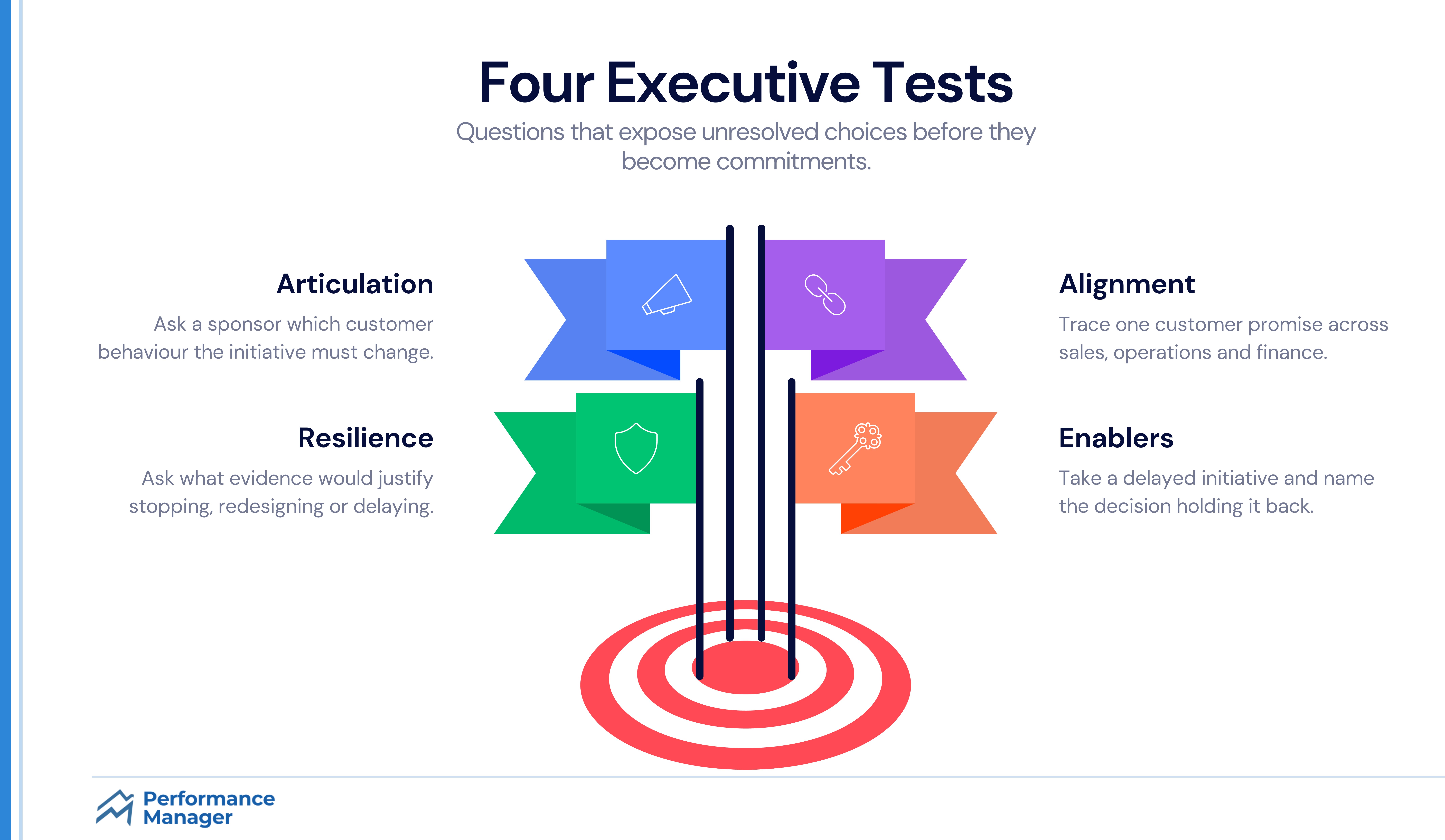
A practical executive test Choose one major initiative and ask its sponsor to explain the customer behaviour or operating result it must change, the evidence of progress, the remaining cost, and the next decision required. If the answer consists mainly of completed activities, ask for the missing results before approving further expansion. |
4. Strategy alignment must reach budgets and incentives
Cascading objectives through departments is only part of alignment. Examine whether capital, people and management attention support the choices. A meta-analytic study by D'Oria and colleagues emphasises the interdependence of strategic resources and the actions managers take to use them. The practical implication is to assess both what the organisation possesses and how it intends to deploy it.
Put the strategy beside the budget. If the next phase depends on a new service capability, identify which expenditure and roles will build it, and which work will be reduced to create room. Include the cost of risk controls and any material environmental or social obligations in the investment case. These are part of judging whether the proposal is viable, not issues to append after approval.
Incentives deserve the same scrutiny. Steven Kerr's analysis describes reward systems that encourage behaviour different from what leaders say they want.[6] Consider an illustrative business that asks salespeople to build profitable relationships but rewards them only for revenue booked. The board should examine whether margins, payment quality and customer retention matter in the reward decision. Communication alone cannot resolve a contradiction built into pay.
A practical executive test Trace one customer promise across sales, operations and finance. Identify the decisions each function controls, the resources it needs, and the measures used to judge it. Look for conflicts: sales may promise speed while operations is rewarded for large production batches and finance restricts inventory. Assign responsibility for resolving the trade-off. Repeating the same corporate measure on every employee's scorecard will not resolve it. |
5. Strategic resilience must protect the next investment
A strategy rests on assumptions about customers, competitors, costs and the operating environment. Some will prove wrong. The useful question is how quickly management will recognise that and what it can still change. Duchek's conceptual work on organisational resilience distinguishes anticipation, coping and adaptation, giving executives a broader perspective than recovery after a crisis.
For each major investment, record the few assumptions that could invalidate the case, the evidence to monitor, and the point at which a fresh decision is required. Examples might include customer adoption below an agreed threshold, funding costs above the level the project can support, or a critical supplier becoming unavailable. Set thresholds for the circumstances of the business; there is no universal review calendar that fits every exposure.
Combine scheduled reviews with reviews triggered by material changes. Mintzberg and Waters' work on deliberate and emergent strategy explains how realised strategy can reflect both intention and learning. More recent experimental evidence from Camuffo and colleagues, involving 759 firms in four randomised trials, found that teaching a scientific approach to entrepreneurial decisions increased idea termination. Those entrepreneurial settings do not establish an identical effect in large corporations. They do offer a reason to take explicit assumptions and tests seriously.
A practical executive test For the next substantial funding request, ask what evidence would justify stopping, redesigning, or delaying the project. Agree who can make that decision. A meta-analysis by Sleesman and colleagues examines the factors behind escalation of commitment, the tendency to persist with a troubled course of action. My recommendation is to separate the case for spending the next dollar from the desire to defend money already spent. |
6. Strategy enablers must make accountability workable
Governance, skills, information and technology matter because managers need the means to make and carry out decisions. Name the executive accountable for each strategic outcome. The strategy function can coordinate the process, challenge reporting and maintain the record, but the operating executives must own the business results.
Test capacity before approving the portfolio. If several initiatives require the same finance specialists, technical staff or senior managers at the same time, separate business cases can conceal a collective delivery problem. Ask for the sequence of work, the critical dependencies and the activities that will be postponed. Funding approval should include a realistic view of the people needed to deliver.
Information quality also depends on whether people can challenge the prevailing view. Edmondson's study of 51 work teams found an association between psychological safety and learning behaviour. For executives, the implication is practical: ask for evidence that challenges the investment case, make it safe to report a mistaken assumption, and distinguish an honest warning from poor performance. A reporting system should help leaders discover problems while they still have choices.
A practical executive test Choose a delayed initiative and identify the specific decision holding it back. Who has authority to decide? What information is missing? Which dependency remains unresolved? Record the decision, its owner, and the deadline. Knowing who coordinates the strategy process is useful, but the stronger test is whether the organisation can resolve a real obstacle. |
What the board should require before approval
Use the six components together. A clear purpose does not compensate for weak customer economics, and a detailed scorecard does not make an unfunded initiative deliverable. The board should be able to follow the argument from the problem management has diagnosed to the choices proposed, the resources required, and the results expected.
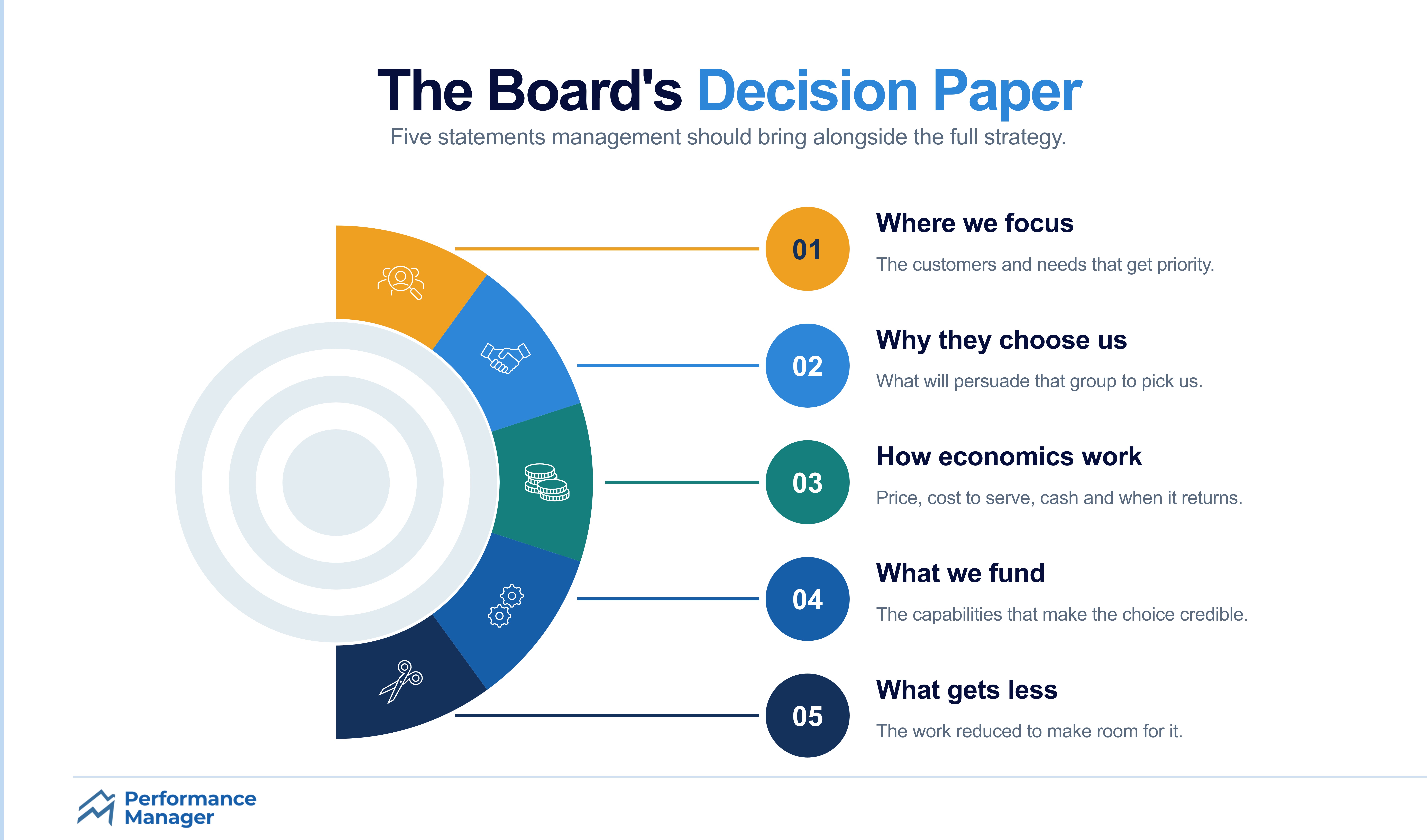
I would ask management to bring a short decision paper alongside the full strategy. It should state where the organisation will focus, why customers should choose it, how the economics work, which capabilities need investment, and what will receive fewer resources. It should also identify the most consequential assumptions and the evidence that would prompt a change. The purpose is to expose unresolved choices before they become expensive commitments.
At the next review, start with what has changed in the evidence. Which assumptions still hold? Which investment now deserves more money, and which deserves less? Where does management need the board to resolve a decision? Progress against activities belongs in the discussion, but it should not crowd out the investment judgement.
The strongest test of a strategy is what it changes in the next difficult decision. If it cannot help management choose where to commit scarce money and capable people, it needs more work.