
Peter Drucker did not set out to create a management fad. When he introduced Management by Objectives in The Practice of Management in 1954, the concept was a direct response to a problem he had watched destroy performance in one large organization after another: managers doing busy work that had nothing to do with what the business actually needed. Departments operated in silos. Supervisors invented their own priorities. And the people at the top assumed, wrongly, that issuing directives was the same thing as achieving outcomes.
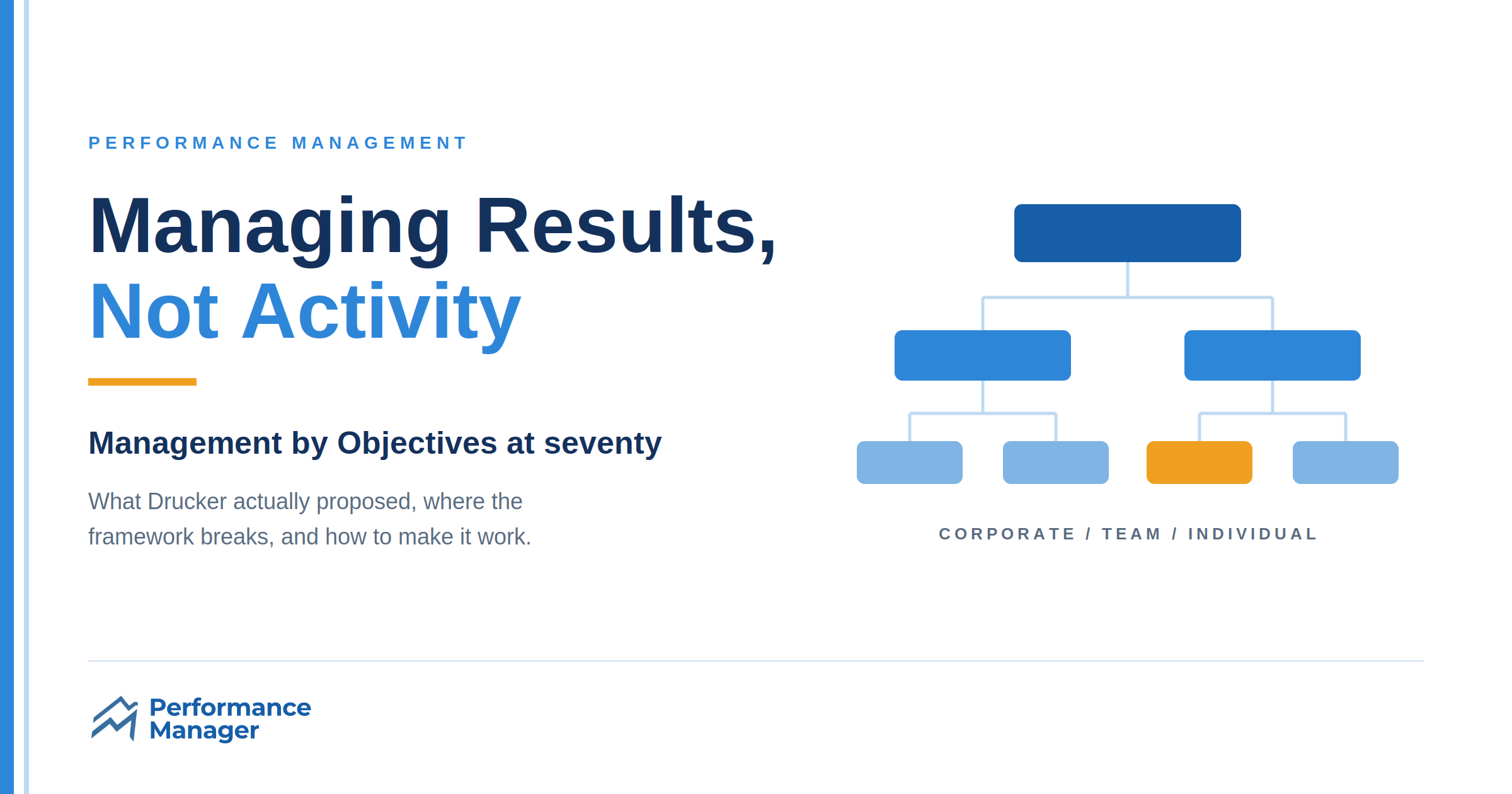
Drucker’s proposition was deceptively simple. Instead of managing activity, manage results. Define what needs to be accomplished. Agree on measurable objectives at every level of the organization. Then hold people accountable for reaching them. The manager’s job is not to monitor how employees spend their time but to ensure that the objectives they pursue are the right ones, aligned upward with the organization’s strategy and downward with operational reality.
Seventy years later, MBO remains one of the most widely referenced performance management frameworks in the world. It has also been one of the most frequently misapplied. The gap between Drucker’s original concept and what most organizations actually do with it explains both the framework’s enduring appeal and its persistent reputation for producing paperwork instead of performance.
How MBO Actually Works: The Process, Step by Step
MBO follows a cyclical process. It is not a single event or a form to be completed annually. When implemented properly, it is a management discipline that shapes how decisions are made, how resources are allocated, and how performance is discussed throughout the year. The cycle has five distinct phases, and skipping any one of them is enough to break the system.
Defining Organizational Objectives
Everything starts at the top. Before any individual objectives can be set, the organization must articulate what it is trying to achieve over the relevant period, typically a fiscal year, though some organizations work in shorter cycles. These objectives should be specific enough to guide action and few enough to force prioritization. An organization with twenty corporate objectives has no priorities at all. Five to seven is a more realistic number for most companies.
The quality of these top-level objectives determines everything that follows. Vague statements like “improve customer satisfaction” or “grow market share” are not objectives in any useful sense. They are aspirations. An objective needs a target, a timeframe, and a way to measure whether it has been met. “Increase net promoter score from 38 to 50 by December” is an objective. “Improve customer experience” is a wish.
Cascading Objectives to Individuals
This is where MBO either succeeds or collapses. Each manager takes the organizational objectives and, in conversation with their direct reports, translates them into individual objectives that are relevant to that person’s role. The word “conversation” is doing heavy work in that sentence. In Drucker’s conception, MBO is a participative process. The manager does not hand down targets. The manager and the employee negotiate them together, drawing on the employee’s knowledge of their role and the manager’s understanding of broader priorities.
This participative element is what makes MBO different from simple target-setting. When an employee contributes to defining their own objectives, they develop a degree of psychological ownership over those objectives that no top-down directive can produce. The research on goal setting, particularly Edwin Locke and Gary Latham’s work, is clear on this point: people commit more strongly to goals they have helped define than to goals imposed upon them, provided those goals are specific, challenging, and accompanied by feedback.
The cascading process also exposes alignment problems early. If a regional sales manager cannot translate the corporate revenue growth objective into meaningful targets for her team, that is not a failure of the individual. It is a signal that the corporate objective may be disconnected from operational reality, or that the resources allocated to that region are insufficient. MBO, done well, surfaces these misalignments before they become year-end surprises.
Monitoring Progress
Objectives set in January and reviewed in December are not being managed. They are being filed. The monitoring phase requires regular check-ins, monthly at minimum, during which the manager and employee review progress against each objective, discuss obstacles, and adjust course where necessary. This is not micromanagement. It is the mechanism through which objectives stay relevant in a changing environment.
A common failure here is treating monitoring as policing. When the check-in becomes an interrogation, asking why targets are not met and applying pressure to catch up, the entire MBO system curdles into a compliance exercise. The purpose of monitoring is problem-solving, not punishment. What is getting in the way? What support does the employee need? Has the operating context changed in a way that makes the original objective unrealistic or irrelevant? These are the questions that keep the system alive.
Evaluating Results
At the end of the cycle, results are assessed against the agreed objectives. This evaluation should hold very few surprises if the monitoring phase was handled properly. An annual review that contains bombshells is a review that was preceded by twelve months of inadequate feedback.
The evaluation should be straightforward: was the objective met, partially met, or not met? And critically, why? MBO’s value as a management tool depends on this diagnostic step. A missed target that resulted from poor effort tells a different story than a missed target caused by a budget cut or an unforeseen market shift. Treating both the same way is lazy management, and employees learn quickly that the system does not distinguish between things within their control and things outside it.

Linking Results to Consequences
The final phase connects evaluation to outcomes: development plans, compensation decisions, promotion considerations, or, in some cases, performance improvement processes. Without this link, MBO is an elaborate conversation that changes nothing. People need to see that achieving their objectives has real consequences, both positive and corrective. The system loses credibility the moment employees observe that their colleague who hit every target receives the same reward as the one who missed them all.
What MBO Gets Right
For all its implementation challenges, the underlying logic of MBO addresses several genuine problems that other management approaches leave untouched.
The first is clarity. In organizations without explicit objective-setting, employees frequently operate on assumptions about what matters. Those assumptions are shaped by habit, by what the previous manager valued, by what gets punished most visibly, or simply by what the employee finds most interesting. MBO replaces guesswork with agreement. When a manager and an employee sit down and agree on four specific objectives for the next six months, both parties know what success looks like. That clarity alone eliminates a surprising amount of wasted effort.
The second is alignment. The cascading structure of MBO creates, at least in theory, a traceable line from individual effort to organizational strategy. A customer service representative who knows that her call resolution target feeds into a departmental service quality objective, which in turn supports a corporate customer retention goal, can see how her daily work connects to something larger. That line of sight is motivating in a way that abstract mission statements are not.
The third is accountability with autonomy. Drucker was explicit on this point. MBO defines the what but not the how. An employee who has agreed to reduce processing errors by fifteen percent is free to figure out the best way to achieve that result. This distinction between ends and means is one of MBO’s most important features, and one of the first things organizations strip away when they implement it badly, layering prescriptive procedures on top of objectives and defeating the purpose entirely.
Where MBO Breaks Down
If MBO were as straightforward as its textbook descriptions suggest, every organization that adopted it would perform brilliantly. They do not. The framework has genuine limitations, some inherent and some self-inflicted.
The Measurability Trap
MBO’s insistence on measurable objectives creates an incentive to set objectives for things that are easy to quantify, regardless of whether those things actually matter. A sales team might set a target for the number of client meetings per month because meetings are countable, even though meeting frequency has almost no correlation with revenue when the quality of those meetings is poor. A training department might measure hours of training delivered rather than whether the training changed anyone’s behaviour.
This problem, sometimes called “surrogate measures,” is not trivial. When people are rewarded for hitting measurable targets, they will optimise for those targets, sometimes at the expense of the outcome the targets were supposed to represent. A hospital that sets a target for emergency department wait times might achieve it by triaging patients faster, which is good, or by reclassifying patients to avoid the metric, which is gaming. MBO does not inherently distinguish between the two.
Short-Termism
Objectives set on an annual cycle encourage annual thinking. Important work that takes three years to bear fruit, building a new capability, establishing a market position, changing an organizational culture, does not fit neatly into a twelve-month objective. Managers facing annual evaluations will rationally prefer projects with visible short-term payoffs over investments with uncertain long-term returns. The system rewards what can be accomplished and demonstrated within the cycle, which systematically undervalues patient, cumulative work.
Rigidity in Volatile Environments
Objectives agreed in January may be obsolete by June. A new competitor enters the market. A key supplier collapses. A regulatory change rewrites the rules. MBO systems that treat objectives as fixed commitments rather than evolving agreements penalise employees for circumstances they could not have predicted. In volatile operating environments, and Zimbabwe’s economy certainly qualifies, this rigidity can turn MBO from a performance tool into a source of organizational frustration.
The remedy is not to abandon objectives but to build formal review points into the cycle where objectives can be revised by mutual agreement. Some organizations now run MBO on quarterly cycles rather than annual ones, precisely to maintain relevance in fast-changing contexts.
The Participation Illusion
Drucker’s model requires genuine participation: the employee and the manager co-creating objectives through dialogue. In practice, what often happens is pseudo-participation. The manager arrives at the objective-setting meeting with targets already determined, and the “discussion” is a thin exercise in obtaining the employee’s signature. The employee learns quickly that participation is cosmetic, and the psychological ownership that MBO depends on never develops.
This failure is cultural, not structural. In organizations where authority is highly centralised and disagreement with senior staff is culturally uncomfortable, participative objective-setting requires deliberate effort and managerial skill. A manager who genuinely wants input must create conditions where employees feel safe to push back, to say that a target is unrealistic, or to propose an alternative objective the manager had not considered. Without that safety, participation is theatre.
MBO and the Balanced Scorecard: Complementary, Not Competing
A question that surfaces repeatedly in performance management consulting is whether organizations should use MBO or the Balanced Scorecard (BSC). The question is based on a misunderstanding. They operate at different levels and serve different purposes.
The Balanced Scorecard is a strategy translation tool. It takes an organization’s strategy and maps it across four perspectives, Financial, Customer, Internal Processes, and Learning and Growth, to ensure that performance is tracked across all dimensions, not just the financial one. It answers the question: what should we measure?
MBO is an individual performance management process. It takes objectives, from whatever source, and cascades them to individual employees through a structured cycle of goal-setting, monitoring, evaluation, and reward. It answers a different question: how do we ensure that each person contributes to what we are measuring?
In a well-designed performance system, the BSC defines the organizational and departmental objectives. MBO is the mechanism through which those objectives reach individual employees. The BSC provides the “what.” MBO provides the “who” and the “how much.” Treating them as alternatives is like asking whether a building needs an architect or a construction crew. It needs both.
MBO in the Zimbabwean Context
MBO was designed in mid-twentieth-century America, for large, stable corporations operating in relatively predictable markets. Zimbabwe in 2026 is none of those things. The economic environment is volatile. Currency fluctuations can render financial targets meaningless within a quarter. Skilled employees are mobile, with remote-work opportunities making geographic borders increasingly irrelevant. And many organizations still operate with highly centralised management structures that resist the participative ethos MBO requires.
None of this makes MBO irrelevant. It does mean that applying it mechanically, importing an American textbook process without adaptation, is a recipe for frustration. Several adjustments improve MBO’s fit for the local context.
First, shorten the cycle. Annual objectives in a volatile economy lose relevance fast. Quarterly or semi-annual cycles keep objectives connected to reality and give managers more frequent opportunities to adjust.
Second, denominate objectives in operational terms rather than purely financial ones. A sales objective expressed in units sold or market share percentage survives currency fluctuation better than one expressed in dollar revenue. Where financial targets are unavoidable, build in explicit provisions for recalibration when macroeconomic conditions shift materially.
Third, invest in managerial capability for participative goal-setting. This is not a natural skill for many managers, particularly in hierarchical organizational cultures. It requires training, modelling from senior leadership, and, above all, patience. The first cycle of genuinely participative MBO will be messy and slow. The second will be better. By the third, the organization starts to see the benefits that Drucker described: employees who understand their objectives, believe in them, and take ownership of achieving them.
Making MBO Work Rather Than Just Exist
The difference between organizations that get value from MBO and those that merely practise it comes down to three disciplines.
The first is selectivity. An employee with twelve objectives has no priorities. Three to five well-chosen objectives, each with a clear measure and a meaningful connection to organizational strategy, will always outperform a long list of targets that nobody can hold in their head simultaneously.
The second is honest monitoring. Check-ins that happen regularly, that treat obstacles as problems to solve rather than failures to punish, and that allow objectives to be revised when circumstances change, are the engine that keeps MBO running. Without them, the system degrades into a year-end form-filling exercise that everyone resents.
The third is consequence. Objectives that have no bearing on development, recognition, or reward are objectives that nobody takes seriously. The system must close the loop. People who achieve their objectives should experience something different from people who do not. That does not always mean money. It can mean career progression, new responsibilities, public recognition, or access to development opportunities. But it must mean something.
Drucker understood that managing by objectives was harder than managing by activity. Activity is visible. Objectives require thought. Activity can be supervised. Objectives require trust. That difficulty is not a flaw. It is the price of managing an organization through results rather than rituals. The organizations willing to pay that price consistently outperform those that are not.