
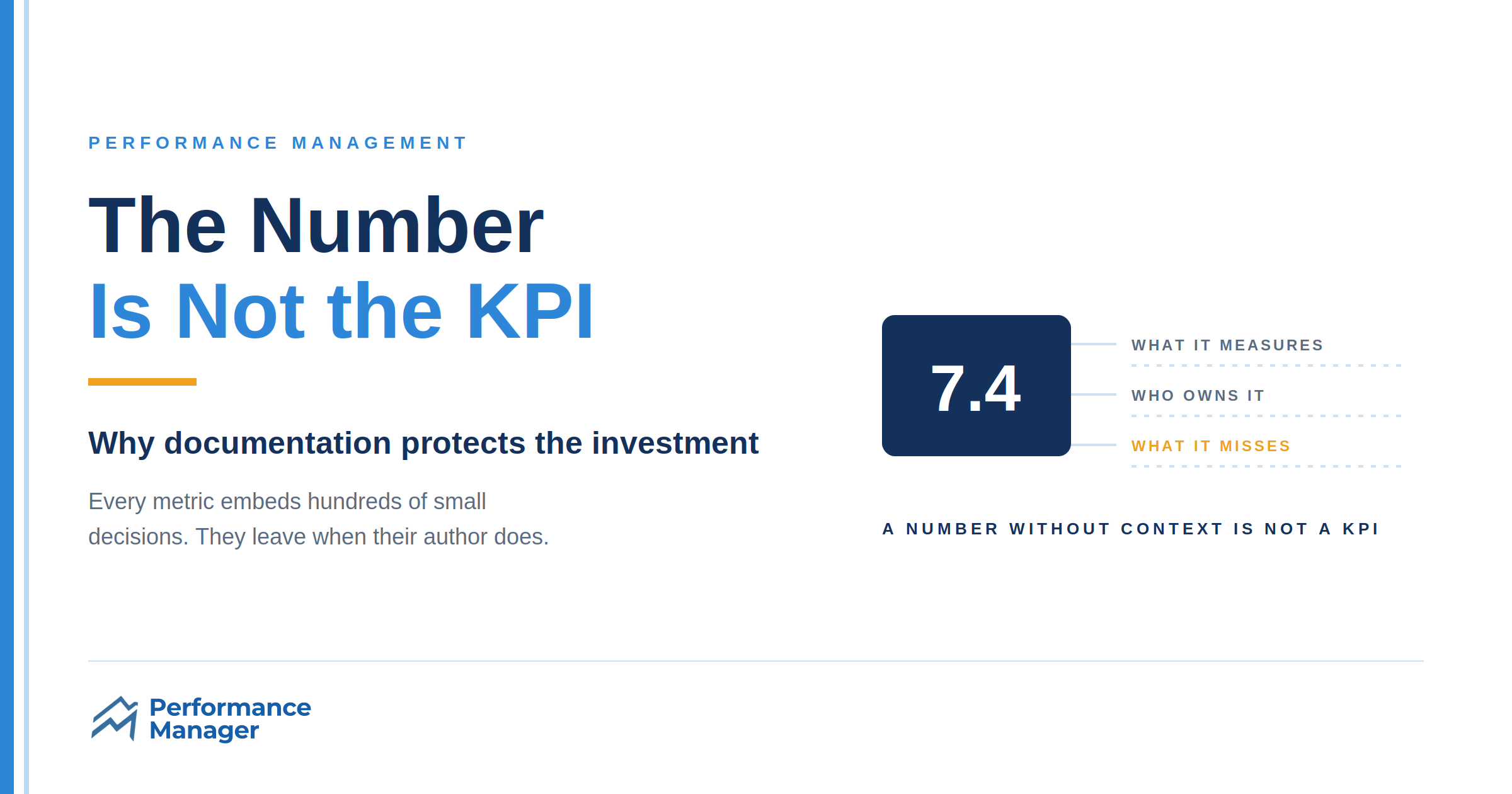
There is a scenario that plays out in organizations with uncomfortable regularity. A key team member leaves. Their successor steps into the role, inherits a dashboard of performance metrics, and immediately runs into a wall of ambiguity.
What exactly does this KPI measure?
How is the data collected?
What does the target represent, and who set it?
Why does the number look different depending on which system it is pulled from?
Who was responsible for tracking this?
Without answers to these questions, the KPI is not a management tool; it is a data point floating free of context, interpretation, or accountability. Its value has essentially evaporated. The organization has invested time and effort in building a performance measurement system and then failed to protect that investment with the most basic form of institutional memory: documentation.
KPI documentation is one of the least glamorous disciplines in performance management, and it is also one of the most consequential.
This article examines why documentation matters, what it needs to contain, how to build a documentation practice that survives organizational change, and the hidden costs of getting it wrong.
"An undocumented process is a process that exists only in someone’s head and that person will eventually leave." Common organizational wisdom
What KPI Documentation Actually Is
KPI documentation is not simply a spreadsheet with metric names and targets. It is a structured record of everything a person needs to know to understand, use, and manage a KPI correctly. That includes the definition of the metric, its strategic purpose, its measurement methodology, its data sources, its ownership, its target rationale, its known limitations, and its review history.
Think of it as the institutional knowledge that would otherwise exist only in the memory of whoever built the metric originally. Every KPI embeds hundreds of small decisions, choices about what to include or exclude from a calculation, how to handle edge cases, how to interpret ambiguous data, what comparison period to use. Without documentation, those decisions are invisible to anyone who did not make them. And invisible decisions are the root cause of most KPI misinterpretation.
The Difference Between Recording Data and Documenting Meaning
Many organizations confuse data storage with documentation. They keep dashboards, export reports, and maintain historical records of metric values over time. This is necessary but insufficient. Data records tell you what the number was. Documentation tells you what the number means, why it was defined that way, what it is supposed to predict or reflect, how it should be interpreted in context, and what its known blind spots are.
A customer satisfaction score of 7.4 is a data point. Whether that represents excellent performance, a concerning decline, or a metric that has been trending consistently within a narrow band for two years is documented context. Without it, the person looking at the number is making interpretive decisions in a vacuum, and those decisions will often be wrong.
Why Proper Documentation Is Strategically Critical
Organizational Continuity
Staff turnover is the most immediately obvious reason documentation matters. People change roles, leave organizations, go on leave, or simply forget the reasoning behind decisions made months or years earlier. When institutional knowledge lives in spreadsheet formulas and tribal memory, it leaves when people leave.
The disruption caused by losing an undocumented KPI owner is rarely dramatic or sudden. More often, it is a slow degradation of data quality and interpretive consistency. The new owner makes slightly different assumptions. Measurement methodologies drift. Comparisons to historical data become unreliable. By the time anyone notices the problem, the historical record has been compromised and rebuilding confidence in the data requires significant effort.
Data Integrity and Auditability
Organizations operating in regulated industries- financial services, healthcare, pharmaceuticals- often have explicit audit requirements that mandate documentation of how performance metrics are calculated. But even outside regulated contexts, auditability matters.
When a KPI shows an unexpected result, a sudden jump, an unusual dip, or a trend that contradicts other data, the first step in diagnosis is usually methodological.
Was there a change in how the data was collected?
Was the calculation updated?
Is there a data quality issue in the source system?
Without documentation, answering these questions is time-consuming and unreliable. With it, diagnostic investigations that might take days can be resolved in hours.
Strategic Alignment Over Time
KPIs are built to reflect strategic priorities at a particular point in time. Strategies change. Markets shift. Organizations pivot. Unless the connection between a KPI and its strategic rationale is documented, it is almost impossible to systematically review whether current metrics still reflect current priorities.
This matters more than it might seem. Outdated KPIs are not benign, they actively direct effort and attention toward goals that may no longer be relevant. Teams optimize for what they are measured on. If the measurement framework is silently misaligned with strategy, the organization is systematically rewarding the wrong behaviours. Documentation enables the periodic audits needed to catch this drift before it compounds.
Cross-Functional Coherence
In organizations of any size, multiple teams often work with related or overlapping metrics. Customer acquisition cost might be tracked by marketing and finance simultaneously, using different methodologies that produce different numbers. Revenue can be measured on a cash basis or an accrual basis. Employee turnover can be calculated as headcount departures or as FTE-weighted departures, producing significantly different figures.
Without documented definitions, these discrepancies surface in meetings as arguments about whose numbers are right — when in fact both sets of numbers may be internally consistent, just measuring different things. Documented KPI definitions enable organizations to have a single source of truth for each metric or to be explicit about why different definitions are used for different purposes. Either way, clarity replaces confusion.
What a KPI Documentation Record Should Contain
A complete KPI documentation record does not need to be long, but it does need to be comprehensive in the right areas. Below is an example of what a well-documented KPI record looks like:
Not all fields will be required in all organizations. This is to write down enough information that any person can take up the record and get an immediate picture of what is under measurement, how, why, and under what limits. Specific attention should be paid to the field The Known Limitations, as it is the most frequently ignored aspect, and it is the aspect that can be misunderstood the most.

The Known Limitations Field: The Most Overlooked Element
Every KPI has limitations. A metric that excludes part of the population it is supposed to represent, a measurement method that has known sources of error, a calculation that produces misleading results under specific conditions- these are not reasons to abandon a metric, but they are reasons to document them explicitly.
In cases where restrictions are not recorded, two occurrences take place. Originally, edge cases are met by people who end up wasting time in their investigation, or worse still they end up making false assertions about the misinterpreted data. Second, the organization implicitly overdevelops its measurement framework. Documented limitations indicate epistemic honesty; they convey that the organization knows how to measure itself and not just give numbers.
The most difficult task in the KPI documentation is not the construction of the template or what to put into it. Building a Documentation Culture: The Organizational Challenge
The most difficult task in KPI documentation is not the construction of the template or what to put into it. It is building the discipline to maintain documentation as a normal part of how performance management works, not as a separate project that happens when there is time.
Make Documentation Part of the Creation Process
The most effective approach is to embed documentation in the KPI creation workflow rather than treating it as a follow-on activity. When a new KPI is proposed, the documentation record should be completed as part of the proposal. If the team cannot complete the required fields, that is a signal that the KPI is not yet fully designed; the documentation requirement functions as a quality gate.
This approach changes the psychological framing. Documentation is no longer a burden on the administration that is added after the real work is completed, but it is a part of the real work. Such teams are always able to deliver better quality KPIs since the rigor of writing down forces good metrics in the first place.
Assign Documentation Ownership
The lack of ownership of documentation is inferior. It should be made clear to the owner of the KPI that it is his/her responsibility to ensure that the documentation is up to date, to update the documentation when the methodology is changed, and to indicate when the strategic rationale should be reviewed. Role descriptions and performance expectations should not be handled as a voluntary contribution but as part of this responsibility.
Review Documentation in KPI Review Meetings
The documentation record should be checked every time there is a formal KPI review. Is anything different now compared to the previous review? Is the source of data the same? Has the strategic environment changed? Are there any new restrictions that should be mentioned? Having the documentation review as a regular agenda item makes it routine and reminds the team of the drift before it turns into an issue.
The Cost of Poor Documentation: A Scenario
The abstract argument for documentation is often less persuasive than a concrete illustration of what poor documentation costs. Consider a financial services firm that has been tracking a customer profitability metric for three years. This measure was developed by a senior analyst who is no longer there. It is partly contained in a complicated spreadsheet and only partially understood by the former colleague of the analyst.
When the strategy of the firm shifts, and it decides to segment its customers based on their profitability, it finds out that the metric has been calculated unevenly over eighteen months - the CRM system changed the way some categories of revenues were captured, and hence the metric was not documented since no one had been recording how the value should have been calculated. The historical information cannot be reconciled. The segmentation project is delayed by four months while analysts rebuild the metric from source data.
The cost is not only the four months of delay. It is the strategic decisions made over the previous eighteen months based on data that was, at some unknown level of magnitude, wrong. The firm cannot know the extent of the damage because it no longer has a reliable baseline.
This is not a hypothetical. It is a pattern that occurs in data-mature organizations regularly, and it is almost entirely preventable.
Documentation in the Digital Age: Tools and Platforms
Modern performance management platforms and tools like Power BI, Tableau, Looker, and dedicated KPI management software like Cascade or IPC Performance Manager often include documentation features built into the metric creation workflow. This is a genuine improvement over the days when KPIs lived in spreadsheets, and documentation existed as a separate Word document that no one updated.
But the tool is never the solution. A platform that allows documentation does not guarantee documentation happens. Companies that have successfully integrated the practice do so due to the fact that these companies have integrated the practice into their processes, bestowed ownership, and established systems of accountability that regard undocumented KPIs as incomplete KPIs. The technology assists; the culture is what actually makes it happen.
Documentation as Organizational Intelligence
Zooming out from the practical mechanics, there is a deeper argument for KPI documentation that often goes unspoken. Organizational intelligence is in the form of well-maintained documentation. It is the knowledge the organization has gained as a group regarding the way the organization's performance functions, what drives performance, what the measurement regime is capable or incapable of informing you, and what the numbers are based on.
Companies that invest in such a type of institutional knowledge progressively improve in performance management with time. They can benchmark at a higher standard. They are able to detect issues more quickly. They are able to recruit new players in the team more efficiently. They can make strategic decisions with more confidence in the information to support them.
The cumulative advantage compounds.
The organizations that neglect documentation, by contrast, face a permanent drain on analytical capacity. Every time someone needs to understand a metric, they have to rediscover context that should have been recorded. The same questions get answered repeatedly from scratch. The same methodological debates resurface in every meeting. It is an invisible tax on organizational productivity.
Conclusion: Documentation as Respect for the Work
There is a mindset dimension to this that is worth naming directly. Poor KPI documentation often reflects an attitude that measurement is a means to an end, something to get through so the real work can happen. The metrics are set, the numbers get tracked, and the documentation can wait until there is more time.
There is never more time. And the attitude misunderstands what a KPI actually is. A well-designed, well-documented KPI is not overhead; it is a precision instrument for navigating organizational performance. Like any precision instrument, it requires care to remain reliable.
Proper documentation is that care. It is the discipline of preserving the thinking that went into building the metric, maintaining the accuracy needed to trust the data, and ensuring that the organizational investment in performance management pays dividends over years, not just quarters. It is, ultimately, a form of respect for the work of measurement itself.