
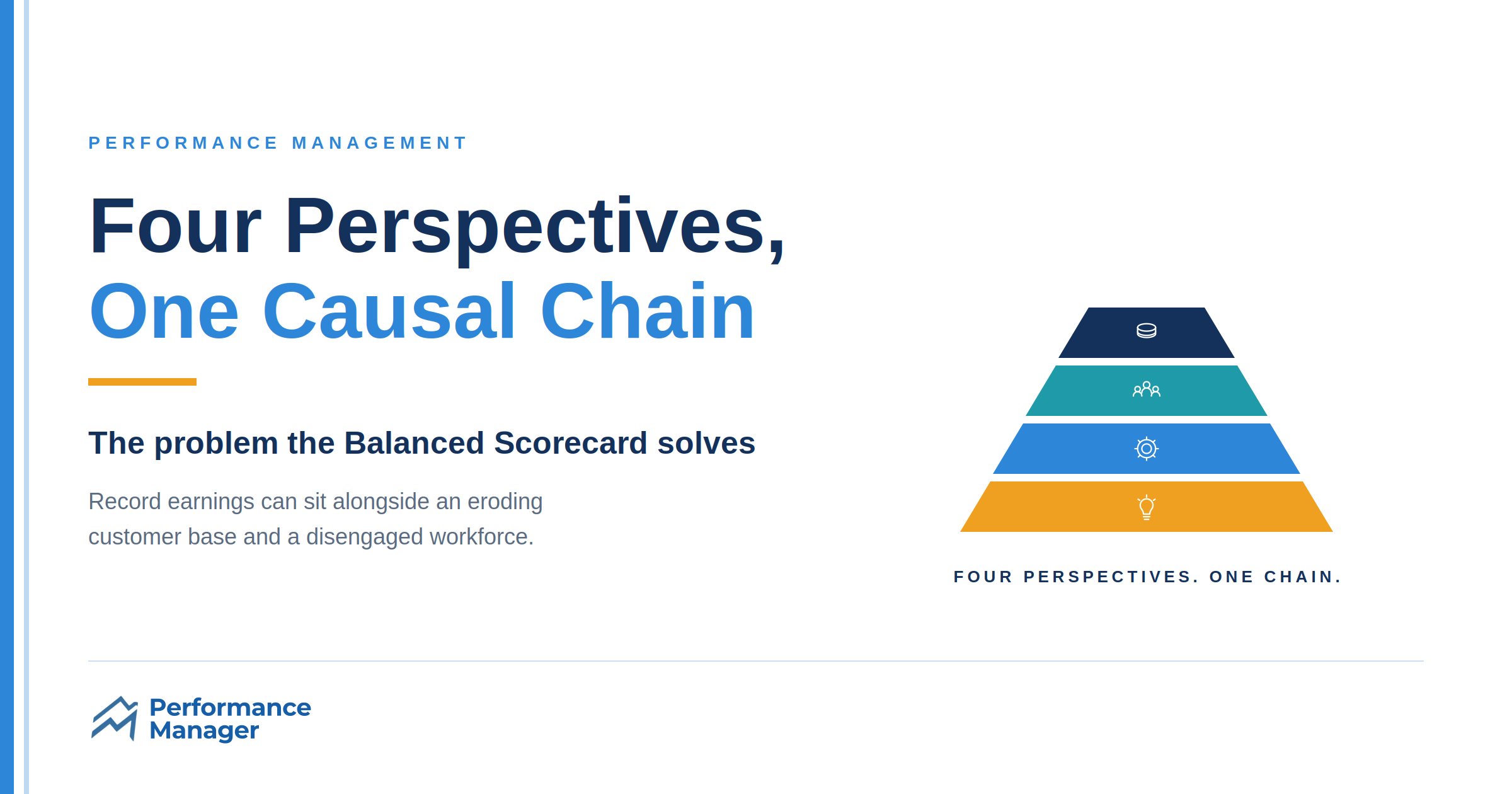
Most organizations measure what is easy to count. Revenue, expenses, profit margins, return on equity. These numbers dominate board reports and performance reviews. And for decades, they were considered sufficient. If the financials looked healthy, the business was healthy. That assumption was wrong more often than anyone cared to admit.
Robert Kaplan and David Norton published their original work on the Balanced Scorecard in the Harvard Business Review in 1992, and the core argument was disarmingly simple: financial measures tell you what already happened, not what is about to happen. A company can post record quarterly earnings while its customer base erodes, its processes stagnate, and its workforce disengages. By the time those problems surface in the income statement, the damage is often irreversible.
The Balanced Scorecard proposed a different logic. Instead of one category of measurement, organizations should track performance across four distinct perspectives: Financial, Customer, Internal Business Processes, and Learning and Growth. Each perspective answers a different question about organizational health, and together they form a cause-and-effect chain that connects daily activity to long-term strategic outcomes.
That chain matters more than the individual perspectives themselves. Executives who treat the Balanced Scorecard as four separate boxes on a dashboard miss the entire point. The power of the framework lies in how the perspectives relate to one another, how an investment in employee skills eventually becomes a revenue line, and how neglecting one perspective quietly undermines the others.
The Financial Perspective: Outcomes, Not Origins
The financial perspective sits at the top of the scorecard in most implementations, and for a good reason. It represents the destination. Every initiative, process improvement, and capability investment eventually needs to show up in financial results. Without this anchor, strategy drifts into abstraction.
But here is the nuance that many organizations overlook: the financial perspective is a lagging indicator by definition. It tells you whether past decisions were correct. It cannot tell you whether current decisions are wise. A company that slashes its training budget will see improved margins this quarter. The capability gaps that follow will only become visible eighteen months later, when critical projects falter and turnover spikes.
What the Financial Perspective Should Actually Measure
The typical approach is to load this perspective with standard accounting ratios: return on investment, operating margin, revenue growth. These are useful but insufficient. The better question is: which financial outcomes reflect our specific strategic choices?
Consider two organizations in the same industry. One pursues a cost leadership strategy; the other differentiates on innovation. Both might measure revenue growth, but the cost leader should prioritize cost-per-unit and asset utilization, while the innovator tracks revenue from new products launched in the last three years and price premiums relative to competitors. Generic financial KPIs produce generic strategies. The financial perspective only works when the metrics reflect genuine strategic intent.
There is a second, subtler problem. Financial metrics create enormous pressure to optimize short-term results at the expense of long-term positioning. This is precisely why Kaplan and Norton designed the scorecard as a system. The other three perspectives act as a counterweight, ensuring that short-term financial gains do not come at the cost of customer loyalty, process capability, or organizational learning.

The Customer Perspective: Value Through Someone Else's Eyes
If the financial perspective measures consequences, the customer perspective measures cause. Revenue does not materialize from nowhere. It comes from customers who choose your organization over alternatives, who return after their first purchase, and who recommend you to peers. The customer perspective asks a deceptively simple question: how do our target customers see us, and is that perception aligned with our strategy?
This sounds straightforward. It is not. The most common mistake is treating the customer perspective as a satisfaction survey. Customer satisfaction is a useful metric, but it is also dangerously incomplete. A customer can be perfectly satisfied and still defect to a competitor who offers something better. Satisfaction measures whether you meet expectations. It does not measure whether those expectations were high enough to begin with.
Segmentation and the Value Proposition
Effective use of the customer perspective requires clarity about who the target customer actually is. Not every customer is equally valuable, and not every customer segment wants the same thing. A financial services firm serving both retail clients and institutional investors operates in fundamentally different value spaces. The retail client might prioritize convenience and digital access. The institutional investor cares about analytical depth, relationship quality, and bespoke reporting.
Trying to measure customer performance without this segmentation produces noise. Overall satisfaction might sit at 78%, but if institutional clients score 62% and retail clients score 89%, the aggregate number hides a serious strategic problem.
The customer perspective should measure what your target segments value most. Kaplan and Norton identified three generic value propositions: operational excellence, customer intimacy, and product leadership, and each demands different KPIs. An operationally excellent company measures on-time delivery, defect rates, and price competitiveness. A customer-intimate firm tracks relationship depth, solution customization, and lifetime value. A product leader watches time-to-market, innovation pipeline strength, and first-mover wins.
The mistake most organizations make is trying to excel at all three simultaneously. The scorecard forces discipline. Pick your value proposition, measure the metrics that matter for that choice, and accept that you will be average or below-average on the metrics that belong to a different strategy.
The Internal Business Processes Perspective: Where Work Gets Done
This is the perspective that connects promise to delivery. The customer perspective defines what the organization commits to its market. The internal processes perspective asks whether the organization can actually execute that commitment. It is where strategy meets operations.
And it is the perspective most frequently mishandled. The default approach is to measure existing processes: manufacturing cycle time, order fulfilment accuracy, call center response time. These operational metrics have their place, but they represent only a fraction of what the internal processes perspective is designed to capture.
The Four Process Categories
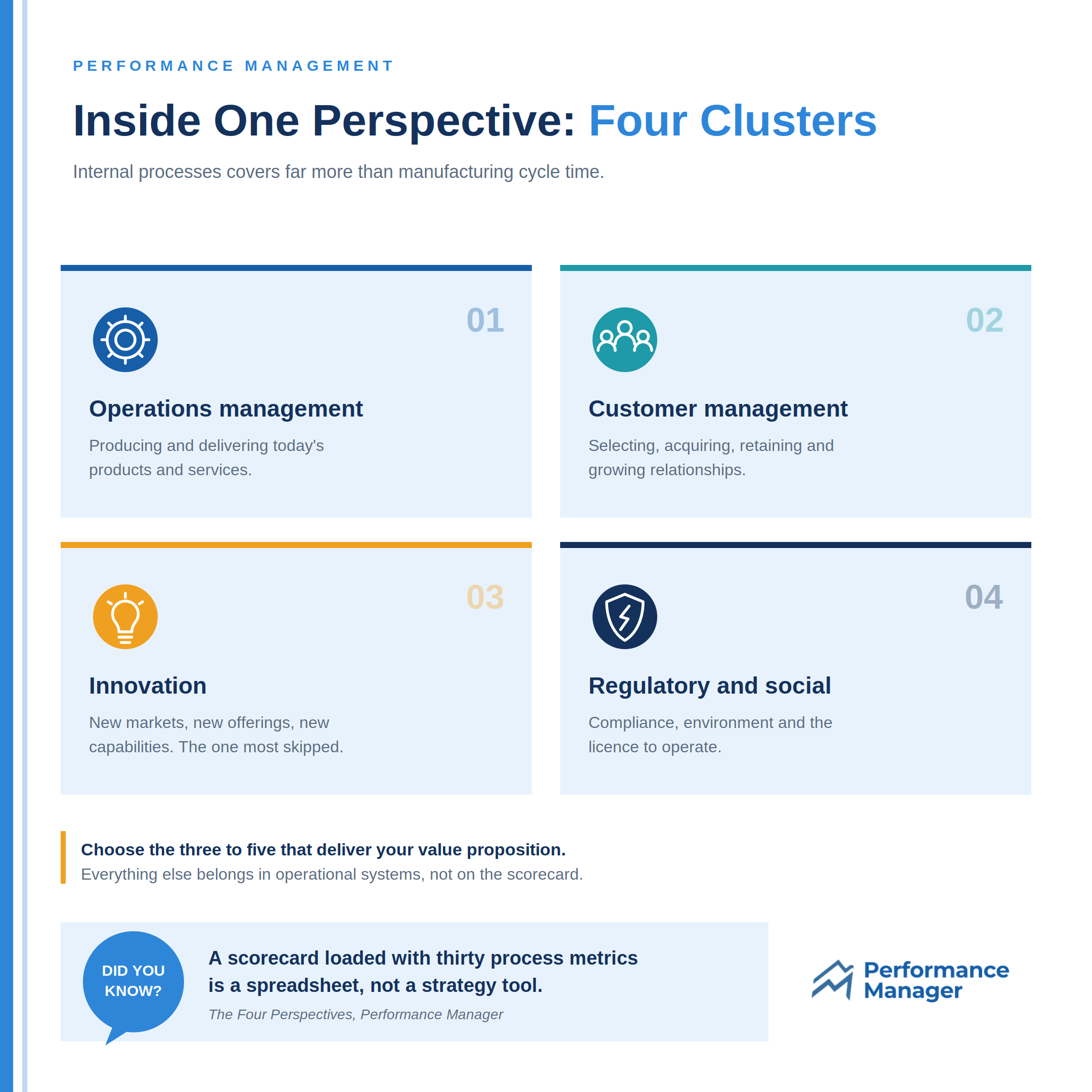
Kaplan and Norton later refined this perspective into four clusters, and the distinction matters. The first is operations management processes, the day-to-day activities that produce and deliver products and services. These are the easiest to measure because they generate visible, quantifiable outputs.
The second cluster is customer management processes: how the organization selects, acquires, retains, and grows customer relationships. A company might have superb manufacturing but terrible customer onboarding, and the financial results will eventually reflect that gap.
Third, innovation processes. This is where the scorecard separates serious strategic thinkers from those who merely manage today's business. Innovation processes cover the identification of new market opportunities, the design of new products and services, and the development of new capabilities. Measuring only current operations is like driving a car while staring at the dashboard instead of the road ahead.
The fourth cluster, regulatory and social processes, captures compliance, environmental performance, community engagement, and stakeholder relations. In many African markets, where regulatory environments are evolving rapidly and community license to operate is genuinely at risk, this cluster carries more weight than many Western management texts acknowledge.
The Trap of Measuring Everything
A common failure mode is to populate the internal processes perspective with dozens of operational metrics. The result is a spreadsheet, not a strategy tool. The discipline of the Balanced Scorecard requires selectivity. Which three to five processes are most critical to delivering our customer value proposition? Those are the ones that belong on the scorecard. Everything else belongs in operational management systems, not to the strategic performance framework.
There is an uncomfortable truth embedded in this logic. If the customer perspective says you compete on innovation, but your internal process metrics focus exclusively on manufacturing efficiency, your scorecard is internally contradictory. The perspectives should tell a coherent story. When they do not, that incoherence is itself a diagnostic finding, evidence that the organization's stated strategy and its actual operational priorities are misaligned.
The Learning and Growth Perspective: The Foundation Nobody Wants to Fund
Here is where the Balanced Scorecard reveals its deepest insight and, simultaneously, where most implementations go wrong. The learning and growth perspective sits at the base of the strategy map. It represents the organizational capabilities that make everything else possible: the skills of your people, the quality of your information systems, and the health of your culture.
It is also the perspective that executives are most tempted to shortchange. Training budgets are easy to cut. Technology upgrades can be deferred. Culture is treated as someone else's problem. The consequences of underinvesting in learning and growth are invisible for months, sometimes years. By the time those consequences appear in customer defection or process breakdowns, the causal link is obscured by a dozen intervening variables. Executives blame the market, the competition, or bad luck. Rarely do they trace failure back to the capability gap they chose not to address three years earlier.
Three Pillars of Organizational Capability
Kaplan and Norton eventually structured this perspective around three categories. Human capital encompasses the skills, knowledge, and competencies that employees bring to their roles. But measuring human capital is not a matter of counting training hours. The relevant question is whether the organization's workforce possesses the specific capabilities required by its strategy. A company pursuing product leadership needs deep R&D expertise and creative problem-solving skills. A company pursuing operational excellence needs disciplined process management and continuous improvement capabilities. Training hours are an input. Strategic skill coverage is the outcome.
Information capital covers the systems, databases, and technology infrastructure that enable employees to do their work. In practice, this means asking whether people have access to the information they need, when they need it, in a format they can use. Many organizations invest heavily in enterprise systems but fail to close the last-mile gap: the system exists, but the data quality is poor, the interface is clunky, or the relevant reports require three levels of IT support to generate.
Organizational capital is the hardest to measure and the most consequential. It includes culture, leadership quality, alignment between individual goals and organizational strategy, and the capacity for teamwork across functional boundaries. An organization can have brilliant people and world-class systems and still underperform because its culture punishes risk-taking, its leaders contradict the strategy, or its departments operate as competing fiends.
Why This Perspective Gets Neglected
The fundamental difficulty is that learning and growth investments have the longest time horizon and the most uncertain payoff. A process improvement might show results in weeks. A customer initiative might shift perception in months. But building a new organizational capability, genuinely changing how people think, work, and collaborate, takes years.
That time horizon clashes with the quarterly reporting cycles that dominate most organizations. Boards want visible progress. Executives want demonstrable returns. And the learning and growth perspective, by its nature, produces results that are slow, diffuse, and difficult to attribute. This is not a flaw in the framework. It is a mirror held up to a real tension in organizational governance: the tension between accountability for short-term results and investment in long-term capability.
The organizations that get this right typically do two things. First, they identify a small number of strategic job families, the roles that disproportionately influence strategic execution, and focus their capability-building efforts there. Not every role needs a detailed competency map. But the twenty or thirty roles that sit at the intersection of strategy and operations require intense attention. Second, they build leading indicators for capability development rather than relying exclusively on lagging ones. Instead of waiting to measure turnover, they track engagement scores, internal mobility rates, and time-to-competency for newly promoted leaders.
Real Power: Cause and Effect Across Perspectives
Any discussion of the four perspectives that treats them as independent categories has missed the architecture of the Balanced Scorecard entirely. The perspectives form a causal chain, and that chain is the framework's most important feature.
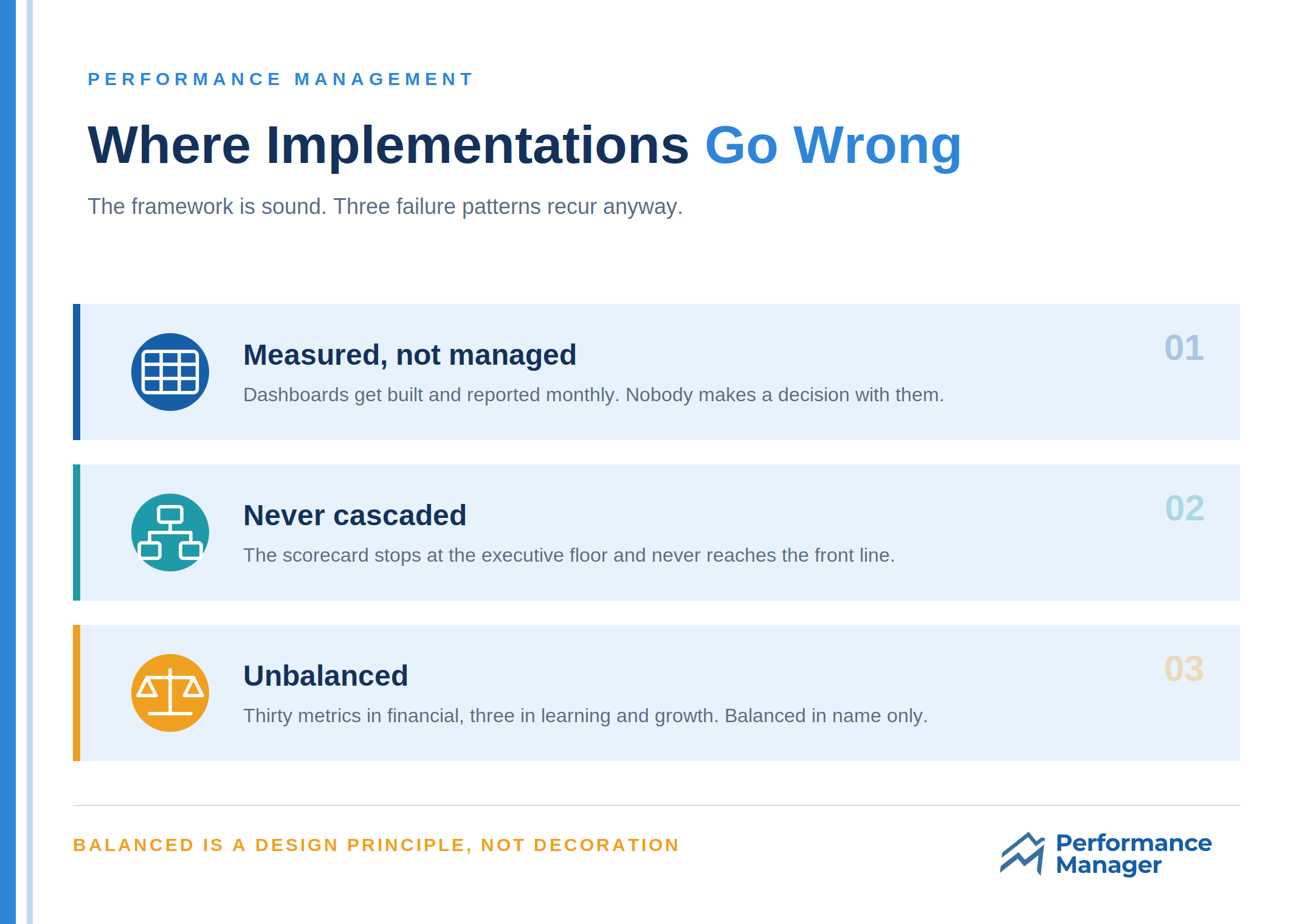
The logic runs like this. Investments in learning and growth (trained employees, better systems, aligned culture) enable improvements in internal processes (faster innovation cycles, more reliable operations, better customer management). Better processes deliver a stronger value proposition to target customers (higher quality, faster delivery, more customized solutions). And satisfied, loyal customers produce the financial results that sustain the organization (revenue growth, improved margins, higher return on capital).
This causal logic has a critical implication for performance management. When financial results decline, the instinct is to fix the financial problem directly: cut costs, raise prices, restructure. Sometimes those actions are necessary. But the Balanced Scorecard suggests that the root cause might sit two or three levels down the chain. Perhaps the real issue is a process bottleneck, a customer perception problem, or a skills gap in a critical team. Treating financial symptoms without diagnosing the underlying cause leads to short-term relief and recurring problems.
Conversely, the causal chain explains why investing in capability building is rational even when financial returns are uncertain. If you can demonstrate that a new training program improves process quality, and that process quality correlates with customer retention, and that customer retention drives revenue growth, then the investment case becomes visible across the full strategy map, not just in the training budget line item.
Where Implementations Go Wrong
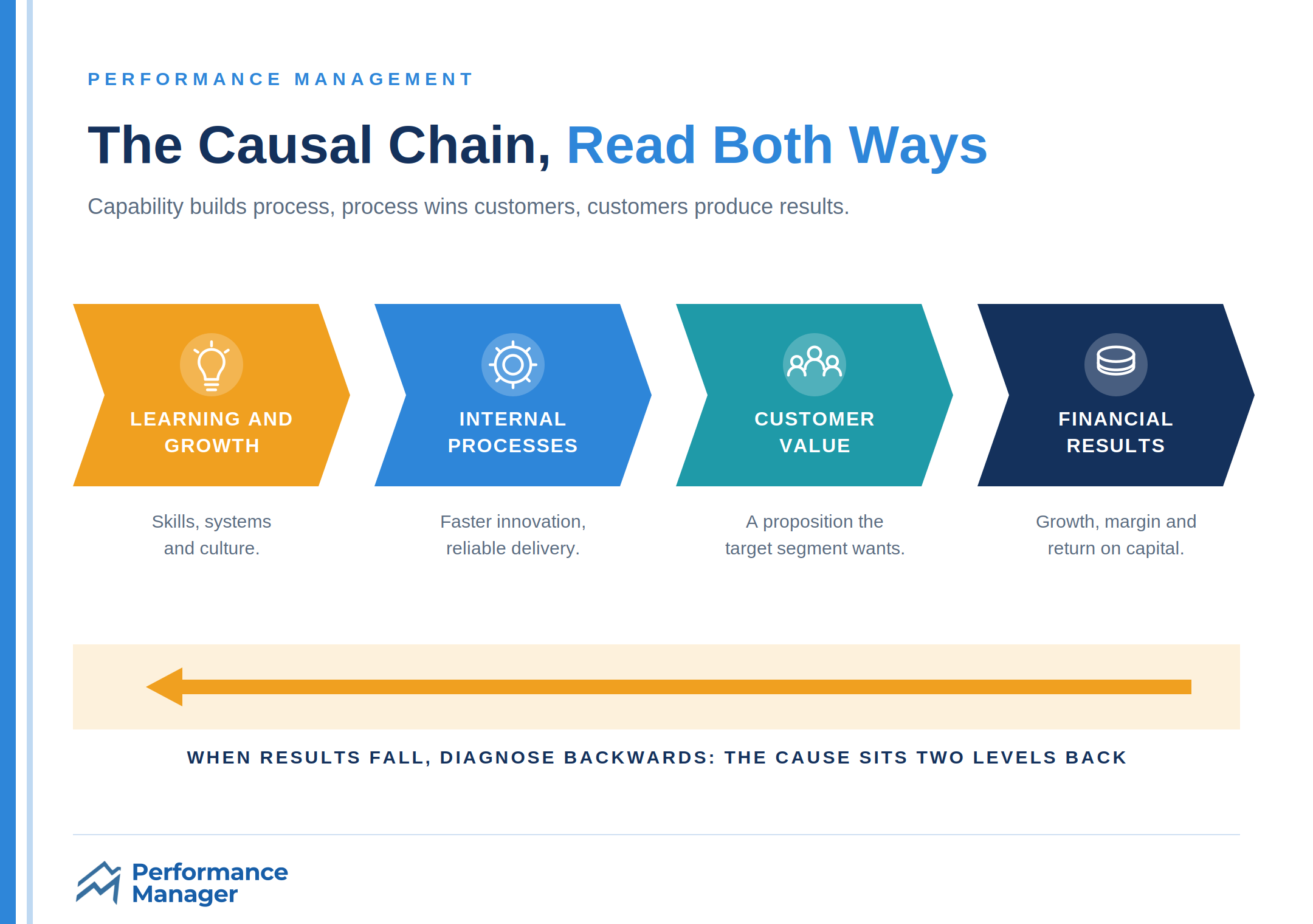
After more than three decades of use, the Balanced Scorecard has accumulated a substantial track record. The framework is sound. The implementations frequently are not. Several failure patterns recur with depressing regularity.
The first is treating the scorecard as a measurement system rather than a management system. Organizations build elaborate KPI dashboards, populate them with dozens of metrics, and report them monthly. Nobody uses the data to make decisions. The scorecard becomes a reporting burden, not a strategic tool.
The second is failing to cascade. A corporate-level scorecard that never reaches the operational level is an executive exercise. Strategy execution happens at the front line, in the decisions that team leaders and individual contributors make every day. If those people cannot see how their work connects to the four perspectives, the scorecard exists in name only.
The third, and perhaps most damaging, is measurement imbalance. Organizations that load thirty metrics into the financial perspective and three into learning and growth have not built a Balanced Scorecard. They have built an unbalanced one with a fancy name. The word balanced is not decorative. It reflects a design principle: all four perspectives require genuine attention, genuine investment, and genuine accountability.
Making the Framework Work
The four perspectives of the Balanced Scorecard are not a checklist. They are a theory of how organizations create value. Financial outcomes depend on customer relationships. Customer relationships depend on internal capabilities. Internal capabilities depend on people, systems, and culture. Break any link in that chain, and performance degrades.
The organizations that extract real value from the framework are those that treat it as a thinking tool rather than a reporting obligation. They use the perspectives to ask hard questions: Are we measuring what matters, or what is easy to count? Do our metrics tell a coherent strategic story, or do they reflect organizational politics? Are we investing enough in the foundation, even when the returns are uncertain, and the timeline is long?
Those questions do not produce comfortable answers. That is precisely the point. The Balanced Scorecard, properly applied, forces organizations to confront the tensions between short-term results and long-term capability, between financial accountability and strategic investment, between measuring today and building for tomorrow. Discomfort with those tensions is not a sign that the framework is failing. It is a sign that the framework is working.