
Introduction: The Work No One Budgets For
In many organizations, some of the most expensive and capable people spend a surprising amount of their time doing work no one ever planned for.
They chase spreadsheets.
They reconcile conflicting figures.
They fix broken formulas.
They resend reports because someone used an outdated version.
This is an undertaking that is scarcely seen in budgets, strategy books, and productivity indicators. But it is guzzling hundreds, sometimes thousands of hours a year.
This is the tax of shadow data: the unspoken price that organizations incur as they carry on with manual reporting as the foundation of performance management.
Manual Reporting Is Not Just Inefficient. It Is Extractive
Manual reporting environments are often defended as “good enough.” After all, the numbers eventually come together, and the report gets sent.
What this view misses is the cumulative toll.
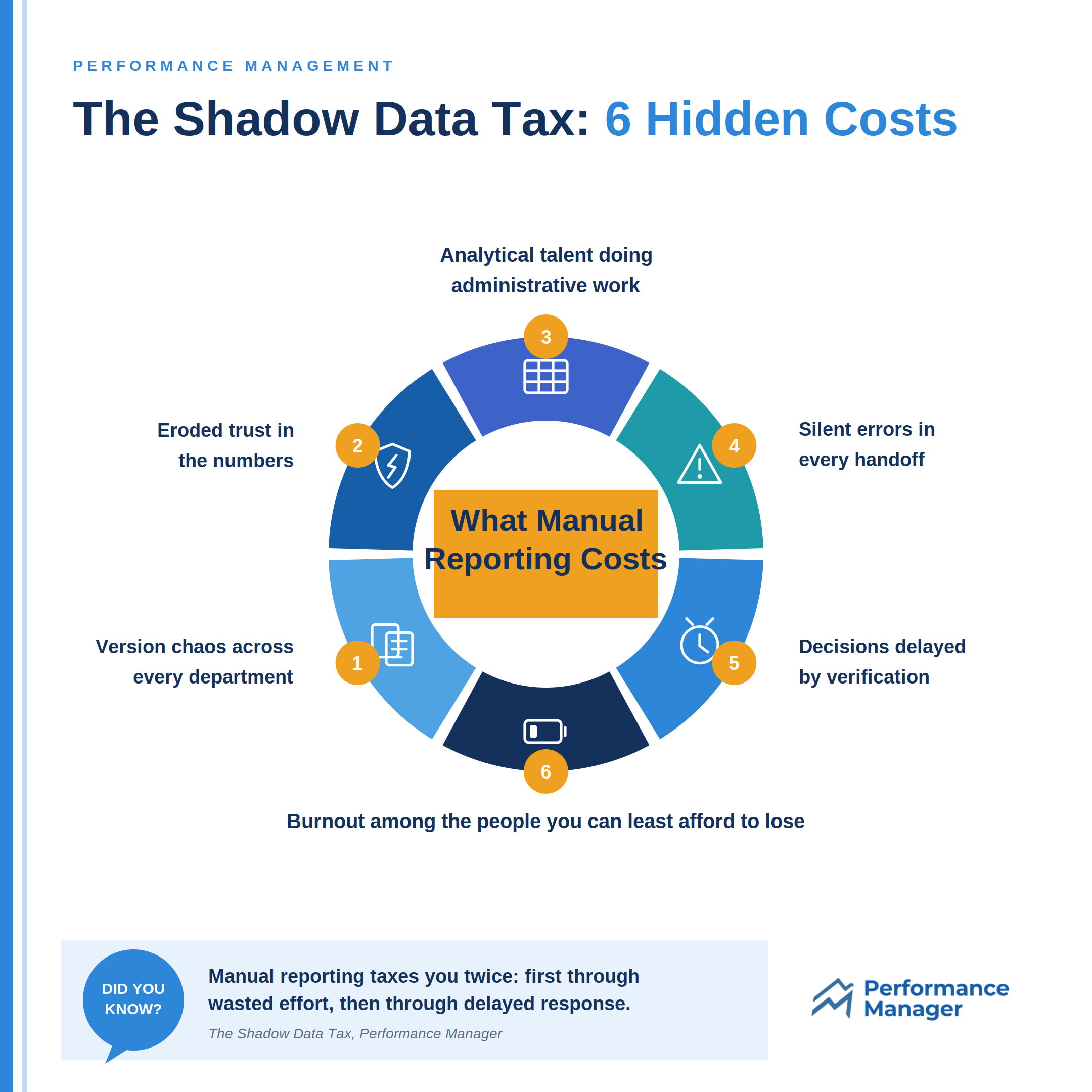
When skilled professionals spend most of their time cleaning, copying, validating, and formatting data, the organization extracts value from them in the least strategic way possible. Analytical talent is converted into administrative labor.
Over time, this has predictable consequences:
Decision quality stagnates
Execution slows
Morale declines
Trust in data erodes
The organization is not just slower, it is more fragile.
The Version Control Crisis
One of the clearest symptoms of the shadow data tax is version chaos.
In manual Excel-based environments:
Different departments report different numbers for the same metric
“Final” reports are revised multiple times after distribution
Meetings begin with debates about whose data is correct
None of this is caused by incompetence. It is structural. When data is manually copied between files, stored in inboxes, and updated asynchronously, inconsistency is inevitable.
The cost is not only time spent reconciling figures. It is confidence. When leaders cannot trust the numbers, decisions are delayed or diluted. Momentum stalls.
Data Cleaning as a Morale Drain
Data cleaning is necessary work, but when it becomes the dominant activity, it is demoralizing.
Employees hired for insight, judgment, and problem-solving quickly realize that their real job is maintenance. Creativity narrows. Initiative fades. The psychological distance between effort and impact grows.
Eventually, people stop asking, “What should we do about this?”
They focus instead on, “Did the numbers balance?”
This shift is subtle, but corrosive. Organizations begin optimizing for report accuracy rather than performance improvement.
The Integrity Problem
Manual processes do not just slow reporting; they weaken data integrity.
Every manual handoff introduces risk:
Accidental overwrites
Silent formula errors
Inconsistent definitions
Selective updates
The more these risks are accumulated, the less confidence people have in analytics. Leaders ask to check more, to back up more, to reconcile more, and ironically more and more, the very workload that brought such a problem in the very beginning.
The way the organization reacts to the fragile data is by adding process and not eliminating the fragility.
Automating the Mundane to Protect the Strategic
Automation is often framed as a productivity upgrade. In reality, it is a strategic safeguard.
An Automated Performance Manager System removes low-value manual work from the reporting chain:
Data is pulled directly from source systems
Metrics are calculated consistently
Reports refresh automatically
Definitions are centralized and enforced
What this buys back is not just time. It restores attention.
Hours previously spent assembling reports can be redirected toward interpretation, intervention, and improvement. Leadership time shifts from verification to decision-making.
Buying Back Decision Speed
The true return on automation lies in speed.
When performance data is timely and trusted:
Issues are addressed before they escalate
Opportunities are acted on while they still matter
Conversations move from explanation to action
Manual reporting taxes organizations twice—first through wasted effort, and then through delayed response. Automation removes both costs simultaneously.
From Custodian to Catalyst
Perhaps the most important shift enabled by automation is role transformation.
When reporting systems handle data collection and validation, staff are freed to do what organizations actually need:
Analyze trends
Challenge assumptions
Support managers with insight
Drive performance improvement
Employees move from being custodians of data to catalysts for change. Their value becomes visible again, not through effort, but through impact.
The Real Cost of Doing Nothing
Organizations often tolerate manual reporting because it feels familiar and controllable. But the cost of inaction compounds quietly.
The shadow data tax shows up as:
Slower decisions
Burnt-out high performers
Strategic drift
Missed opportunities
None of these appear on a balance sheet. Yet together, they define whether an organization can grow, adapt, and execute.
Conclusion: What You Can’t See Is What’s Costing You
Manual reporting does not fail dramatically. It succeeds just enough to remain unquestioned.
But beneath the surface, it drains energy, erodes trust, and diverts talent away from performance improvement. The shadow data tax is paid not in cash, but in lost momentum.
Organizations that automate reporting are not chasing efficiency for its own sake. They are reclaiming focus, restoring confidence, and protecting their most valuable resource: human judgment.
The question is not whether manual reporting works.
It is whether the organization can afford what it silently takes.