
A mining executive in Bulawayo once said his company reviews its Balanced Scorecard twice a year: once at the annual strategic retreat in Nyanga, and once when the auditors ask for it. The rest of the year, it collects dust in a shared drive nobody opens. His company is not unusual. Across Zimbabwean boardrooms, the Balanced Scorecard has become a ritual artefact rather than a management tool.
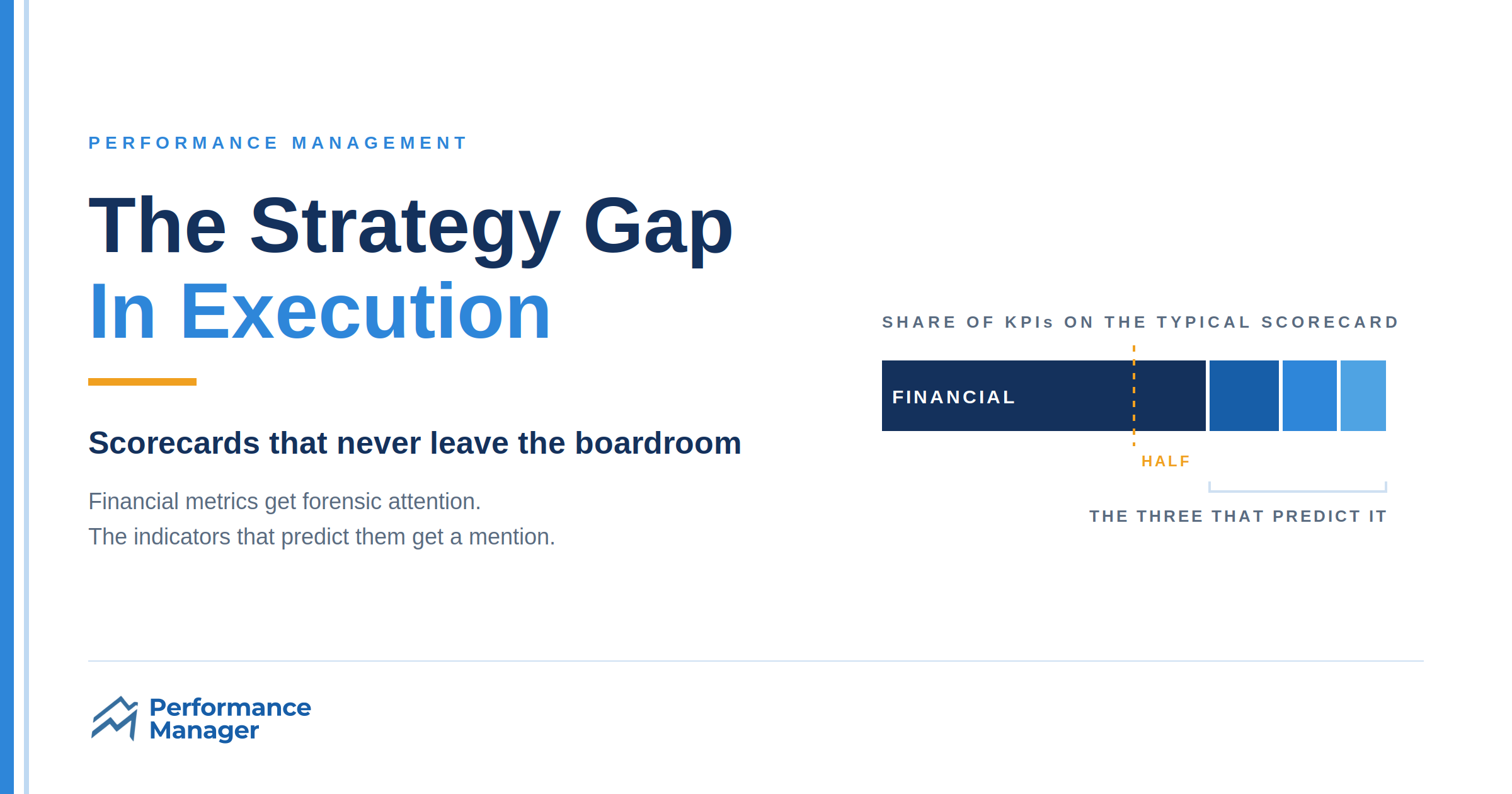
The pattern is remarkably consistent. Organizations track financial metrics with forensic attention: revenue, EBITDA, currency hedging ratios, cost-to-income percentages. These numbers get reported monthly, debated quarterly, and scrutinized at every board meeting. But the metrics that actually drive those financial outcomes, the people indicators buried in the Learning and Growth and Internal Processes perspectives, receive little more than a passing mention. If they are measured at all, nobody acts on them.
This is not a minor oversight. It is a structural blind spot that explains why so many Zimbabwean firms can articulate a strategy but cannot execute one. The financial perspective of the Balanced Scorecard tells you what has already happened. The other three perspectives, particularly those concerned with human capital, tell you what is about to happen. When you only measure outcomes without tracking the inputs that produce them, you are not running a business. You are conducting a post-mortem.
With the National Development Strategy 2 (NDS2) pushing Zimbabwe towards higher-value, knowledge-intensive industries, the gap between financial tracking and people tracking is about to become untenable. The Organizations that close it will execute. The ones that do not will continue producing strategies that read well and deliver poorly.
The Trap of the Lag Indicator
The most widespread monitoring and evaluation (M&E) failure in Zimbabwean performance management is an over-reliance on lag indicators. These are metrics that record results after the fact: annual profit, staff turnover rate, customer complaints per quarter. They are easy to measure and satisfying to report, because they produce clean numbers with clear baselines. They are also, by the time you read them, old news.
Measuring only lag indicators is like driving by staring exclusively at the rear-view mirror. You can see exactly where you have been, and you can describe the road behind you in impressive detail. But you cannot see the bend ahead. By the time your turnover rate spikes, the disengagement that caused it started eighteen months ago. By the time your profit margin collapsed, the process inefficiencies that eroded it were visible a year earlier, in data nobody was collecting.
The corrective is straightforward in principle, though difficult in practice: install lead indicators into the human-centered perspectives of the Balanced Scorecard. Lead indicators measure conditions that predict future outcomes. They require more effort to define and more discipline to track, but they give managers the one thing lag indicators cannot: time to intervene.
Lead Indicators That Matter
Three lead indicators deserve particular attention in the current Zimbabwean operating environment.
The first is the Employee Engagement Index. Most Organizations only discover why employees are disengaged during exit interviews, which is roughly the worst possible time to learn. Monthly pulse surveys, even brief ones covering five to eight questions, provide a rolling picture of workforce sentiment. When engagement scores begin to dip in a specific department or role cluster, that signal typically precedes a turnover spike by three to six months. The data exists to act early, but only if someone is watching it.
The second is the Skills Currency Ratio. As automation and artificial intelligence reshape the Zimbabwean workplace, the shelf life of technical skills is shrinking. An M&E system that tracks the proportion of employees actively upskilling, through formal training, certifications, or structured on-the-job learning, provides an early warning of capability decay. A workforce that stops learning is a workforce that is slowly becoming obsolete, and no amount of financial monitoring will surface that risk until it is too late.
The third is Internal Service Quality. In any Organization of reasonable complexity, departments serve one another before they serve external customers. When internal handoffs are slow, information is hoarded across silos, or support functions bottleneck operational teams, the dysfunction eventually reaches the customer. The Internal Processes perspective of the Balanced Scorecard should capture this. Metrics like internal service level agreement (SLA) compliance, cross-functional project cycle time, and internal customer satisfaction scores reveal whether the Organization’s machinery actually works, or whether people are spending their energy fighting the system rather than serving clients.
Cascading the Scorecard: From Boardroom to Branch Office
A second, equally damaging failure is the tendency for the Balanced Scorecard to remain trapped at the executive level. The board approves a strategy map. Senior management sets KPIs. And then nothing happens below the third tier of the Organization chart. A teller in Mutare or a site manager in Kwekwe has no idea how their daily work connects to the corporate scorecard, and no reason to care.
This is not a communication problem. It is a design problem. Cascading a scorecard means translating high-level strategic objectives into specific, role-relevant KPIs that employees at every level can understand, influence, and track. The responsibility for this translation sits squarely with HR, and it is one of the most technically demanding things an HR function can do well.
Consider a practical example. A corporate Learning and Growth objective might state: “Improve digital literacy across the workforce.” At the branch level, this translates into a specific KPI: the number of frontline staff who complete a digital skills certification within a defined period. That certification, in turn, connects to an Internal Processes objective: reducing average customer wait time by enabling self-service channels. The employee can now see a direct line between the course they are taking and the operational outcome it produces. Purpose becomes visible.
In an economy where real wages erode, and monetary incentives lose their motivational power, this line of sight matters more than most executives realize. When employees understand how their development goals connect to the Organization’s strategy, career growth becomes a form of compensation that inflation cannot devalue. Purpose and professional development are the most stable currencies an employer can offer in Zimbabwe today.

The Fifth Perspective: Environmental, Social, and Governance (ESG) as a Strategic Lever
The classical four-perspective Balanced Scorecard was designed in the early 1990s, for a business environment that looked nothing like 2026. One of the most significant evolutions in scorecard thinking over the past decade has been the emergence of a fifth perspective: Environmental, Social, and Governance (ESG) impact.
For many Zimbabwean Organizations, ESG still reads as a compliance exercise, something the sustainability team writes into the annual report to satisfy listing requirements or donor expectations. That is a missed opportunity. Progressive African companies are beginning to treat ESG metrics as genuine performance indicators, tracked on the scorecard alongside financial and operational measures, because they have discovered something important: ESG performance is a retention lever.
This is particularly true for the generation now entering the Zimbabwean workforce. Younger employees, shaped by climate awareness, social media transparency, and a deep skepticism of institutional rhetoric, are not satisfied by a competitive salary alone. They want to know whether their employer’s operations contribute to or undermine the communities they serve. They ask questions that previous generations did not: What is our carbon footprint? Do we source locally? Are we creating value beyond shareholder returns?
When an M&E system tracks social and environmental metrics, something shifts in how employees relate to their performance data. A field officer who sees that her team’s work has contributed to a measurable increase in local out-grower program participation is not just meeting a KPI. She sees tangible evidence that her job matters beyond the balance sheet. That shift, from compliance to conviction, is the difference between an employee who reports numbers and an employee who owns outcomes.
Organizations that embed ESG into their scorecards do not do it because regulators demand it. They do it because it changes the psychological contract between the company and its people. And in a labor market where Zimbabwean talent is increasingly mobile, where remote work has made geography irrelevant for knowledge workers, strengthening that psychological contract is a strategic priority, not a philanthropic gesture.
Digital M&E: Replacing the Annual Appraisal with Real-Time Feedback
The annual performance review is one of the most widely practiced and least effective management rituals in Zimbabwean Organizations. Once a year, a manager and an employee sit across a desk, review a form that was last updated twelve months ago, and attempt to reconstruct a year’s worth of performance from memory. The conversation is awkward. The ratings are subjective. And the employee walks away with a score that tells them very little about how to improve.
The problem is not that performance reviews are inherently flawed. The problem is that they happen too infrequently to be useful. A feedback cycle measured in months cannot keep pace with a business environment that shifts in weeks. By the time the annual review surfaces a development need, the moment for intervention has long passed.
Digital performance dashboards change this equation entirely. When employees can log into a system and see their own Balanced Scorecard progress, updated weekly or even in real time, two things happen simultaneously. First, the information asymmetry between manager and employee disappears. Performance data is no longer a secret that managers reveal once a year. It is a shared reference point that both parties can see at any time. Second, the manager’s role shifts. When the data is transparent and current, there is no need for a manager to function as an evaluator delivering a verdict. Instead, the manager becomes a performance coach: someone who helps the employee interpret the data, identify patterns, and adjust course.
That shift from evaluator to coach is not a soft HR aspiration. It is a retention imperative. The most capable employees in Zimbabwe’s labor market, the ones every Organization wants to keep, are the same ones with options. Remote-work opportunities with companies in Nairobi, Cape Town, London, and Dubai are one Zoom call away. If your management culture feels like surveillance rather than support, those employees will leave. Not eventually. Soon. And they will not mention it in an exit interview you scheduled three months too late.
Where the Real Competitive Advantage Lives
There is a persistent belief in Zimbabwean business that competitive advantage comes from capital: better equipment, larger facilities, stronger balance sheets. Capital matters, of course. But capital is a commodity. It can be borrowed, invested, or attracted. What cannot be easily replicated is a workforce that is skilled, engaged, and aligned with the Organization’s strategic direction.
That workforce lives in the Learning and Growth perspective of the Balanced Scorecard. It is the perspective that receives the least investment and the least attention, precisely because its returns are slow, diffuse, and difficult to attribute to a single budget line. Training a cohort of middle-aged managers in coaching skills will not show up in this quarter’s financial results. But it will shape the engagement levels, process efficiency, and customer experience that determine next year’s results, and the year after that.
The Organizations that understand this cause-and-effect chain- that investing in people drives process improvement, which drives customer satisfaction, which drives financial performance- are the ones that will navigate the next decade successfully. The ones that continue treating the Balanced Scorecard as a financial reporting tool with three decorative appendices will wonder why their strategies never translate into results.
Three Steps to Start
For Organizations ready to move from compliance to culture, three practical actions offer the highest immediate return.
First, audit your KPI balance. Count the number of metrics on your scorecard that sit in the financial perspective versus the other three. If more than half of your KPIs are financial, your scorecard is not balanced regardless of what it is called. Rebalance towards lead indicators in Learning and Growth and Internal Processes.
Second, close the learning loop. Monitoring without learning is bureaucracy. Every M&E cycle should produce at least one insight that changes management decisions. If your quarterly review meeting produces a report that nobody reads and no actions that anyone follows, the meeting is a waste. Build a structured learning loop in which data triggers discussion, discussion triggers decisions, and decisions are tracked to completion.
Third, share the data. Performance information that only reaches the board is performance information that only the board can act on. When frontline teams see their own scorecard data, they gain the context to self-correct, to identify problems early, and to connect their daily work to outcomes that matter. Transparency is not a risk. Opacity is.
The Balanced Scorecard was never intended to be a policing instrument. It was designed as a map, a way to make the connections between daily activity and long-term outcomes visible to everyone in the Organization. When those connections are visible, people stop performing for compliance and start performing from conviction. That is the shift from measurement to culture, and it is the only shift that produces results worth keeping.