
There is a specific, sinking feeling that every corporate manager knows. It happens during the quarterly business review. You are looking at a slide deck projected on the wall, and one of the key initiatives, perhaps a critical software migration or a sales offensive, is marked with a bright, unforgiving red "X."
The project has failed. The targets were missed. However, the sinking feeling is not the failure itself; business can be risky in nature, and failure is an option. The nausea is due to the understanding that the failure really took place six weeks ago.
During the previous month and a half, the team has had to work under the assumption that they were still in the game and to spend the resources and political capital on a cause that had already lost. The information was there, in either the server logs, the CRM activity reports, or the supply chain variance sheets, but it was not yet formatted into a report.
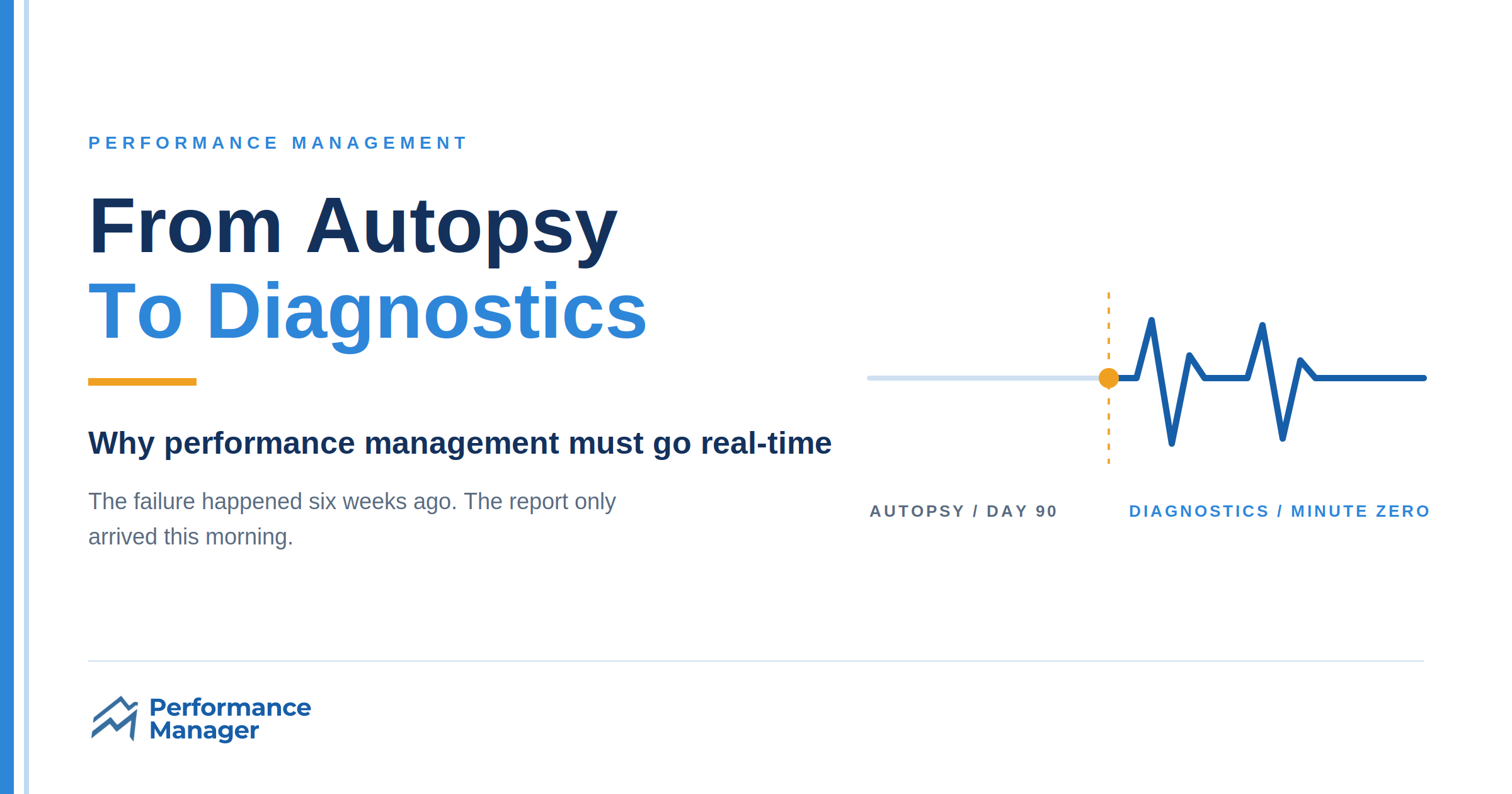
This situation illustrates the inherent weakness in the way the majority of organizations manage performance. We treat it as an autopsy. We wait until the period is over, the patient (the project or the fiscal quarter) is dead, and then we cut it open to find out what killed it. The diagnosis is usually 100% accurate, but it is also 100% useless for saving the patient.
In an era of high-frequency trading, real-time logistics, and algorithmic customer sentiment analysis, managing human performance on a ninety-day cycle is not just traditional; it is negligent. To survive in a high-velocity market, organizations must shift from the autopsy model to a diagnostic model, a system of continuous, real-time signal detection that allows for intervention while the outcome is still undecided.
The Decay of Data Value
The core problem with the annual or quarterly review is not that it is "mean" or "stressful", though it is often both, but that it relies on data that has lost its utility.
Data has a half-life. The value of a performance metric decays exponentially from the moment the event occurs.
At Minute zero (Real-time): The data is actionable. A drop in server uptime or a spike in customer complaints triggers an immediate fix.
At Day 7 (Weekly Check-in): The data is corrective. You can adjust the tactic, retrain the employee, or shift resources.
At Day 90 (Quarterly Review): The data is forensic. It can only be used to assign blame or calculate a bonus.
When we force performance management into a quarterly cadence, we are voluntarily accepting that we will only use data after it has decayed into a forensic state. We are choosing to judge history rather than shape the future.
This latency creates a "reality gap" between the shop floor and the executive suite. While the front-line employee knows on Tuesday that the target is unachievable because of a supply shortage, the "system" does not officially recognize this until the end-of-month report. For three weeks, the organization is hallucinating, operating on a plan that reality has already invalidated.
The "Judge" vs. the "Coach"
The autopsy model does not just fail operationally; it fails psychologically. It forces managers into a role that most of them hate, and few are good at being the Judge.
When you save up feedback for a formal review, you are essentially building a legal case. The manager arrives with a list of "evidence" (missed deadlines from two months ago, a complaint from February), and the employee arrives with their "defense." It is not a collaboration meeting but a trial.
The reaction of the human brain to this dynamic is to trigger our primal survival instincts. In cases where the employee perceives that he/she is being sentenced due to the actions that he/she can no longer redo, the employee disengages. They do not listen to learn but to rebut.
Diagnostic in real-time is the complete opposite. When the dashboard tells the manager there is a performance decline on a Tuesday morning, the manager can walk over and tell him, I see that the numbers are down in the new campaign, so what is blocking you, and how could I get you clear of the way?
Here, the manager does not act as a Judge; he is a Coach. They are looking at the same scoreboard as the employee during the game, helping them win. The feedback is not an attack on the employee’s character; it is a commentary on the current situation. This shift reduces anxiety and builds what Google’s Project Aristotle identified as the single most important factor in high-performing teams: Psychological Safety.

Moving Beyond the "Form"
If the philosophy of real-time performance management is compelling, the execution is where most organizations stumble. They assume that "more frequent feedback" means "more forms." They replace the annual appraisal with monthly "check-ins" where employees still have to fill out a Word document listing their achievements. This is not modernization; it is bureaucracy that is just more frequent.
True real-time performance management is not a human resources process; it is a systems integration challenge. It requires us to acknowledge that in a modern digital enterprise, a digital tool usually mediates “work”.
The CRM (Salesforce, HubSpot) occurs in sales work.
The process of development occurs in the repository (GitHub, Azure DevOps).
Logistics work happens in the ERP (SAP, Oracle).
Customer service work happens in the ticketing system (Zendesk).
Therefore, the human should not manually report performance data; it should be ingested via API directly from these systems. Thus, the human should not be reporting performance data manually, but it should be fed directly through an API to these systems.
This is where special platforms such as an Automated Performance Management System will be necessary. As opposed to static spreadsheets, which conceal the data in silos, this system digitalizes the Balanced Scorecard model, making it not a theoretical concept but an active working machine. It enables the organization to ingest performance data by automatically tracking Objectives, Measures, and Initiatives.
Visualize a performance dashboard without asking a salesperson, " How did you do this week? Rather retrieves their call volume, conversion rate, and pipeline velocity directly out of the CRM each morning. This develops a "Single Source of Truth. There is no debate about what happened. The data is objective, transparent, and available to both the manager and the employee simultaneously.
This is where the intersection of HR and Big Data Analytics becomes critical. The role of the modern HR or Strategy function is not just to design competencies but also to design the architecture that captures these signals. We need to move from writing policy manuals to building data pipelines.
Related Article: The “Shadow Data” Tax: The Hidden Cost of Manual Reporting
The Check Engine Light: Managing by Exception
One of the most frequent objections to the strategy is the fear of micromanagement. Will my boss hover over my shoulder in case it is discovered that he or she looks at my data on a daily basis? Ironically, less, not more, micromanagement can be applied to real-time data. It enables Management by Exception.
Consider the dashboard as the instrument panel of a car. You do not look at the oil gauge as you drive around. You ignore it completely until the light turns red. As long as the metrics are within the agreed "green" variance, the manager leaves the employee alone. The employee has autonomy.
However, the moment a metric crosses a threshold say, the error rate in the accounting department spikes by 5% the "check engine light" flashes. The manager intervenes immediately, not to punish, but to diagnose. Is it a training issue? A software bug? A resource constraint?
Such management by exception will provide the high-achievers with the freedom that they desire and make sure the struggling employees do not sink. It is the final demonstration of trust: I trust you to take the wheel, but I will be back the moment the engine starts overheating.
The Crawl, Walk, Run Implementation Roadmap.
For companies on top of the old systems and annual performance appraisal forms, the jump to real-time diagnostics can be daunting. It does not necessarily have to occur overnight. The transition can be phased.
Phase 1: The Proxy Metrics (Crawl)
You may not be able to measure "Strategic Leadership" on a daily basis. Proxies, however, can be measured. Your project management software allows you to track how many project milestones have already been accomplished. Start with identification of three to five pulse metrics that are indicators of the bigger objectives.
Phase 2: The Weekly Stand-up (Walk).
Phase out the monthly status report. Instead of the 45-minute daily, have it as 15 minutes weekly stand-up, with the specific agenda being the dashboard. The agenda is strict:
What does the data say about last week?
What are the blockers for next week?
Who needs help?
This conditions the culture to look at data frequently without fear.
Phase 3: Automated Ingest (Run)
Connect the pipes. Work with your IT and Data Science teams to build the APIs that pull data automatically. Build the "Executive Cockpit" that allows the EXCO to see the health of the organization in real-time, drilling down from the corporate P&L to the individual unit's performance with a click.
The Speed of Correction
The business environment of the next decade will be defined by volatility. Strategies that are perfect in January will be obsolete by June. In this environment, the organizations that win will not necessarily be the ones with the smartest initial strategy. They will be the ones with the fastest Speed of Correction.
The organization that waits for the quarterly autopsy to realize it is off track will always be outmaneuvered by the organization that adjusts its course every Tuesday morning.
Performance management is not about filling out forms for HR. It is the guidance system of the enterprise. It is time to stop analyzing the dead and start monitoring the living. It is time to turn on the diagnostics.