

Every weighted scorecard makes a statement about what matters.
Balanced scorecard weights determine how much each measure contributes to an overall score, and they are normally expressed as percentages that add up to 100 at each level of the scorecard. They do two jobs at once: they calculate the rating, and they tell people where to spend their effort. Set them carelessly and the second job quietly overrides the first.
Yet weights are often decided in the last few minutes of a planning meeting, or split equally because nobody wants the argument. This article covers how weighting works, what the research says about getting it wrong, and how to set weights that reflect your real priorities for 2027.
Why do scorecard weights matter?
Weights do two things. They determine the score, by combining each measure’s result according to its share. And they signal priorities, because people read the weights as a statement of what the organization values and respond to that message.
Steven Kerr named this problem in 1975, in a paper whose title has outlived most management writing of its decade: On the Folly of Rewarding A, While Hoping for B. His argument was that organizations build reward systems that pay off for one behavior while the rewarder hopes dearly for another. A scorecard that puts most of its weight on short-term financial results, while the strategy depends on customer loyalty or capability building, is the same folly in a modern format. The surprise that follows is ours, not the employee’s.
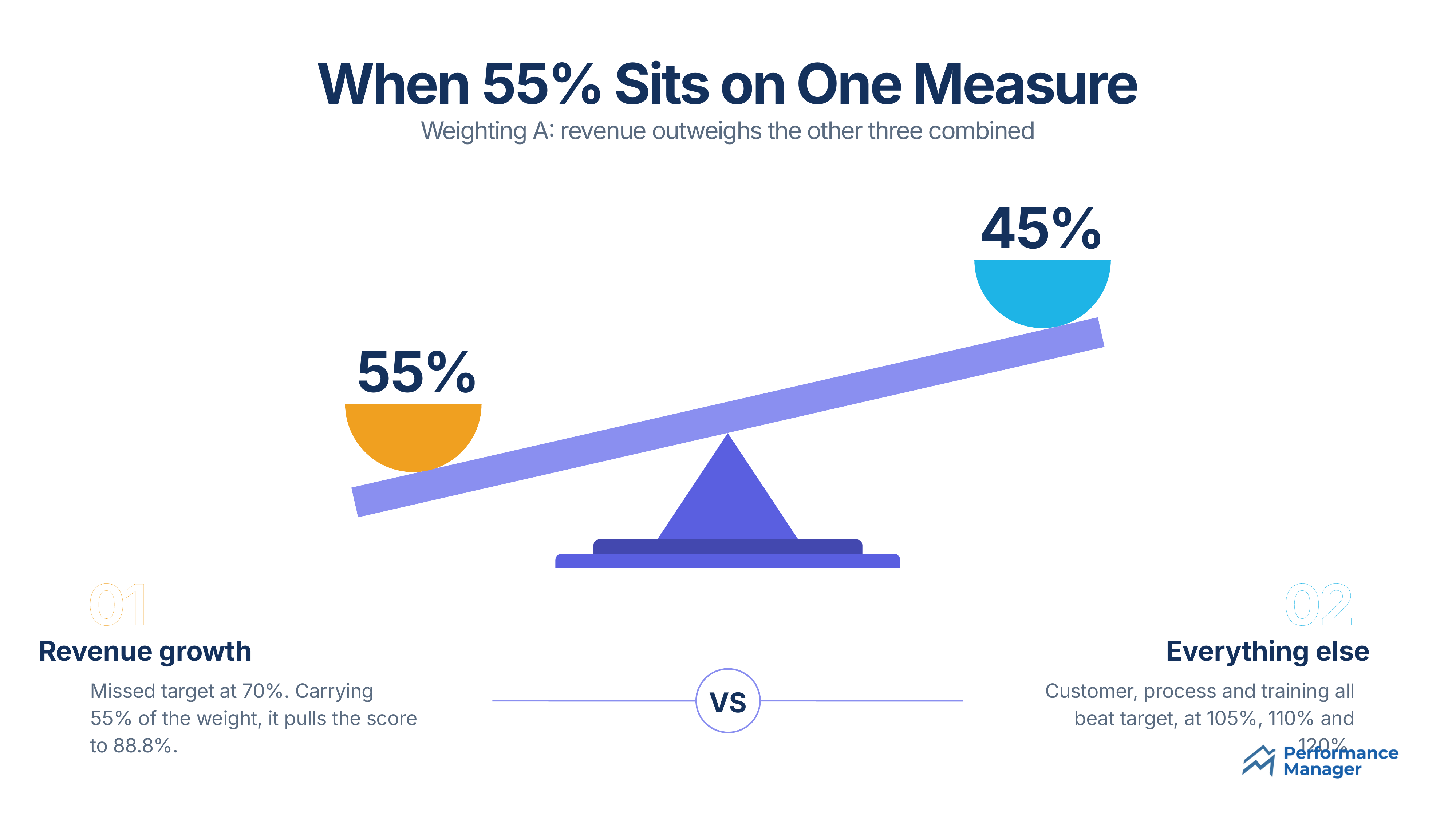
Exhibit 1 shows how much difference the weights alone can make. The employee’s results are identical in both cases.
Exhibit 1. The same results, two different weightings (illustrative)
Measure | Result against target | Weighting A | Weighting B |
Revenue growth | 70% | 55% | 30% |
Customer satisfaction | 105% | 15% | 30% |
Process cycle time | 110% | 15% | 25% |
Training completed | 120% | 15% | 15% |
Overall weighted score |
| 88.8% | 98.0% |
Illustrative data. Under Weighting A the revenue shortfall dominates, because it carries more than half the weight. Under Weighting B the same results produce a score roughly nine percentage points higher. Neither weighting is automatically right. The question is which one reflects the strategy.
What does the research say about weighting?
Kaplan and Norton designed the balanced scorecard to correct an over-reliance on financial measures by adding customer, internal process, and learning and growth perspectives. Adding the measures turns out to be the easy part. How they are weighted, and whether those weights survive contact with a manager, decides whether any of it works.
Two studies in The Accounting Review are worth knowing in detail.
Marlys Lipe and Steven Salterio ran an experiment on how superiors evaluate business units whose scorecards mix measures common to several units with measures unique to one. They found that only the common measures affected the evaluations. The unique measures, which are precisely the ones chosen to capture a unit’s own strategy, were effectively ignored. If you have gone to the trouble of giving a department leading indicators that nobody else has, this is the finding that should worry you.
Christopher Ittner, David Larcker and Marshall Meyer then studied what happens in a live bonus plan. A major financial services firm ran a balanced scorecard bonus scheme in which superiors applied the weights subjectively. They used that discretion to place most of the weight on financial measures, to bring in factors that were not on the scorecard at all, to change the criteria from quarter to quarter, to ignore measures that predicted future financial performance, and to weight measures that predicted nothing anyone wanted. Branch managers complained of favoritism and of not knowing what they were being judged on. The scorecard bonus plan was ultimately abandoned in favor of a formula based solely on revenues.
That last sentence is the one to sit with. A deliberately balanced scheme, run with discretion over the weights, collapsed back into the single financial measure the balanced scorecard exists to counterbalance.
The lesson across all three sources is the same. Agree weights explicitly before the year begins, derive them from the strategy rather than from habit, and then apply them consistently even when a result looks unfair.
How do balanced scorecard weights actually work?
Most scorecards apply weights at two levels. First, weight is distributed across perspectives or objectives, so the most important parts of the strategy carry the most. Second, each objective’s weight is divided between the measures that track it. At each level the weights add up to 100 percent.
The calculation is then straightforward. Each measure’s result is expressed as an achievement against target, multiplied by its weight, and the weighted results are added together.
What is not standard is the detail, and the detail is where disputes start. Systems differ on whether achievement is capped at the stretch target, how measures where lower is better are converted, and what happens when a measure has no data for the period. Write those rules down and publish them with the scorecard. Nobody argues about arithmetic they agreed to in January.
Five ways to set weights
As with targets, there is no single correct method, and most good scorecards combine two.
Exhibit 2. Five approaches to weighting a scorecard
Approach | How it works | Best used when |
Equal weighting | Every objective or measure receives the same weight | Priorities are genuinely balanced, or as a temporary start while better information is gathered |
Strategic priority | Weights follow the importance of each objective in the strategy | The strategy clearly identifies which outcomes matter most this year |
Points allocation | Each leader distributes 100 points across the objectives, and the results are averaged | Leaders need a shared view, and the disagreements are worth surfacing |
Pairwise comparison | Objectives are compared two at a time, and the results converted into weights | Several objectives compete and a transparent, structured method is needed |
Controllability | Weight is reduced where results depend heavily on factors outside the person’s control | Setting individual scorecards, where fairness depends on what the person can influence |
In practice, organizations often set objective weights by points allocation and then adjust individual measure weights for controllability.
How much weight should one measure carry?
Between about 5 and 30 percent, with five to eight measures on an individual scorecard. The following come from our experience designing scorecards across sizes and sectors, and they are starting points rather than rules.
Keep the number of measures manageable. Five to eight on an individual scorecard is usually enough. Beyond that each weight becomes too small to change anyone’s behavior.
Avoid very small weights. A measure under about 5 percent rarely moves the overall score. If it matters, give it real weight. If it does not, track it somewhere other than the scorecard.
Avoid very large weights. Above about 30 to 40 percent, one result can dominate the entire appraisal, as Exhibit 1 shows.
Give leading measures real weight. Not just the end results that arrive months after anyone could act on them.
Match weights to this year’s strategy, not last year’s template. Revisit them whenever priorities change.
Agree weights before the year begins and keep them stable. Changing them after results are known is exactly what Ittner and colleagues watched destroy a bonus plan.
Balanced scorecard weights: a worked example
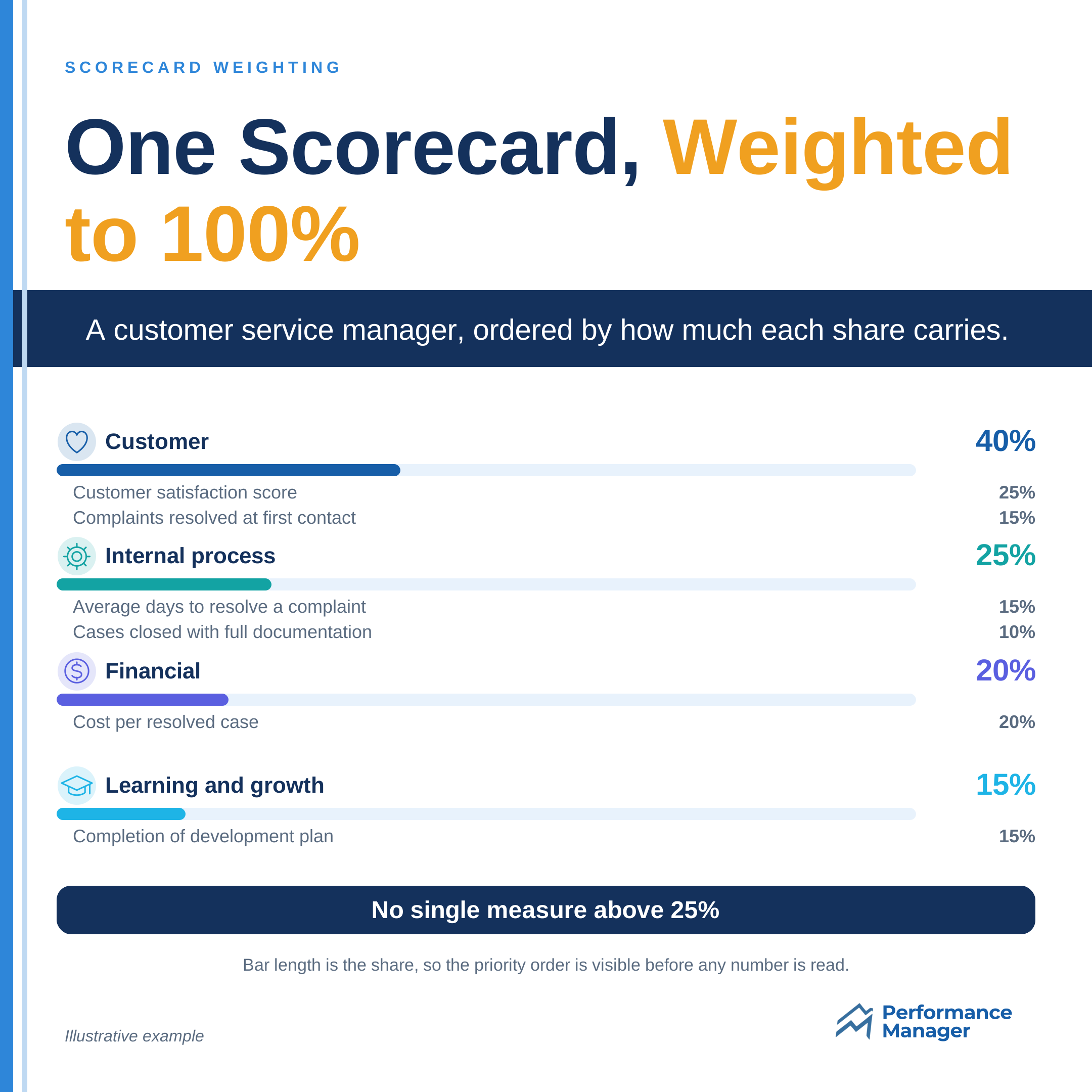
Exhibit 3 shows how a customer service manager’s individual scorecard might be weighted. The figures are illustrative; the reasoning is the part to copy.
Exhibit 3. Weighting an individual scorecard: an illustrative example
Perspective | Measure | Weight | Reasoning |
Financial (20%) | Cost per resolved case | 20% | Important, but largely shaped by decisions above this role |
Customer (40%) | Customer satisfaction score | 25% | The department’s main strategic priority this year |
| Complaints resolved at first contact | 15% | A leading indicator of satisfaction |
Internal process (25%) | Average days to resolve a complaint | 15% | Directly within the team’s control |
| Cases closed with complete documentation | 10% | Supports quality and audit requirements |
Learning and growth (15%) | Completion of agreed development plan | 15% | Builds capability for the new case system |
Total |
| 100% |
|
Three things are worth noticing. The customer perspective carries the most weight because it is the stated priority, so the scorecard and the strategy say the same thing. No single measure exceeds 25 percent, so no one result can swallow the appraisal. And the financial measure is held at 20 percent precisely because this role does not control it, which is the controllability method doing its job.
A checklist for approving weights
Before you sign a scorecard, test the weights against these ten points.
Weights at each level add up to 100 percent.
The highest weights sit on the objectives the strategy treats as most important.
No measure carries less than about 5 percent.
No single measure carries so much weight that it dominates the score.
Leading indicators carry meaningful weight, not only end results.
Individual weights account for what the person can actually control.
The weights have been agreed with the person whose scorecard it is.
Everyone understands how the overall score is calculated, including the edge cases.
The weights are fixed before the performance year begins.
Any change during the year will be documented and explained.
Tick at least eight and the weighting is in good shape.
Points one, eight and ten are the ones that fail in a spreadsheet, because a weight is easy to retype and a calculation rule has nowhere to live. Performance Manager applies perspective, objective and measure weights automatically, so the score is computed the same way in every period and any change to a weight leaves a record. A spreadsheet manages it too, as long as there is exactly one and the rules are written beside it.
Frequently asked questions
What is weighting in a balanced scorecard? Weighting is the share of the overall score that each perspective, objective or measure contributes, normally expressed as a percentage. It turns a list of measures into a ranking of priorities, because a measure weighted at 30 percent counts for three times as much as one weighted at 10 percent, both in the arithmetic and in how people read it.
Should scorecard weights add up to 100 percent? Yes, at every level. Weight is distributed across perspectives or objectives to total 100 percent, then each objective’s share is divided between its measures. Weights that do not total 100 make the overall score impossible to interpret and almost always indicate a measure was added or removed without the rest being adjusted.
What is a good weight for a single KPI? Roughly 5 to 30 percent on an individual scorecard carrying five to eight measures. Below 5 percent a measure cannot realistically change the score, which raises the question of why it is on the scorecard. Above about 30 to 40 percent, a single result starts to determine the whole appraisal regardless of everything else.
Can scorecard weights change during the year? They can, but the bar should be high: a genuine change in strategy or in the role, agreed by whoever approved the original weights, documented with a reason, and applied before results are known. Changing weights after results are visible is the specific practice that research has linked to complaints of favoritism and to a scorecard bonus plan being abandoned altogether.
Where to start
Weights turn a list of measures into a statement of priorities. Set carelessly, they reward the wrong behavior, let one result dominate an appraisal, or open the door to adjustments that people experience as favoritism. Set well, they focus effort where the strategy needs it and give everyone a consistent basis for their score.
Take one scorecard you already use and check it against the ten points. Most organizations find two things: a measure sitting at 3 percent that nobody can justify, and a rule about capping or direction that has never been written down anywhere.
Your scorecard weights tell people what matters. Make sure they are telling the truth.