
Human resource strategic planning is the management practice almost everyone recommends and almost nobody does. McKinsey’s HR Monitor 2025, a survey of 1,925 human resources professionals across seven countries, put long-term strategic workforce planning in the United States at 12 percent of organizations.
Human resource strategic planning is the process of forecasting the workforce you will have, forecasting the workforce your strategy requires, costing the difference, and deciding how to close it. It differs from annual headcount budgeting in its horizon, which is usually three to five years, and in its direction. It starts from the business strategy rather than from last year’s payroll.
Most articles on this subject give you seven steps. This one gives you the arithmetic, because the steps are easy to find and the arithmetic is not. By the end you will be able to turn a revenue target into a number of people, a budget and a hiring rate you can defend in front of a finance director.
What is human resource strategic planning, and what is it not?
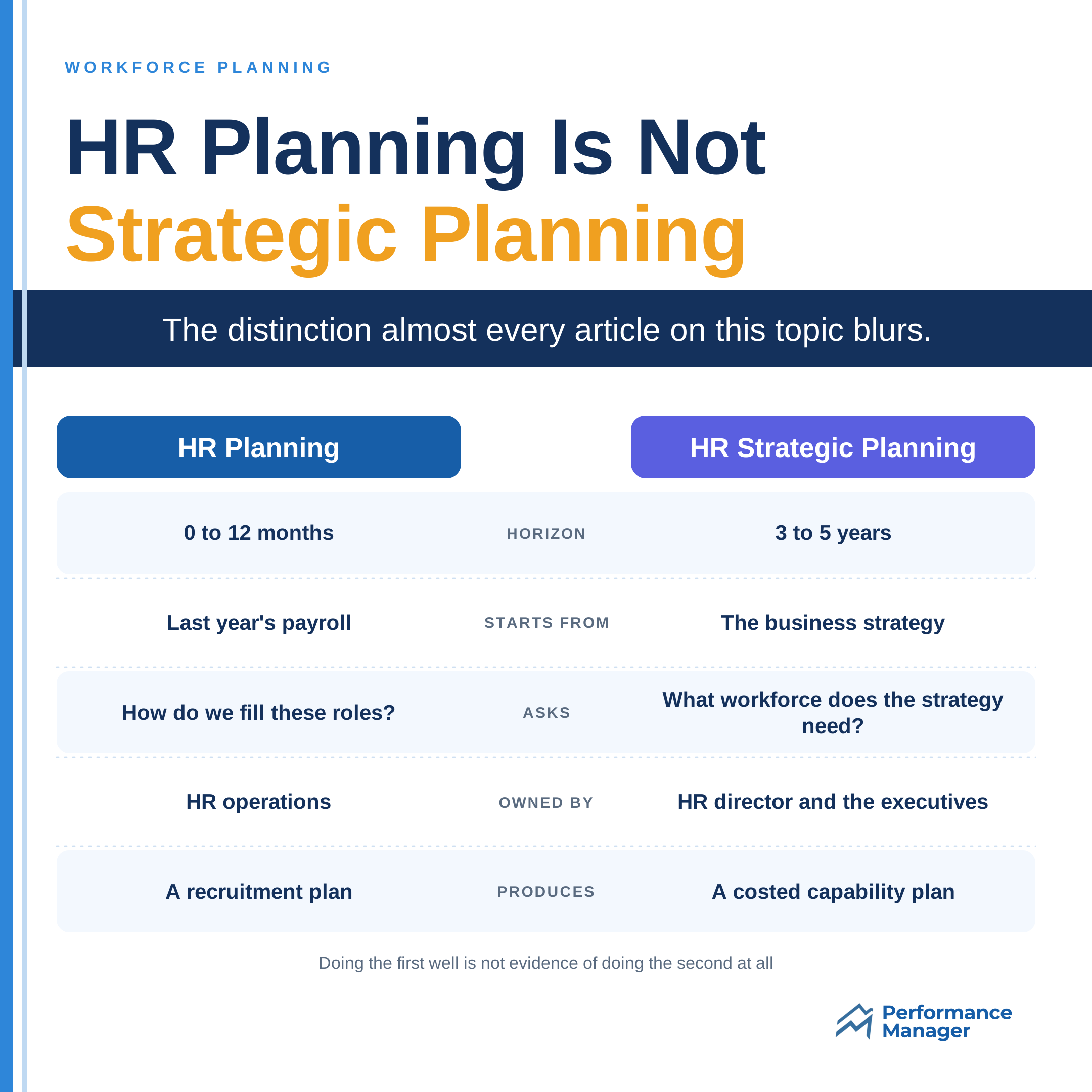
It is the multi-year version of a question HR answers every year anyway. The difference is horizon and direction of travel. Annual planning asks how to fill the posts already in the budget. Strategic planning asks what the strategy implies about the shape of the workforce, then works backward to this year.
Four terms get used interchangeably in this field, including by most of the pages ranking for it. They are not the same thing, and the confusion is expensive, because it lets an organization believe it has done the strategic work when it has only done the annual work.
Term | The question it answers | Horizon | Usually owned by |
Human resource planning | How do we fill the roles in this year’s budget? | 0 to 12 months | HR operations |
Human resource strategic planning | What workforce does the strategy require, and what will it cost? | 3 to 5 years | HR director with the executive team |
Strategic human resource management | How do our people practices create competitive advantage? | Continuous | The whole HR function |
Workforce planning | How many people, with what skills, where? | Either, depending on who is asking | HR, finance or operations |
That is how we use the terms in our consulting work, and the boundaries are contested in the academic literature. What matters is that your organization picks one set of definitions and stops sliding between them mid-meeting.
The practice gap is wide. The Chartered Institute of Personnel and Development surveyed 1,014 human resources professionals for its 2026 resourcing report and found more than a third of organizations collect no workforce planning data at all.
How do you forecast the workforce you will have?
Start here, not with demand. The supply forecast is the one most plans skip, and skipping it is what makes the final number wrong. You are projecting the headcount you would be left with in three years if you hired nobody.
The calculation is subtraction:
Opening headcount minus voluntary leavers minus retirements minus involuntary exits plus returns from extended leave equals closing supply
Run it year by year, not once across the whole period, because turnover compounds. A team of 100 losing 15 percent a year is at 85 after twelve months and 72 after twenty four, not 70.
Two rules make this forecast usable. First, the turnover rate has to come from your own payroll, not from a published benchmark. National figures describe a labor market, not your organization, and the gap between them is often larger than the thing you are trying to measure. Second, segment before you forecast. Turnover is not evenly distributed by age, and the United States Bureau of Labor Statistics measured median tenure at 4.1 years overall in January 2026 but only 3.0 years for workers aged 25 to 34. A department staffed by people in their late twenties will lose staff at roughly twice the rate of one staffed by people in their fifties, and a single blended rate hides that completely.
Worth noting for anyone planning against a scarcity narrative: that tenure figure rose from 3.9 years in 2024, and the Bureau’s turnover survey recorded 38 million quits in 2025, down 1.3 million on the year. People are moving slightly less, not more. The case for planning is not that the labor market is getting harder. It is that your replacement need exists whatever the market is doing.
How do you forecast the workforce you will need?
Demand forecasting converts a business plan into a headcount. Three methods cover almost every situation, and the choice depends on what your business plan actually contains.
Ratio analysis. Divide the planned output by output per person. Revenue per employee is the common version. Use it when the business plan has revenue targets and your work scales roughly with volume.
Span of control. Set a target ratio of staff to supervisor, then derive the management layer from the front line. Use it when the growth is in operations and the question is really about structure.
Driver-based modeling. Pick the thing that actually generates work, such as claims processed, branches opened or students enrolled, and model staffing against that. Use it when revenue is a poor proxy for workload, which in the public sector it usually is.
When the business plan has no numbers in it, which happens more often than the literature admits, model two or three scenarios and attach a headcount to each. A plan that says “if we win the government contract we need 40 more claims assessors by June, and if we do not we need six” is more useful to an executive team than a single forecast built on a strategy nobody has committed to.
One warning for anyone planning in an emerging market. A high unemployment rate does not mean hiring is easy. Statistics South Africa put official unemployment at 33.6 percent in the second quarter of 2026, yet unemployment among graduates stood at 12.4 percent, against 39.2 percent for those without matric. The roles a growing organization actually needs sit in the tightest part of the market. Plan for the segment you are hiring from, never for the headline.
What does the gap actually cost? A worked example
Here is the whole calculation on one organization. The company is illustrative; the method and the benchmarks are not.
A short-term insurer in Harare employs 240 people and books $18 million in annual revenue, which is $75,000 per employee. The strategy commits to 30 percent revenue growth over two years and an 8 percent productivity improvement from a new claims system.
Step | Calculation | Result |
Target revenue | $18.0m × 1.30 | $23.4m |
Target revenue per employee | $75,000 × 1.08 | $81,000 |
Demand in year 2 | $23.4m ÷ $81,000 | 289 people |
Supply, end of year 1 | 240 × 0.86 | 206 people |
Supply, end of year 2 | 206 × 0.86 | 177 people |
Gap | 289 − 177 | 112 hires |
Growth component | 289 − 240 | 49 hires |
Replacement component | 240 − 177 | 63 hires |
The 14 percent turnover rate comes from this company’s own payroll, which is the only place it should come from.
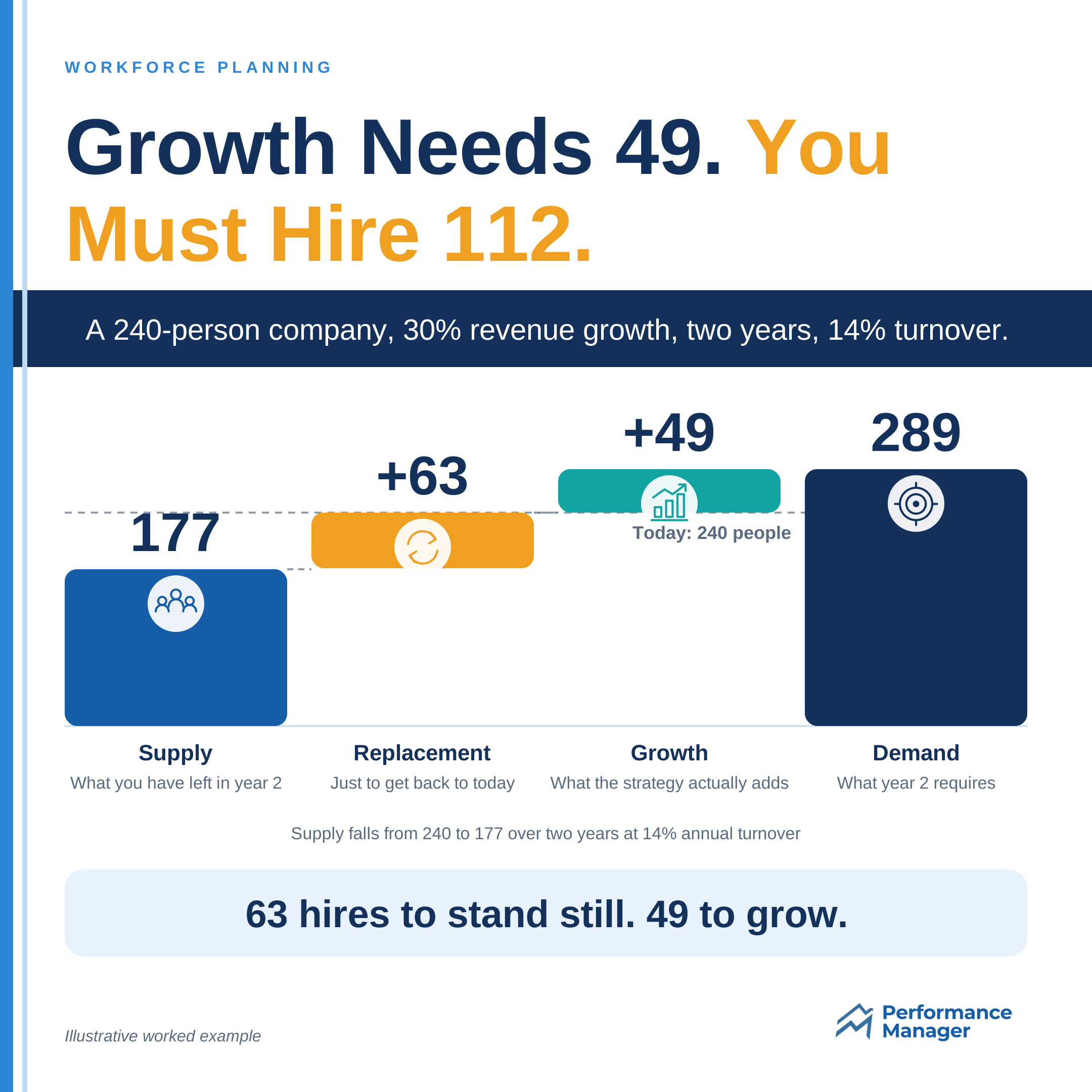
Now look at what the arithmetic exposed. The number that reaches most plans is 49, because 49 is what growth appears to require. The real requirement is 112, and the replacement component is larger than the growth component. An organization that budgets for 49 hires will spend two years quietly shrinking while believing it is growing.
The cost follows. The Society for Human Resource Management’s 2025 benchmarking report, based on 2,371 member responses, put median cost per hire at $1,200 for nonexecutive roles, so 112 hires is roughly $134,000 of direct recruiting spend. Treat that as a floor rather than the cost: it captures recruiting expenditure, not lost productivity, management time or the revenue a vacant desk does not earn.
The capacity check matters more than the money. At the same report’s median time to fill of about 45 days, 112 hires across 24 months means about five starts a month and seven requisitions open at any moment. Against a median of 20 requisitions per recruiter, one recruiter can carry it. Had the gap been 400, the plan would have needed a second recruiter before it needed anything else, and that is the kind of thing a plan without arithmetic discovers in month nine.
How tightly is your plan coupled to the business plan?
Weak coupling is the usual failure, and it is structural rather than personal. A workforce plan written after the business plan is finished can only react to it. Golden and Ramanujam argued in a 1985 paper that the degree of integration between human resource and business planning varies systematically between organizations and can be assessed, which is still the right way to think about it.
In practice we find four levels, and most organizations can place themselves in about ten seconds:
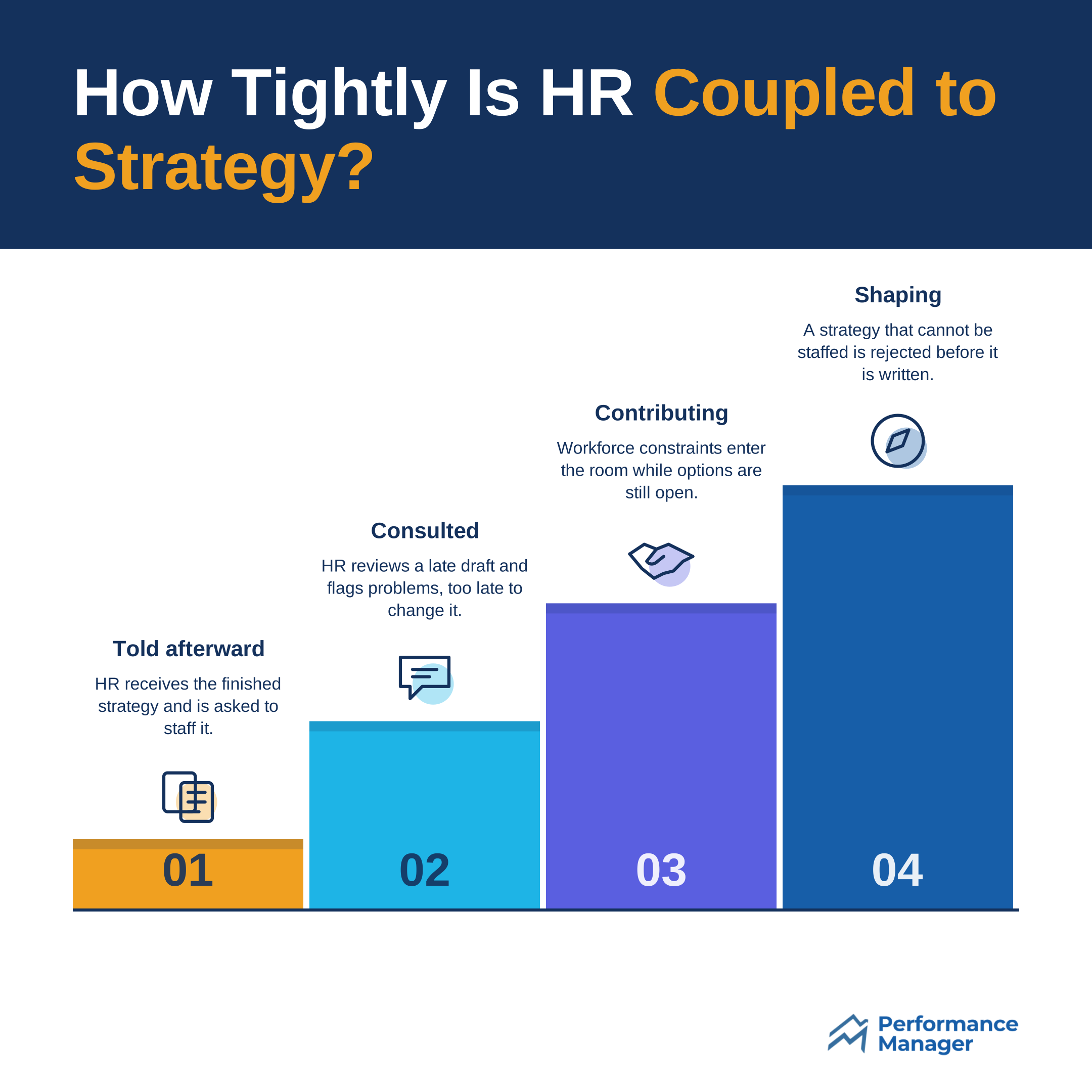
Told afterward. HR receives the finished strategy and is asked to staff it.
Consulted. HR reviews a late draft and flags problems, usually too late to change anything.
Contributing. HR brings workforce constraints into the planning meetings while options are still open.
Shaping. Workforce capability is treated as a strategic constraint in its own right, so a strategy that cannot be staffed is rejected before it is written.
The test for which level you are at is simple. Has a proposed strategy ever been changed because the workforce plan said it could not be delivered? If not, you are at level one or two whatever the organization chart says.
This is also where strategy stops reaching people. Donald Sull and colleagues, analyzing 124 organizations for MIT Sloan Management Review, found that only 28 percent of the executives and middle managers responsible for executing strategy could name three priorities of their own company. A workforce plan derived from a strategy that its own managers cannot state is built on sand, which is why the plan and the cascade into team goals have to be the same exercise rather than two documents.
What goes into the human resource strategic planning document?
Eight things, and it should run to about fifteen pages. Anything longer stops being read, and anything shorter is missing the arithmetic.
The business objectives it serves, quoted from the strategy rather than paraphrased
The supply forecast, by segment, with the turnover assumption stated
The demand forecast, with the method named and the scenario it assumes
The gap, split into growth and replacement
The cost, with cost per hire and recruiter capacity shown
The actions, each with an owner and a date
The measures, with baselines and review dates
What you will stop doing, because every plan that only adds is a wish list
The eighth item is the one that gets left out, and leaving it out is why most plans never survive their first budget round.
On the measures: pick few and make them reviewable. The same benchmarking report found that only 20 percent of organizations measure quality of hire, down from 27 percent in 2022, so most organizations can say how fast they hired and not whether they hired well. If you need a starting set, our list of HR KPIs worth tracking is a reasonable place to begin.
There is a structural argument for not writing this as a standalone document at all. A separate human resources plan is weakly coupled to the business plan by construction, because it lives in a different file, goes to a different meeting and is reviewed on a different cycle. Putting the workforce objectives into the Learning and Growth perspective of the organization’s scorecard, alongside the financial and customer objectives, removes that separation rather than managing it. That is what the balanced scorecard module in Performance Manager is for, and it is also perfectly achievable in a spreadsheet as long as there is only one of them and everybody knows which.
Is the effort worth it? The strongest evidence remains Mark Huselid’s 1995 study in the Academy of Management Journal, which surveyed 968 firms and found that a one standard deviation improvement in high performance work practices cut turnover 7 percent and was associated with $27,044 more sales per employee. Two honest caveats: the data are from 1991 and 1992, and the study is correlational, so it establishes association rather than cause. It also measures a bundle of people practices wider than planning alone. It remains the most rigorous evidence in the field, and nothing since has overturned it.
Frequently asked questions
What is the difference between human resource planning and strategic planning? Human resource planning fills the roles in the current budget over a twelve month horizon. Human resource strategic planning works three to five years out and starts from the business strategy, asking what workforce that strategy requires rather than what last year’s payroll contained. The first is operational; the second changes what the organization can attempt.
How far ahead should human resource strategic planning look? Three to five years for most organizations, matched to the business planning cycle rather than chosen independently. Roles with long lead times, such as actuaries, surgeons or senior engineers, need a longer horizon because you cannot recruit or develop them inside a year. Review annually and re-forecast rather than rewriting.
How do you plan when the business strategy keeps changing? Model scenarios instead of a single forecast. Attach a headcount and a cost to each plausible version of the strategy, then identify the hires common to all of them and start those immediately. The shared core is almost always larger than executives expect, and it is safe to act on while the rest is argued about.
Who owns the human resource strategic plan? The human resources director writes it, the executive team owns the decisions inside it, and line managers own the actions. If HR owns the outcomes alone the plan has no authority, because the people who control hiring budgets and workload sit outside the function.
Where to start
The arithmetic is the part that cannot be delegated or borrowed. Pull your own turnover by segment, run the subtraction year by year, apply one demand method to the strategy you actually have, and look at the gap it produces. Most organizations find the replacement component is larger than the growth component, and finding that out in a planning meeting is considerably cheaper than finding it out in month nine of a hiring freeze you did not anticipate. Everything else in a human resource strategic plan is commentary on that number.
If your plan is sound and delivery is where things come apart instead, that is a different problem, and one we looked at in why Zimbabwean firms fail at execution.