
A strategy only becomes real when people at every level know what it asks of them this year. Cascading is the process that makes that connection, by turning a handful of organisational objectives into goals that each department, team and employee can act on. This guide sets out how to do it well, with a worked example and a checklist you can use for your 2027 goal-setting.
Why cascading matters
Most organisations invest heavily in agreeing their strategy, and far less in translating it for the people who will deliver it. The result is a gap between what the leadership team intends and what everyone else works on. Research from London Business School found that only a third of senior managers could correctly name their firm’s top three priorities, and even those who had helped to develop the strategy managed only slightly more than half (London Business School, 2015; Sull, Homkes and Sull, 2015). If senior managers find the priorities hard to name, it is unlikely that frontline employees can connect their daily work to them.
A good cascade closes that gap. It gives every employee what is often called a “line of sight”: a clear understanding of how their own goals contribute to the organisation’s objectives. It also gives managers a practical way to turn strategy into execution, because the goals people are measured on are the same goals the strategy depends on.
Where the idea comes from
The idea of cascading objectives through an organisation is not new. Drucker (1954) described management by objectives and self-control, in which each manager’s objectives are derived from the objectives of the wider business, and in which managers take part in setting the objectives they are accountable for. That principle of participation is still the part most often forgotten, and it is explored further in our article on why management by objectives still matters.
Kaplan and Norton (1996) later gave organisations a structure for the same task through the balanced scorecard, which translates strategy into objectives and measures across financial, customer, internal process and learning perspectives. In later work, Kaplan and Norton (2006) focused specifically on alignment, showing how business units and support functions can build scorecards that connect to the corporate strategy rather than simply sitting beside it. Our article on the problem the balanced scorecard was built to solve covers the background.
Research on goal-setting explains why this matters for performance. Locke and Latham (2002) found that “specific, difficult goals consistently led to higher performance than urging people to do their best”, particularly when people are committed to the goal and receive feedback on their progress. A well-designed cascade supplies all three conditions: it gives people specific goals, it shows them why those goals matter, and it creates regular points at which progress is reviewed.
The four levels of a cascade
Most organisations cascade strategy through four levels. Exhibit 1 shows what each level owns and how the levels connect.
Exhibit 1. The four levels of a strategy cascade
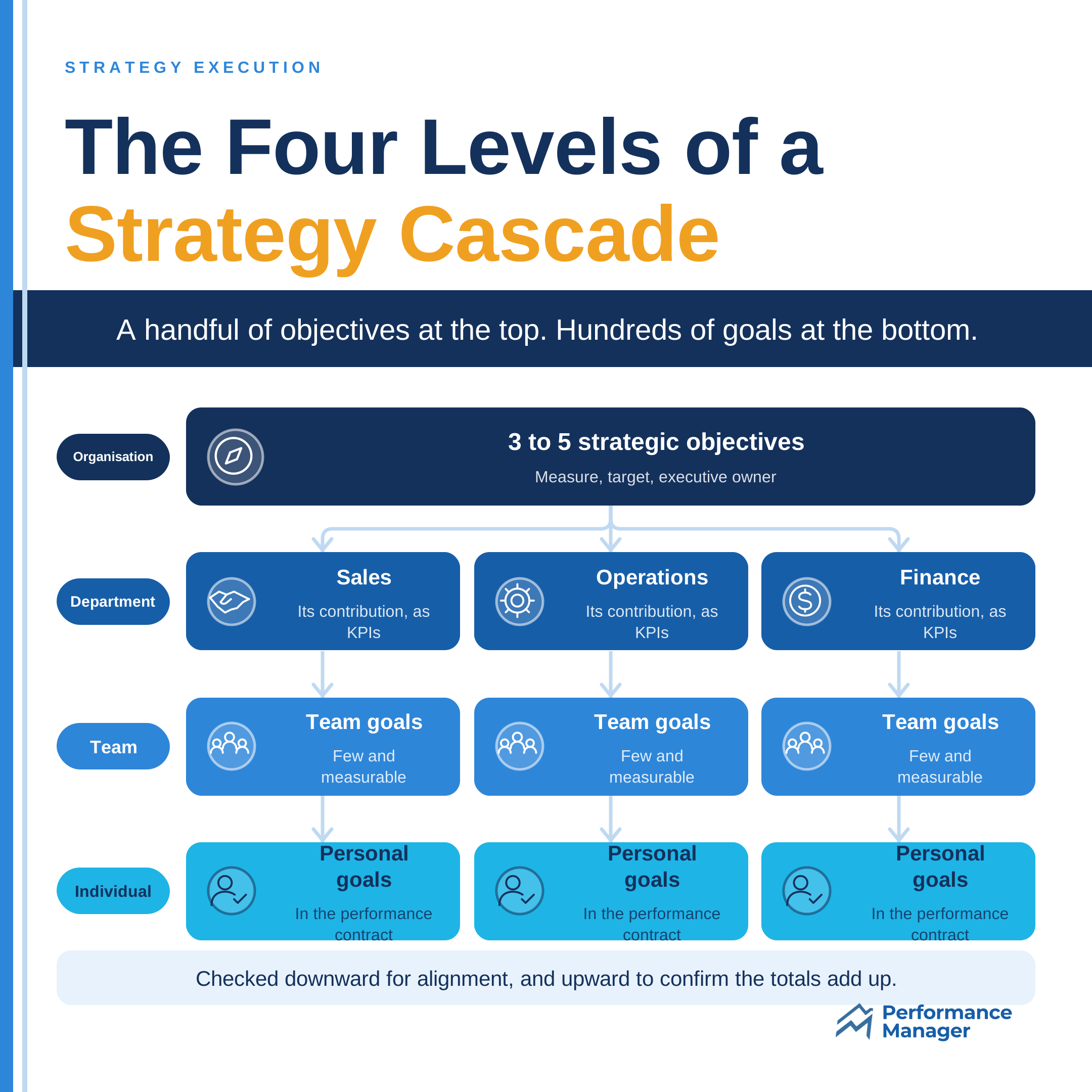
Each level translates the goal above it into its own terms. The checks run both ways: from the top down to confirm alignment, and from the bottom up to confirm that the goals can be achieved.
Organisation. The board and executive team agree three to five strategic objectives, each with an outcome measure, a target and a named executive owner. Fewer objectives make the rest of the cascade far easier.
Department. Each department identifies its contribution to the organisational objectives and sets departmental key performance indicators (KPIs) with targets.
Team. Team leaders translate departmental KPIs into a small number of measurable team goals.
Individual. Each employee agrees on personal goals that support a team goal, recorded in their performance contract or performance agreement.
In the public sector, the same logic underpins performance contracting. Zimbabwe’s performance management guidelines for state enterprises and parastatals describe how organisational performance contracts are meant to connect to the targets of the individuals responsible for delivering them (Office of the President and Cabinet, Ministry of Finance and Economic Development and State Enterprises Restructuring Agency, 2017).
A five-step method
The following steps work for most organisations, whatever their size or sector.
Agree the organisational objectives first. Confirm three to five strategic objectives, each with an outcome measure, a baseline, a target and an owner. If the strategy itself is unclear, no amount of cascading will fix it, so resolve that before moving on.
Ask each department what it must contribute. Rather than handing departments a list of targets, ask them: “What must we do to make these objectives happen?” Departments that help shape their own contribution are far more committed to it, which is the principle of participation that Drucker (1954) emphasised.
Translate contributions into team goals with clear measures. Turn each departmental contribution into a few measurable team goals. Use SMART criteria, and make sure every measure is properly documented with a definition, a data source, a baseline and a reporting frequency.
Set individual goals with a line of sight. Each employee should have a small number of goals, and each goal should link visibly to a team goal. A simple test is whether the employee can explain, in one sentence, how a goal helps the organisation achieve one of its objectives.
Check the cascade in both directions. Review it from the top down to confirm that every organisational objective is fully covered. Then review it from the bottom up to confirm that, if every team and individual achieves their goals, the organisational targets will actually be met. Gaps and over-commitments usually become obvious at this stage.
A worked example
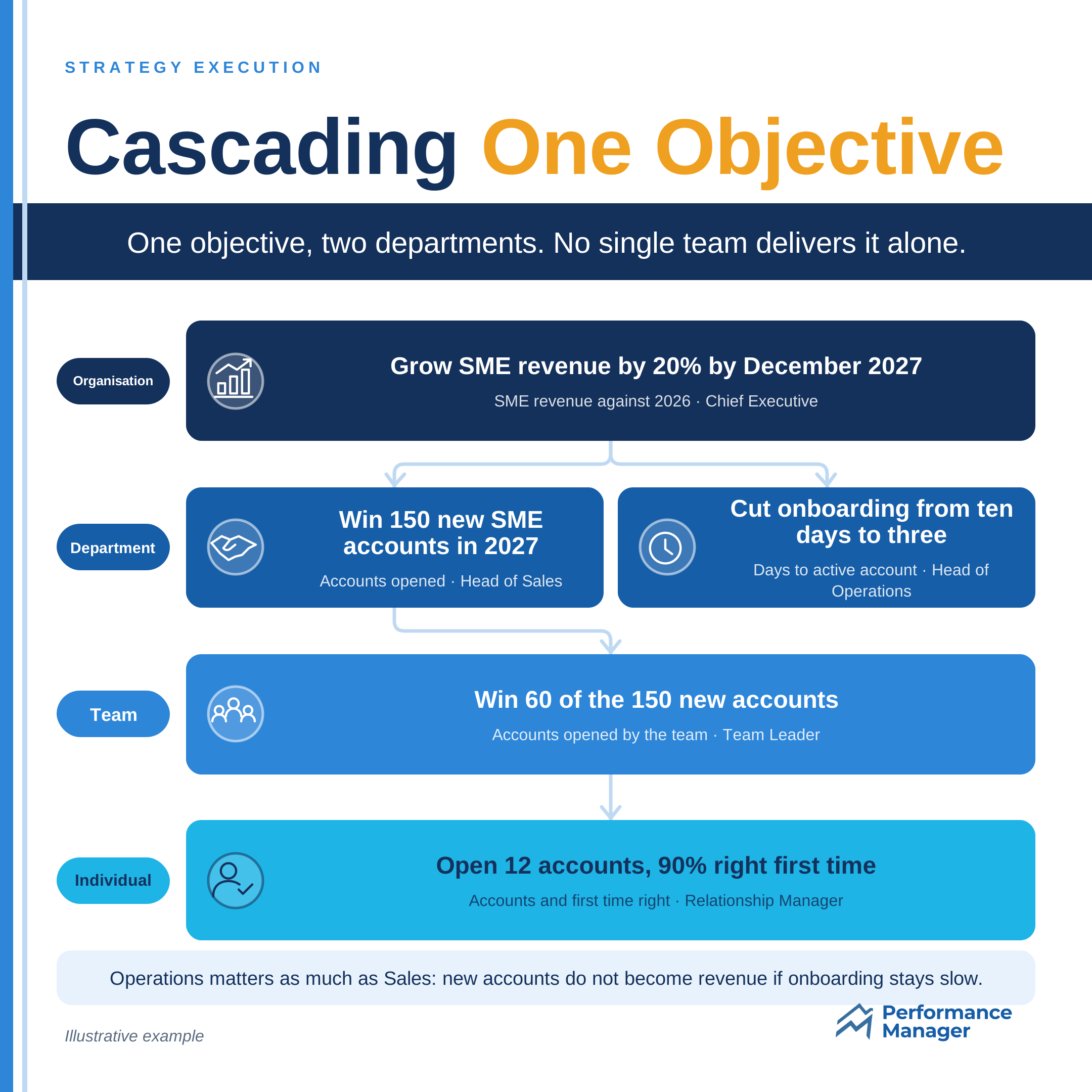
Exhibit 2 traces one strategic objective from the board to a frontline employee. The organisation and figures are illustrative, but the structure is the one we recommend.
Exhibit 2. Cascading one objective: an illustrative example
Level | Goal | Measure | Owner |
Organisation | Grow revenue from small and medium-sized enterprise (SME) customers by 20% by December 2027 | SME revenue against 2026 baseline | Chief Executive Officer |
Department: Sales | Win 150 new SME accounts during 2027 | Number of new SME accounts opened | Head of Sales |
Department: Operations | Reduce SME onboarding time from ten working days to three | Average days from application to active account | Head of Operations |
Team: Harare SME sales team | Win 60 of the 150 new SME accounts | New accounts opened by the team | Team Leader |
Individual: Relationship Manager | Open 12 new SME accounts, with 90% of applications complete at first submission | Accounts opened; first-time-right rate | Relationship Manager |
Illustrative example. The operations goal matters as much as the sales goal: new accounts will not turn into revenue if onboarding remains slow, which is why one objective often needs contributions from several departments.
Two features of this example are worth noting. First, the organisational objective is supported by more than one department, so no single team can deliver it alone. Second, the individual goal combines an outcome (accounts opened) with a quality measure (applications complete first time) that supports the operations team’s goal. Good cascades often connect teams in this way, rather than leaving each one to pursue its own targets in isolation.
Common mistakes and how to avoid them
Copying goals instead of translating them. When a corporate objective such as “improve customer satisfaction” is pasted unchanged into every department’s plan, nobody knows what they should actually do differently. Each level should restate the goal in terms of its own work.
Setting too many goals. Ten or more goals per person dilutes attention and makes reviews superficial. Three to five well-chosen goals are usually enough.
Measuring activity rather than results. Goals such as “hold four workshops” are easy to achieve but say little about progress. Where possible, measure outcomes, and use a balance of leading and lagging indicators so that problems become visible early.
Ignoring dependencies between teams. Where one team’s result depends on another team’s work, make the shared goal explicit and agree how it will be reported. Kaplan and Norton (2006) stress that alignment across units, and not only alignment from top to bottom, is what creates value.
Treating the cascade as a once-a-year exercise. Goals set in January and reviewed in December give people little chance to adjust. The cascade works best when it is reviewed regularly throughout the year.
Keeping the cascade alive during the year
A cascade is only as good as the conversations that follow it. Locke and Latham (2002) found that goals are most effective when people receive feedback on their progress, so the review rhythm is as important as the goals themselves.
Hold quarterly check-ins at every level, using the same goals and measures that were agreed at the start of the year.
Use a simple dashboard so that progress is visible to managers and employees alike. Our article on KPI dashboard examples offers some practical designs.
Adjust goals when the strategy changes. If an organisational objective is revised during the year, cascade the change promptly rather than leaving teams to work towards targets that no longer apply.
Review performance as it happens. Waiting for the year-end appraisal turns performance management into an autopsy rather than a diagnosis.
A checklist for your 2027 goal-setting
HR teams and line managers can use the following checklist to test the quality of their cascade before the new performance year begins.
Exhibit 3. A ten-point cascade checklist
Is your cascade ready?
|
In summary
Cascading is where strategy meets daily work. Done well, it gives every employee a clear understanding of how their goals support the organisation’s objectives, and it gives leaders confidence that the sum of everyone’s efforts will deliver the strategy. The essentials are straightforward: keep the number of objectives small, translate rather than copy at each level, involve people in setting their own goals, check the cascade in both directions, and review progress throughout the year.
A strategy becomes real when every employee can say how their work helps to deliver it.