
A 360 degree feedback process can make performance worse. In Kluger and DeNisi's 1996 meta-analysis of 607 effect sizes, feedback raised performance on average but lowered performance in more than a third of cases.
A 360-degree feedback process collects structured ratings on a set of behaviors from a person's manager, peers, direct reports, and sometimes customers, alongside a self-assessment, and returns them as one report. The process works when the report leads to a conversation, two or three goals, and action. It backfires when the report reads as a verdict on the person.
A scorecard tells you what someone achieved. It says far less about how they achieved it: how they treat colleagues, explain decisions, and develop their people. This guide gives you six steps, a sample report with numbers, and the research on what separates a 360 that helps from one that harms.
What is a 360-degree feedback process?
A 360-degree feedback process is a structured survey in which one employee is rated on the same set of behaviors by several groups: their manager, peers, direct reports, sometimes customers, and themselves. The ratings are combined into one report, with peer and direct-report scores shown as group averages so that no individual rater can be identified.
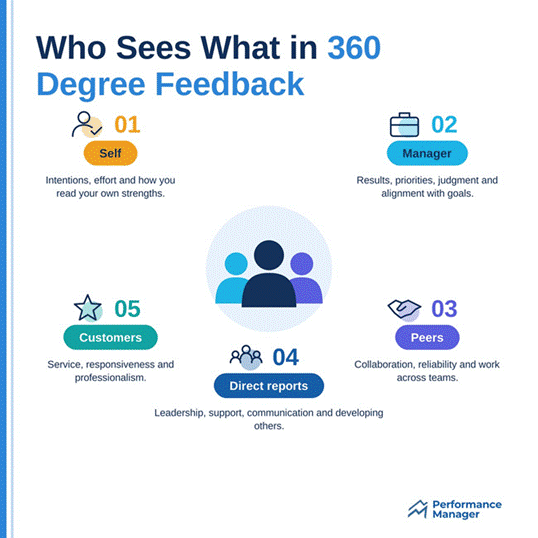
The value of 360-degree feedback is the range of viewpoints. Each rater group sees a different side of the job. Your manager sees how you handle priorities and deadlines. Your direct reports are the only people who know what you are like to work for.
Human resources (HR) teams also call 360-degree feedback multi-rater feedback, and the research literature calls it multisource feedback. All three names describe the same process.
Table 1. Who sees what in a 360-degree feedback process
Rater group | Best placed to comment on | Typical number |
Self | Intentions, effort and how the person reads their own strengths | 1 |
Manager | Results, priorities, judgment and alignment with goals | 1 |
Peers | Collaboration, reliability and working across teams | 3 to 5 |
Direct reports | Leadership, support, communication and developing others | 3 or more |
Customers or stakeholders | Service, responsiveness and professionalism | Where relevant |
Does 360-degree feedback improve performance?
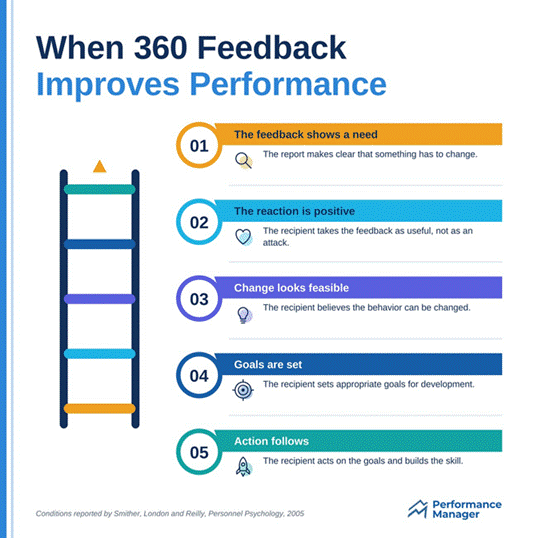
360-degree feedback improves performance a little on average, and only under certain conditions. The largest review of the evidence, covering 24 longitudinal studies, found small gains in how direct reports, peers, and managers rated a person afterward. Gains were larger when the person saw a need to change, set goals, and acted on them.
Smither, London, and Reilly published that review in Personnel Psychology in 2005. Corrected effect sizes were 0.15 for direct-report ratings, 0.15 for supervisor ratings, and 0.05 for peer ratings, and the authors concluded that improvement over time "is generally small." Their advice to practitioners was not to expect large, widespread change.
The same review names when improvement after 360-degree feedback is most likely: the feedback shows that change is necessary, the recipient reacts positively, believes change is feasible, sets appropriate goals and takes action.
Kluger and DeNisi's meta-analysis explains the failures. Feedback helps when it holds attention on the task. Feedback hurts when it pulls attention toward the self, which is what happens when a 360 report feels like a judgment of your worth. Writing in the Academy of Management Executive in 2000, DeNisi and Kluger argued that 360-degree appraisal systems typically have design characteristics that reduce their effectiveness, and that you should evaluate yours instead of assuming it works.
What the recipient does next matters most. Walker and Smither followed 252 managers through five annual rounds of upward feedback. Managers who met with their direct reports to discuss the results improved more than managers who did not, and each manager improved more in the years when that meeting took place.
So judge your 360-degree feedback process on what happens after the report, not on the survey.
Should you use 360-degree feedback in performance appraisal?
Use 360-degree feedback for development first. If 360 results feed a performance appraisal, give them a small weight next to results-based measures. Ratings gathered for pay or promotion decisions are associated with smaller improvement, and a rating says as much about the person giving it as about the person receiving it.
In the Smither, London and Reilly review, the average effect size was 0.25 when 360-degree feedback was used only for development and 0.08 when it was used for administrative decisions. The authors caution that few studies covered administrative use, so treat the gap as a signal, not a law.
Purpose also changes the ratings themselves. Greguras and colleagues compared ratings collected for both purposes in a 2003 field study. Direct reports gave better quality ratings when the purpose was developmental. Peer ratings did not differ.
Then there is the rater. Scullen, Mount, and Goff analyzed two large sets of manager ratings in the Journal of Applied Psychology in 2000. The rater's own idiosyncratic tendencies explained 62% and 53% of the variance in ratings, more than twice the share explained by the performance of the person being rated (21% and 25%).
That finding is the case for a modest weight. A scorecard captures results against the goals you cascade to each person, action plans capture delivery of the initiatives behind those results, and 360-degree feedback captures how the work was done. Our recommendation is to give the 360 or competency element about 10% of the overall score, let key performance indicators (KPIs) and action plans carry the rest, and use the full report for development.
The 10% figure is a judgment, not a research finding. The reasoning is the same as when you set balanced scorecard weights: a weight signals what matters, so a subjective rating shouldn't outvote a measured result.
How do you run a 360-degree feedback process step by step?
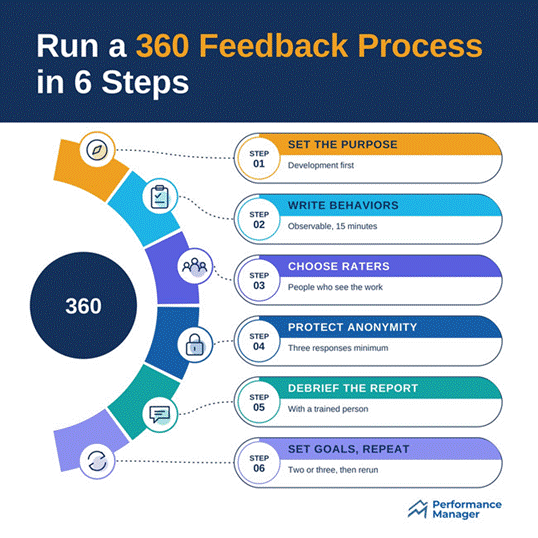
To run a 360-degree feedback process, set the purpose, write a short questionnaire of observable behaviors, choose raters who know the person's work, protect anonymity, debrief each report with a trained person, and turn the report into two or three development goals. Then repeat the process after a year to check progress.
Set the purpose. Decide whether the 360 is for development, appraisal, or both, and tell participants before anyone rates anyone. People answer differently when pay is at stake.
Write the questionnaire around behaviors. Rate what a colleague can observe, such as "explains decisions and the reasons behind them," not a trait such as "good communicator." Keep the questionnaire to about 15 minutes, because long questionnaires produce tired, careless answers.
Choose raters who see the work. One manager, three to five peers, and three or more direct reports is a sound mix. Let the employee propose raters and the manager approve the list.
Protect anonymity and brief everyone. Report peer and direct-report ratings as group averages with at least three responses per group. If a manager has only two direct reports, fold them into a combined "others" group instead of publishing a group of two. Brief raters on giving specific, respectful comments, and stagger requests so nobody rates 12 colleagues in one week.
Debrief the report with a trained person. A manager, an HR partner or a coach helps the recipient find two or three themes and the examples behind them. In a study of 1,361 senior managers, those who reviewed their feedback with an executive coach were more likely to set specific goals and improved more than other managers, though the effect was small (d = 0.17).
Turn the report into goals, then repeat. Record two or three development goals with dates and support. Write them with the discipline of a specific, measurable, achievable, relevant, and time-bound (SMART) KPI; our guide to creating SMART KPIs covers the method. Run the 360 again after 12 months to see whether the ratings moved.
What does a 360-degree feedback report look like? An example
A 360-degree feedback report shows, for each competency, the person's self-rating beside the average rating from others, plus written comments. The most useful reading is the gap between the two numbers. A self-rating well above others' ratings marks a possible blind spot. A self-rating below others' ratings marks a hidden strength.
Here is an illustrative 360-degree feedback example. Tariro is an operations manager at a 300-person distributor. Her manager, four peers, and five direct reports rated her on a five-point scale, where 1 means rarely demonstrated, and 5 means consistently demonstrated.
Table 2. Sample 360-degree feedback report: self-rating compared with others (illustrative data)
Competency | Self | Others (average) | Gap | Reading |
Communication | 4.5 | 3.6 | +0.9 | Possible blind spot |
Teamwork | 4.2 | 4.3 | -0.1 | Aligned |
Customer focus | 4.0 | 4.1 | -0.1 | Aligned |
Decision-making | 4.4 | 3.5 | +0.9 | Possible blind spot |
Developing others | 4.1 | 3.2 | +0.9 | Possible blind spot |
Three gaps of 0.9 look alike on paper. They aren't equally urgent. Developing others has the lowest score from others, 3.2, and direct reports are the group best placed to judge it, so it goes first.
Tariro's debrief ends with two goals. She will hold a monthly development conversation with each direct report, and she will explain the reasoning behind every scheduling decision in the weekly team meeting. Both are things her team can see her do, which is what keeps the feedback about the work.
Producing that table by hand is where a 360 degree feedback process usually strains. Someone in HR merges 10 survey exports in a spreadsheet, averages each group, checks that no group falls below three responses, and emails a file that then sits apart from the person's goals. The Competency Assessments module in Performance Manager keeps the assessment results in the same record as the scorecard and action plans, so the development goals sit next to the KPIs they are meant to support.
What goes wrong in a 360 degree feedback process?
A 360 degree feedback process usually fails in one of five ways: the questionnaire is too long, everyone rates everyone in the same two weeks, nothing happens after the report, raw ratings drive pay or promotion, or the feedback is delivered as a personal verdict. Each failure has a design fix.
Table 3. Five 360 degree feedback pitfalls and how to fix them
Pitfall | What it causes | Fix |
Too many questions | Rater fatigue and careless answers | A focused set of behaviors that takes about 15 minutes |
Too many requests at once | Rushed, generic ratings | Stagger requests or cap how many each person completes |
No follow-up | Participants stop believing in the process | A debrief and written goals for every recipient |
Raw ratings used for high-stakes decisions | Scores shaped by relationships and office politics | A small weight beside results-based measures and manager judgment |
Feedback delivered as a verdict | Attention moves from the work to the self | Behavior-based items, specific examples, a trained debriefer |
If you fix only one pitfall, fix follow-up. A 360 report with no conversation and no goal teaches raters that their effort was wasted, and the next round gets thinner answers.
Frequently asked questions
What questions should a 360 degree feedback survey ask?
A 360 degree feedback survey should ask raters how often they see specific behaviors, on a five-point scale, plus two or three open questions. Good items describe something observable, such as "gives credit to others for their work." Add "What should this person keep doing?" and "What should this person do differently?" for written comments.
How many raters do you need for 360 degree feedback?
Plan for seven to 10 raters per person in a 360 degree feedback process: one manager, three to five peers and three or more direct reports, plus the self-assessment. The floor that matters is three responses in any group reported as an average, because a smaller group cannot stay anonymous.
Is 360 degree feedback anonymous?
In a well-designed 360 degree feedback process, peer and direct-report ratings are anonymous and the manager's rating is not, because there is only one manager. Anonymity depends on reporting group averages with at least three responses and on editing written comments that would identify their author. Tell participants who will see what before the survey opens.
What are the pros and cons of 360 degree feedback?
The main advantage of 360 degree feedback is range: direct reports and peers see behavior a manager never observes. The main disadvantages are that ratings reflect the rater as well as the person rated, average improvement is small, and badly delivered feedback can lower performance. Careful design and follow-up reduce all three risks.
Conclusion
360-degree feedback adds what a scorecard can't: a rounded view of how someone works, from the people who see it every day. The evidence says the gains are real but small, and that they depend on what you build around the survey. Keep the purpose developmental, rate observable behaviors, protect anonymity, and give every recipient a debrief and two or three written goals. Then run the process again in a year and check whether the ratings moved. Before your next cycle, write down who will debrief each report and where the goals will be recorded.