
AI in performance management works well for drafting, summarizing and detection, and badly for scoring, ranking and deciding. The dividing line is whether a human reviews the output and carries responsibility for the decision. Where someone does, the technology is a useful assistant. Where nobody does, the model is making the decision whatever the policy says.
That distinction matters more than any feature list, because it predicts which deployments survive their second year and which get quietly switched off.
Most writing here treats AI as a single capability that is either arriving or overhyped. It is neither. It is several capabilities with very different track records, governed by law that has moved quickly. This article separates them and gives you a test to apply to a vendor demonstration.
What does AI actually do in performance management?
In performance management, AI covers four distinct jobs: generating text such as review drafts and goal wording, summarizing unstructured input such as notes and feedback, detecting patterns such as broken metrics and inconsistent ratings, and predicting outcomes such as attrition or target misses. They are not equally mature, and only the first three are reliable today.
Adoption is also narrower than the discussion suggests. SHRM’s survey of 2,366 human resources respondents found roughly one employer in four using AI for human resources work at all. Among those that do, talent acquisition leads at 64 percent, learning and development follows at 43 percent, and performance management comes third at 25 percent. Within performance management, the dominant use is already the modest one: 57 percent use it to help managers write more comprehensive feedback, and 46 percent for goal setting. Almost nobody is asking it to decide anything.
Vendors rarely separate them, which is how a product that drafts competent review text gets described in the same breath as one claiming to identify future leaders. The techniques differ, the evidence differs, and so does the legal exposure. Keeping the four jobs apart turns an unanswerable question into four answerable ones.
What AI does well
Three categories hold up: drafting, summarizing, and detection. All three share the feature that explains why they work. The output is checkable by the person using it, in seconds, without specialist knowledge.
The pattern in the wider evidence is that assistance helps weaker performers most. In a study of 5,179 customer support agents, Brynjolfsson, Li and Raymond found access to a conversational assistant raised issues resolved per hour by 14 percent on average, but by 34 percent for novice and low-skilled workers, with minimal effect on experienced ones. Their reading is that the tool spreads the tacit knowledge of the strongest performers to everyone else. That is a useful way to think about what a drafting tool does for a weak manager’s review writing.
Drafting. A manager with a year of notes and a blank review form faces a writing problem, not a judgment problem. The judgment happened over twelve months. A first draft built from evidence the manager supplies turns an hour into ten minutes, and the manager can see immediately whether it is right, because they already know what they think. The failure mode is visible: a manager with no notes gets a fluent review about nobody in particular.
Summarizing. Pulling twelve months of notes, peer feedback, and goal updates into a usable summary improves on the status quo, which is usually that nobody reads the first nine months at all. Recency bias is among the best-documented problems in appraisal, and a summary that weights February equally is a direct countermeasure.
Detection. The most underrated and least marketed of the three. Automated checks notice what humans miss across large sets of metrics: a key performance indicator unchanged for six weeks because its data feed broke, a metric moving opposite to the one it supposedly drives, or one manager whose ratings sit a full point above every peer.
None of these is a decision. Each is a prompt to go and look, which is the right division of labor. Detection also pays back fastest, because it attacks the reporting burden rather than the judgment, and that burden is usually larger than anyone has measured.
What AI does badly
AI fails wherever the person relying on it cannot check the output. That covers scoring and ranking employees, predicting rare events, and inferring states such as engagement or sentiment from behavioral data. In each case, the output arrives with more authority than its accuracy deserves.
The sharpest demonstration comes from a pre-registered experiment with 758 consultants. On tasks within the tool’s competence, Dell’Acqua and colleagues found AI users completed 12.2 percent more work, 25.1 percent faster, at more than 40 percent higher quality. On a task deliberately placed outside its competence, the same users were 19 percentage points less likely to reach the correct answer than colleagues working without it. The tool did not announce which task was which. Neither will yours.
Prediction looks better than it performs
Here is the arithmetic vendor demonstrations skip. A model predicts which employees will resign within twelve months with 80 percent accuracy. You have 500 employees and 12 percent annual voluntary turnover, so 60 will leave, and 440 will stay.
At 80 percent accuracy in both directions:
Of the 60 leavers, the model correctly flags 48 and misses 12.
Of the 440 stayers, it correctly clears 352 and wrongly flags 88.
The model raises 136 flags. Forty-eight are right. A manager acting on a flag is wrong roughly 65 percent of the time.
Nothing is broken. Eighty percent accuracy is good performance. The arithmetic does the damage, because the event is rare, and the rarer the event, the worse a good model looks in practice.
So never ask a vendor “how accurate is it”. Ask “of the people you flag, what share actually leave”. That is a different number; it governs whether a manager should act, and it is usually far less flattering. Prediction is a leading-indicator problem, with the same cautions as any leading indicator you plan to act on.
Measurement changes behavior, and automation amplifies it
When a metric stands in for a goal, people optimize the metric and let the goal go. Accounting researchers call this surrogation, and it long predates AI. Choi, Hecht, and Tayler, writing in the Journal of Accounting Research, found that managers involved in choosing the strategy surrogate less than managers who merely deliberate about it, which suggests the cure is participation rather than better measures.
What automation changes is speed and reach. A measure reviewed monthly by a manager who knows the context behaves differently from the same measure updating hourly on a dashboard that ranks the team. Automation makes the proxy more immediate, more visible, and harder to argue with, and all three strengthen the substitution. The conclusion is uncomfortable: the better your automated measurement becomes, the more carefully you must choose what you measure, because the system will deliver precisely what you asked for.
The human baseline is not clean either
The case against AI in appraisal usually assumes the alternative is sound judgment. Often it is not. Rating distributions get adjusted to fit bonus budgets, calibration meetings move scores for reasons unrelated to the work, and a manager writing forty reviews in a fortnight writes worse ones by the end. We have documented how appraisal scores get altered after the fact to fit a bonus pool.
So the real comparison is not algorithm against ideal judgment. It is algorithm against what managers do under deadline, a lower bar than the ethics debate assumes.
It cuts both ways. An inconsistent human process fails inconsistently, and an employee can argue with a person. A biased model fails identically every time, at scale, with the authority of arithmetic behind it, and often nobody present can explain the output.
Worse, the people relying on it tend not to notice. In a 2024 experiment published in Frontiers in Psychology, 260 participants reviewed algorithmic candidate scores in which equally qualified applicants from one ethnic background were scored roughly 10 percent lower. The bias went unnoticed by about 60 percent of them. A systematic discount applied to a whole group is not the kind of error a reviewer catches by reading carefully, because every individual score looks plausible.
Amazon learned the same lesson expensively. Its experimental recruiting tool, trained on ten years of past resumes in a male-dominated field, learned to penalize resumes containing the word “women’s” and the names of women’s colleges. Engineers neutralized those specific terms, then abandoned the project because they could no longer trust it was neutral in ways they had not thought to check.
Can AI write a performance review?
AI can write a competent first draft of a performance review from evidence you supply, and that is a legitimate use. It cannot form the judgment the review expresses. A draft generated from specific notes, examples, and goal outcomes saves real time. A draft generated from nothing produces fluent text about nobody in particular.
The practical test: could you defend every claim in the draft in a conversation with the employee? If a sentence sounds right but you cannot point to the week it refers to, it is the model’s invention, and it has to come out.
Settle the disclosure question before you start rather than after an employee asks, because the label itself changes how the feedback lands. In a 2026 vignette experiment with 192 employees, Marót and colleagues held the feedback text identical and varied only the stated workflow. Attributing it to AI lowered nearly every outcome measured, including the employee’s reported relationship with their supervisor, 4.69 on a seven-point scale for human-written against 3.23 for AI-generated, and their willingness to ask that supervisor for help.
The order of the workflow mattered in a way that cuts against the obvious one. Feedback written by a human and then polished by AI was statistically indistinguishable from fully human feedback. Feedback drafted by AI and then edited by a human recovered on only three of the nine measures. Treat this as a caution about disclosure rather than proof about quality: it is a small single-country sample measuring anticipated reactions to a hypothetical, the authors ran no equivalence test, and they note the effects may be inflated by how prominent the label was. But if you are choosing a workflow, the evidence currently favors the manager writing first.
Can AI manage people?
No. AI can support specific management tasks, but managing a person means deciding what to do about ambiguous information, taking responsibility for that decision, and holding a relationship that makes the decision acceptable. None of those is a prediction problem.
The useful question is narrower: which parts of a manager’s week are clerical? Assembling evidence, writing it up, noticing anomalies, and preparing for a conversation all are. The conversation itself, and the decision that follows, are not.
There is some evidence on what happens when that line is crossed. Across 21,869 European establishments, Kinowska and Sienkiewicz found algorithmic management associated with lower workplace wellbeing, working mainly through reduced job autonomy rather than directly. The effect is small, and the authors acknowledge weak measurement reliability, so take the mechanism rather than the magnitude: what algorithmic management costs is autonomy, and the damage scales with how much discretion you remove.
Watch for the phrase “the system recommends”. If a recommendation is followed 95 percent of the time, it is not a recommendation. It is a decision with a human signature on it, which is worse than an honest automated decision, because nobody owns it.
Why metric definitions decide everything
Most AI projects in performance management fail before anyone reaches the interesting ethical questions. They fail because the organization cannot say what its metrics mean.
Ask three managers to define “customer response time,” and you will often get three answers: time to first reply, time to resolution, or time until the ticket closes. All three are defensible, each produces a different number, and a model trained across all three learns the inconsistency rather than the performance.
This is the unglamorous precondition for everything above. A metric needs one definition, one formula, one owner, and one data source before machine learning adds value to it. Most teams discover this three months into an implementation, when the model disagrees with the spreadsheet, and nobody can establish which is right.
Doing this in a spreadsheet works until the third quarter, when three people maintain three versions of the same definition and the disagreement is about governance rather than arithmetic. A KPI documentation tool that holds one definition per metric, with an owner and a formula attached, removes the argument rather than settling it. Performance Manager’s KPI documentation module exists for this. Get it right before adding anything automated on top, because automation applied to inconsistent definitions produces confident nonsense faster.
What the law now requires
The regulatory position has moved faster than most performance management practice. Two developments matter most.
In the European Union, the AI Act classifies as high risk any AI system used to “monitor and evaluate the performance and behaviour” of workers, and any used in decisions on “the promotion or termination of work-related contractual relationships” (Annex III, point 4). That is not a loose reading of the text. Performance evaluation is named explicitly, and the classification brings documentation, human oversight and record-keeping obligations with it.
In New York City, Local Law 144 requires any employer using an automated employment decision tool to have it audited for bias within the preceding year, to post a summary of the audit results publicly, and to notify candidates and employees 10 business days before the tool is used on them. The city began enforcing it on 5 July 2023.
The direction of travel in both is the same, and it tracks the division described above. Assistance is lightly regulated. Decisions about a person’s livelihood are not. If you are choosing between a tool that drafts and one that scores, compliance is a reason to prefer drafting beyond the quality argument.
One date is worth getting right, because many articles have not caught up. The high-risk obligations for Annex III systems, the category performance evaluation falls into, now apply from 2 December 2027 rather than the August 2026 date still widely quoted.
The more instructive story is what enforcement looks like in practice. Researchers presenting at a 2024 conference checked 391 New York employers and found 18 had posted a bias audit, about 5 percent. Of the impact ratios that were published, 96 percent cleared the fairness threshold, and a fifth were simply omitted. Then in December 2025 the New York State Comptroller audited the regulator. Across two years the department had received two complaints, had reviewed 32 companies, and had found a single instance of non-compliance. The state auditors reviewed the same 32 companies and found at least 17.
Draw the right conclusion from that. It is not that the rules can be ignored, since enforcement regimes tighten. It is that a published bias audit is currently close to worthless as evidence that a tool is fair, because almost everyone who publishes one passes.
Verify current obligations for your own jurisdiction. Rules here are being written quickly, and an article is not legal advice.
How to decide what to automate
One question separates the uses that work from the ones that cause damage: does the output get reviewed by someone who can overrule it, and who will be held responsible for the decision?
Where the answer is yes, the failure modes above are manageable, because a human catches them. Where the answer is no, every one of them becomes a live risk.
Applied across the capabilities vendors currently sell:
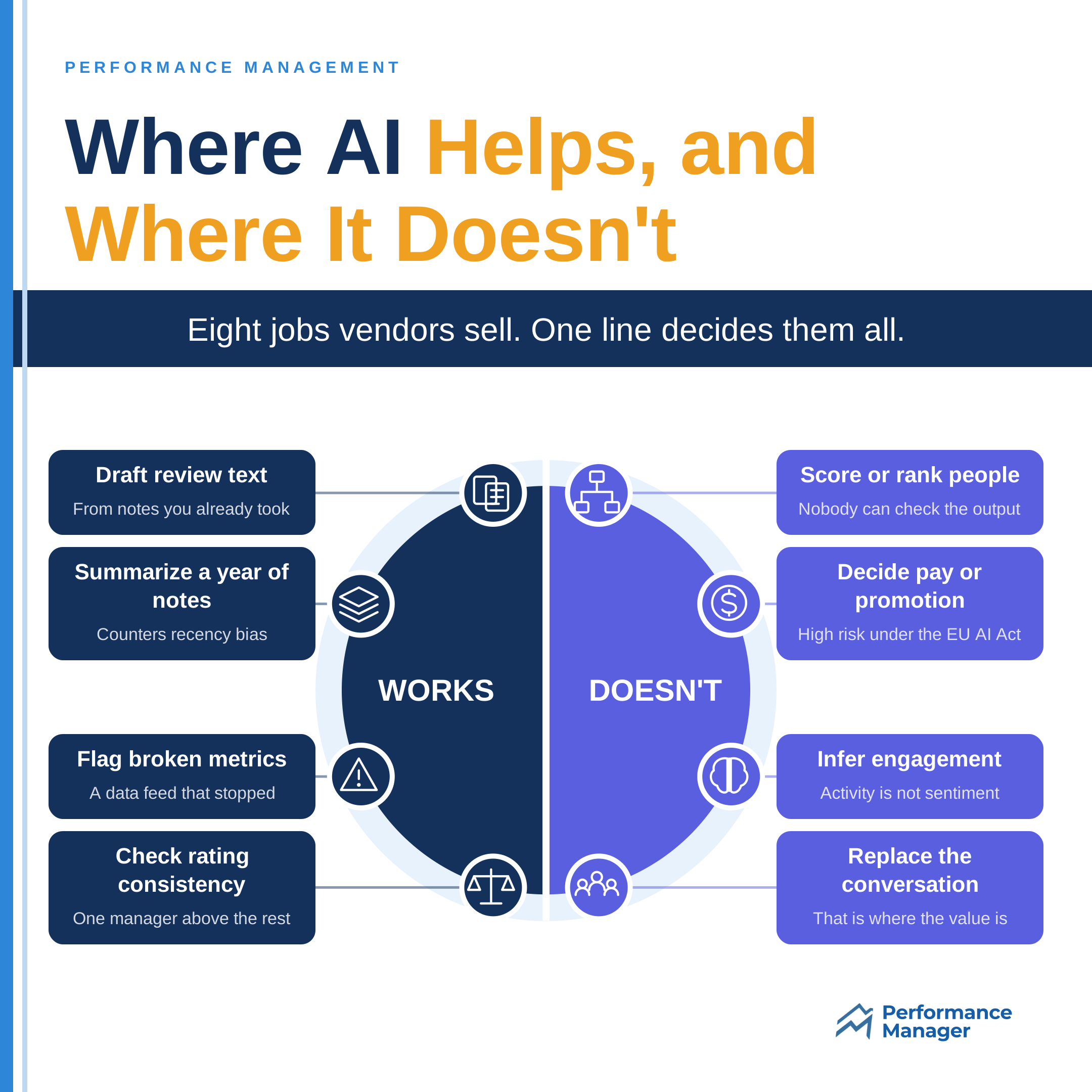
What you want AI to do | Does it work? | What stays human |
Draft review text from notes and evidence | Yes, with editing | The judgment behind it, and the final wording |
Summarize a year of notes and feedback | Yes | Deciding what the summary means |
Flag metrics that have stopped updating or moved abnormally | Yes, reliably | Deciding whether the anomaly matters |
Check rating consistency between managers | Yes, and underused | The conversation about why they differ |
Transcribe and structure performance conversations | Yes | Whether the conversation was any good |
Suggest goal wording and test goals against criteria | Yes, with review | Whether it is the right goal |
Predict who will leave or who will miss a target | Partly, read the base rate first | Every decision that follows |
Score or rank employees against each other | No | All of it |
Decide promotion, pay, bonuses or termination | No, and increasingly unlawful | All of it |
Infer engagement or sentiment from activity data | No | All of it |
Replace the performance conversation | No | All of it |
The “yes” rows all have AI handling the clerical load around judgment: assembling, drafting, summarizing, checking. The “no” rows all have something being decided about a person’s standing. That line is roughly where the law has landed, which is less of a coincidence than it looks.
Frequently asked questions
How is AI used in performance management? AI is used for four things: drafting review text and goal wording, summarizing notes and feedback, detecting anomalies in metrics and inconsistencies in ratings, and predicting outcomes such as attrition. The first three are reliable. Prediction requires understanding the base rate before acting on any flag.
Can AI replace performance reviews? No. AI can draft the write-up and assemble the evidence behind it, but the review’s value comes from a manager’s judgment and the conversation that follows. Removing the conversation removes the mechanism by which the review changes anything.
Is AI biased in performance evaluation? It can be, and it fails more consistently than humans do, which makes it worse at scale. A model trained on historical ratings learns whatever bias those ratings contained. The relevant comparison is against your actual current process, not an ideal one, and both need checking.
What should I ask a vendor about their AI features? Ask which of the four jobs each feature performs, and for predictions ask what share of flagged people actually experience the predicted outcome, not the accuracy rate. Then ask who reviews the output and who is accountable for the resulting decision.
Where this leaves you
The split is clean enough to act on. AI earns its place by removing clerical work from around human judgment, and it causes damage when asked to supply the judgment instead. Drafting, summarizing, and detection are ready now. Scoring, ranking, and deciding are not, and the law is moving against them.
The precondition is less exciting than the technology: metrics that mean one thing, with an owner and a formula attached. Fix that first and automation adds value. Skip it, and you get faster disagreement.
Start with detection. Lowest risk, attacks the reporting burden rather than the judgment, pays back soonest.