
The Boardroom Illusion vs. The Cubicle Reality
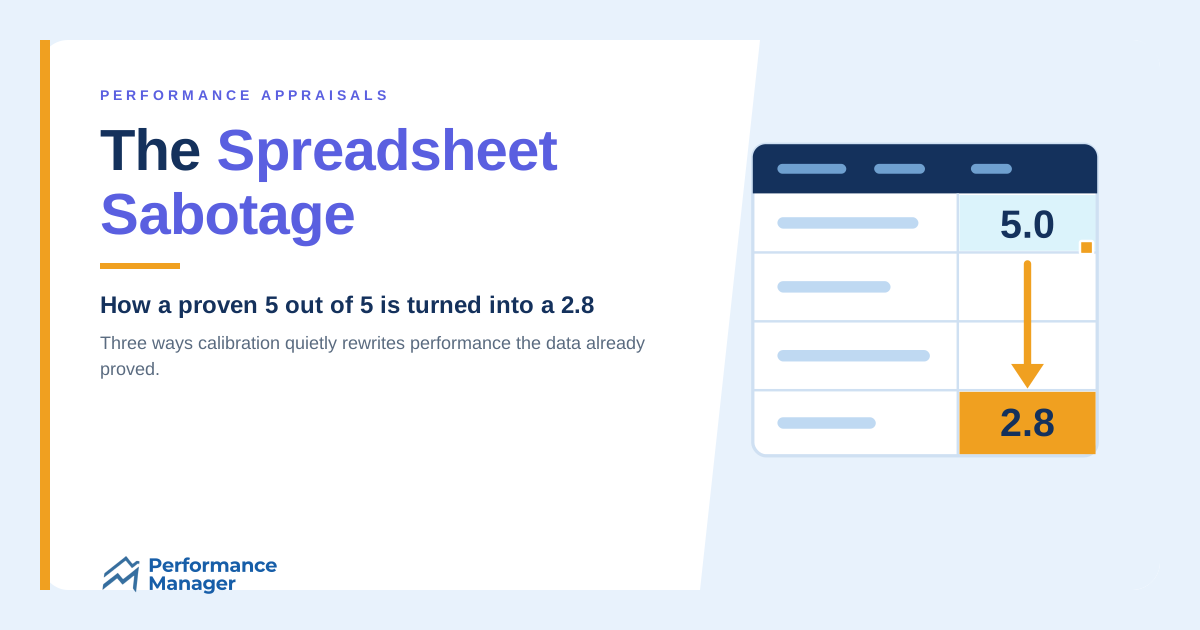
We all know the feeling. You walk into your year-end performance review holding a portfolio of crushed targets. You worked the late nights. You built the data models, optimized the operational systems, and delivered the complex projects that kept the company afloat during turbulent times. By every objective measure on your performance tracking sheet, you are a solid 5 out of 5.
You sit down, your manager clears their throat, shifts uncomfortably in their chair, and then the dreaded word drops: “But...”
What follows is rarely a genuine, constructive conversation about your professional development, capacity building, or career trajectory. Instead, it is a masterclass in corporate gymnastics, a carefully choreographed dance designed to explain why your undeniable, mathematically proven 5 has magically become a 2.8.
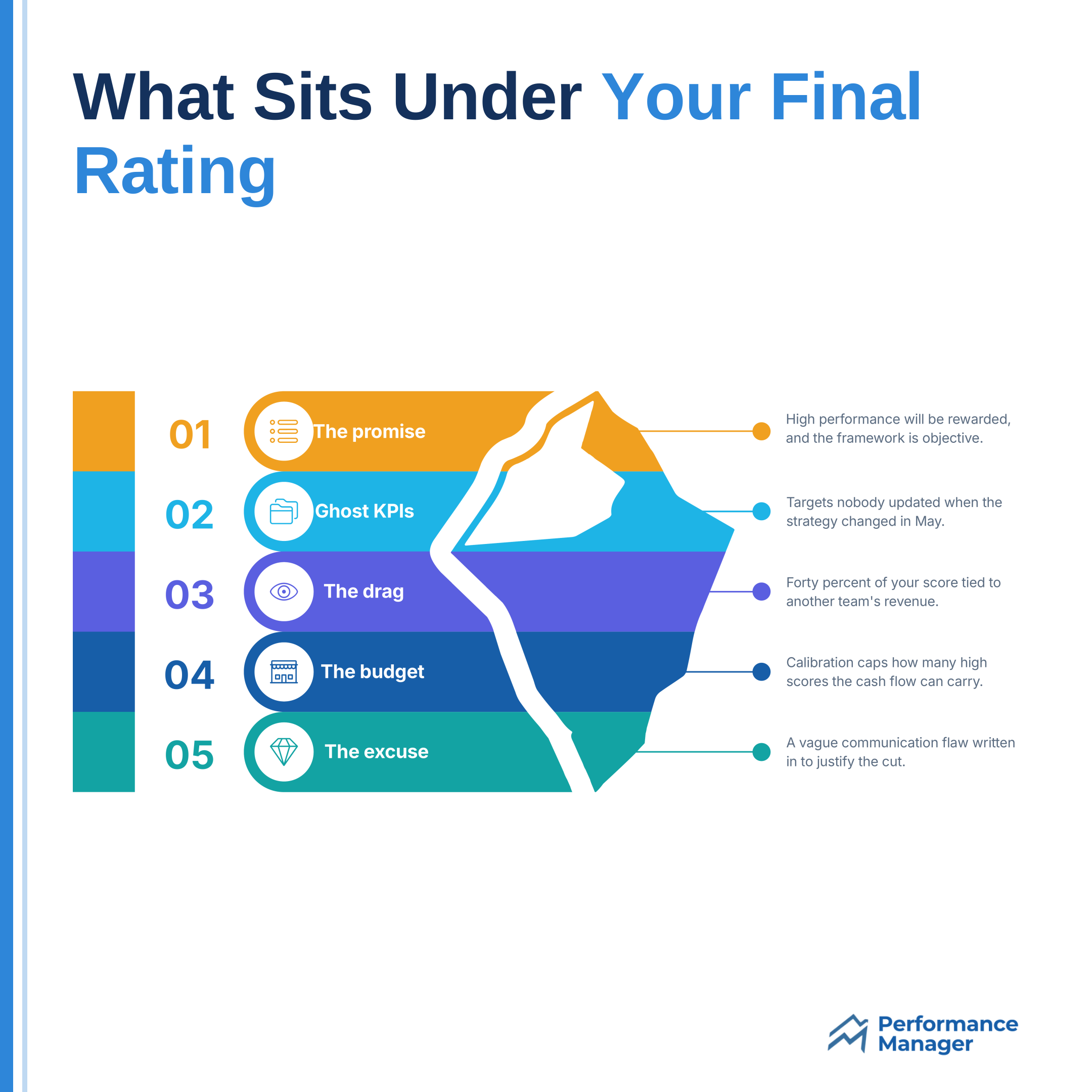
In our local corporate landscape, performance measurement frameworks—whether it is the Balanced Scorecard, Integrated Results-Based Management (IRBM), Objectives and Key Results (OKRs), or Management by Objectives (MBOs)—are frequently heralded by Human Resources as the ultimate tools for fairness, meritocracy, and transparency. Executive leadership touts these frameworks at town halls, promising that “high performance will be rewarded.”
Yet behind closed doors in executive calibration meetings, these same systems are routinely weaponized. The very tools meant to measure objective reality are contorted to serve a hidden agenda. It forces a deeply uncomfortable question that we desperately need to address: Are we actually measuring human performance, or are we just using spreadsheets to manage the payroll and cover up executive failures? Let’s dissect how your hard-earned appraisal score gets mathematically assassinated.
The Local Context: Strategy in a Blender
To understand why this sabotage happens so frequently, we have to look at the unique operating environment of the African, and particularly the Zimbabwean, corporate sector. We do not operate in a static, predictable, low-inflation environment where a five-year strategic plan can be executed without deviation.
We operate in a highly volatile matrix of currency fluctuations, sudden liquidity crunches, shifting statutory instruments, and unpredictable supply chain disruptions. In this environment, a corporate strategy formulated in January is often completely obsolete by April.
This volatility requires incredible agility from the workforce. Middle managers, technical specialists, and frontline staff must pivot violently to keep the business alive. They abandon long-term growth projects to focus on immediate cost-containment, risk mitigation, and cash-flow preservation.
However, while the reality on the ground changes overnight, the performance management system remains frozen in time. HR software is notoriously rigid. Executive boards are often reluctant to formally revise annual targets because it looks like a failure to shareholders. This disconnect between dynamic reality and static measurement creates the perfect breeding ground for appraisal manipulation. The system becomes a trap.
1. The 'Ghost KPI' Trap (The Mid-Year Pivot)
Let’s look at the first method of assassination: The Ghost KPI.
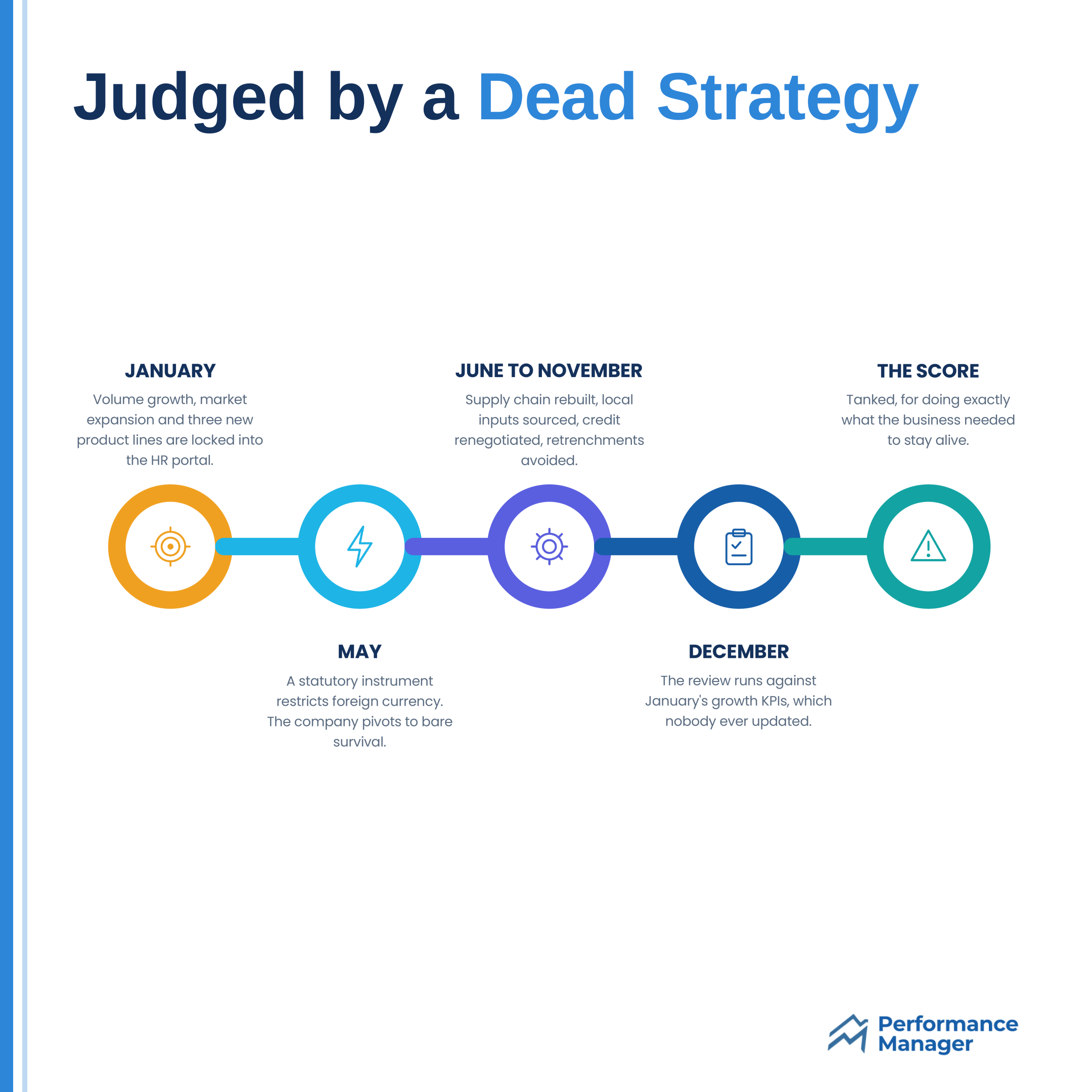
It is early January. You are the operations manager for a large manufacturing or FMCG firm. The executive team hands you a strict set of KPIs centered heavily on volume growth, market expansion, and launching three new product lines. You sign the document, lock it into the HR portal, and get to work.
By May, the macroeconomic reality flips. A new Statutory Instrument drops, severely restricting access to foreign currency, or a major global supply chain bottleneck cuts off your primary raw materials. The executive leadership team panics and pivots the entire company strategy from 'aggressive growth' to 'bare-bones survival and cost-containment.'
You spend the next six months working 80-hour weeks. You redesign the supply chain from scratch, source alternative local inputs, negotiate brutal credit terms with vendors, automate reporting workflows to track every cent of waste, and put out daily operational fires just to keep the business afloat and avoid retrenchments.
Come December, you sit down for your review, exhausted but proud that you saved the company millions. But the HR system still contains your original January 'volume growth' KPIs. No one at the executive level bothered to cascade the new survival strategy down the formal scorecard.
You are told, 'Look, you did an amazing job keeping us alive during the crisis. We really appreciate your hustle. But technically, you missed your core volume and product launch targets.'
Your score is tanked.
This is the Ghost KPI trap. You are being judged against the ghost of a strategy that died six months ago. You are punished for organizational agility and doing exactly what the business needed you to do to survive, while leadership’s administrative failure to update the strategic framework is blamed entirely on you. The message this sends to top talent is devastating: next time the ship is sinking, don't help bail water; just focus on polishing the brass because that's what your KPI says.
2. The 'Corporate Drag' (Paying for the Sins of Others)
The second method of mathematical assassination is the 'Corporate Drag.' This happens when individual brilliance is deliberately diluted by collective mediocrity, usually through a structural flaw in the appraisal framework itself.
Imagine a high-performing specialist—perhaps a Business Intelligence (BI) architect, a data scientist, or an IT infrastructure lead. Throughout the year, this individual operates flawlessly. They hit every single system uptime target, deploy complex DAX measures that save the finance team hundreds of hours, configure automated performance management dashboards ahead of schedule, and maintain a 100% internal SLA rating.
Their individual performance is an undeniable, mathematically verifiable 5/5. Their immediate line manager knows it, and the data proves it.
Then comes the sabotage. The company’s rigid performance framework dictates that 40% (or sometimes even 50%) of every individual's final appraisal score is forcibly linked to the Overall Corporate Financial Target (EBITDA, Net Profit, etc.).
Because the sales and marketing clusters completely missed their revenue targets for the year—perhaps due to poor pricing strategies, ineffective campaigns, or simply a failure to close deals—the corporate multiplier crashes. That 40% weighting drags the brilliant IT specialist’s final, blended score down to a 2.8 or a 3.0.
This violates a core principle of performance management: Line of Sight. An employee should only be heavily penalized on metrics they can directly control or influence. An IT specialist cannot force a customer to sign a contract; they can only build the CRM system that enables the sales team to do so.
When you tie a specialist's personal appraisal score to the failures of a completely different department, you destroy motivation. The employee is left demoralized, wondering why their personal excellence is being penalized simply because another department couldn't close deals. Why work overtime to build a perfect system if your bonus is going to be wiped out by the sales director's incompetence? The natural response is to stop trying. When individual brilliance is diluted by collective mediocrity, top talent updates their CV and leaves.
3. The 'Bonus Pool Mathematics' (The Forced Downgrade)
We now arrive at the darkest open secret in corporate performance management: The calibration room forced downgrade.
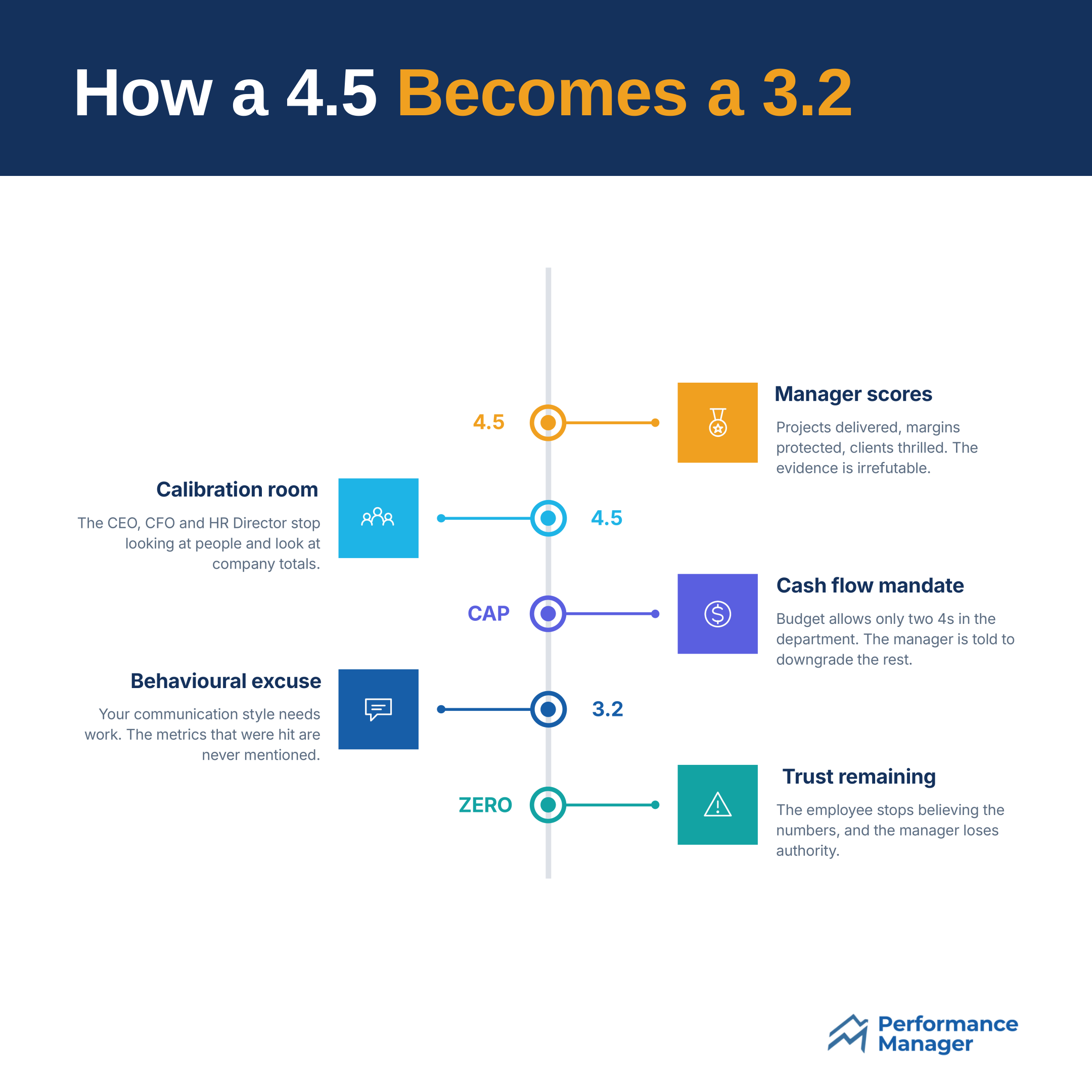
A dedicated departmental manager runs a tight ship, tracks team utilization meticulously, and objectively scores their top three subordinates at a 4.5/5. The evidence is irrefutable. The projects were delivered, the margins were protected, and the clients are thrilled. The manager proudly submits these scores to the HR department for the final executive calibration committee review.
The calibration committee—usually comprising the CEO, CFO, and HR Director—sits in a boardroom and looks at the aggregate numbers across the entire company. The CFO runs a quick calculation and realizes a horrifying truth: if they approve all these high scores, the performance bonus payout will completely cripple the company's Q4 cash flow.
Instead of being honest about the financial constraints, a mandate comes down from the top: 'We cannot afford this many high performers. The bell curve is skewed. We only have budget for two 4s in your department. You need to downgrade the rest of your team to a 3.'
The middle manager is now forced into an impossible, soul-crushing position. They have to call a brilliant, hardworking employee back into the office, look them in the eye, and somehow explain why their 4.5 is now a 3.2. Because they cannot use the real metrics (which the employee clearly hit), the manager must invent a subjective, flimsy excuse.
They reach for the 'Behavioral' or 'Core Values' section of the appraisal form. They say things like, 'Your technical work is great, but we feel you need to improve your communication style,' or 'You lack a bit of emotional intelligence in cross-functional meetings,' or 'We just aren't seeing enough cultural fit.'
It is a lie. Both the manager and the employee know it is a lie. The subjective 'behavioral' score is simply being used as a mathematical sinkhole to drag the overall average down to a financially acceptable level.
In this scenario, the appraisal completely ceases to be a performance evaluation. It becomes a reverse-engineered accounting trick designed to protect the bottom line while pretending to maintain a meritocracy. This practice permanently destroys the employee's trust in leadership and completely undermines the authority of the middle manager.
The Heavy Cost of Sabotage
Executive committees often justify these practices as 'tough business decisions' or 'necessary evils' to protect the company's financial health. But the long-term cost of this spreadsheet sabotage is catastrophic.
First, it breeds a culture of malicious compliance, often referred to today as 'quiet quitting.' When employees realize that outstanding performance is rewarded with fabricated downgrades, they will mathematically calculate the exact minimum effort required to not get fired, and they will deliver precisely that. Innovation dies. Discretionary effort—the willingness to go above and beyond in a crisis—evaporates.
Second, it accelerates the brain drain. In an economy where specialized skills (Data Science, BI Architecture, Strategy Consulting, High-Level Engineering) are in massive demand globally, top performers do not have to tolerate being cheated. They will take their 5/5 talent to a competitor, or they will take it across borders to an international market that respects their output. You are left with a workforce comprised only of those who couldn't leave.
Finally, it destroys the credibility of the HR department and the performance management framework itself. The Balanced Scorecard becomes a joke. OKRs become a bureaucratic compliance exercise that everyone rolls their eyes at. When the measurement tool is known to be rigged, no one respects the measurement.
How to Fix a Broken System
If corporate leadership is serious about driving high performance and retaining top talent, the spreadsheet sabotage must stop. Fixing this requires courage, transparency, and a fundamental redesign of how we view appraisals.
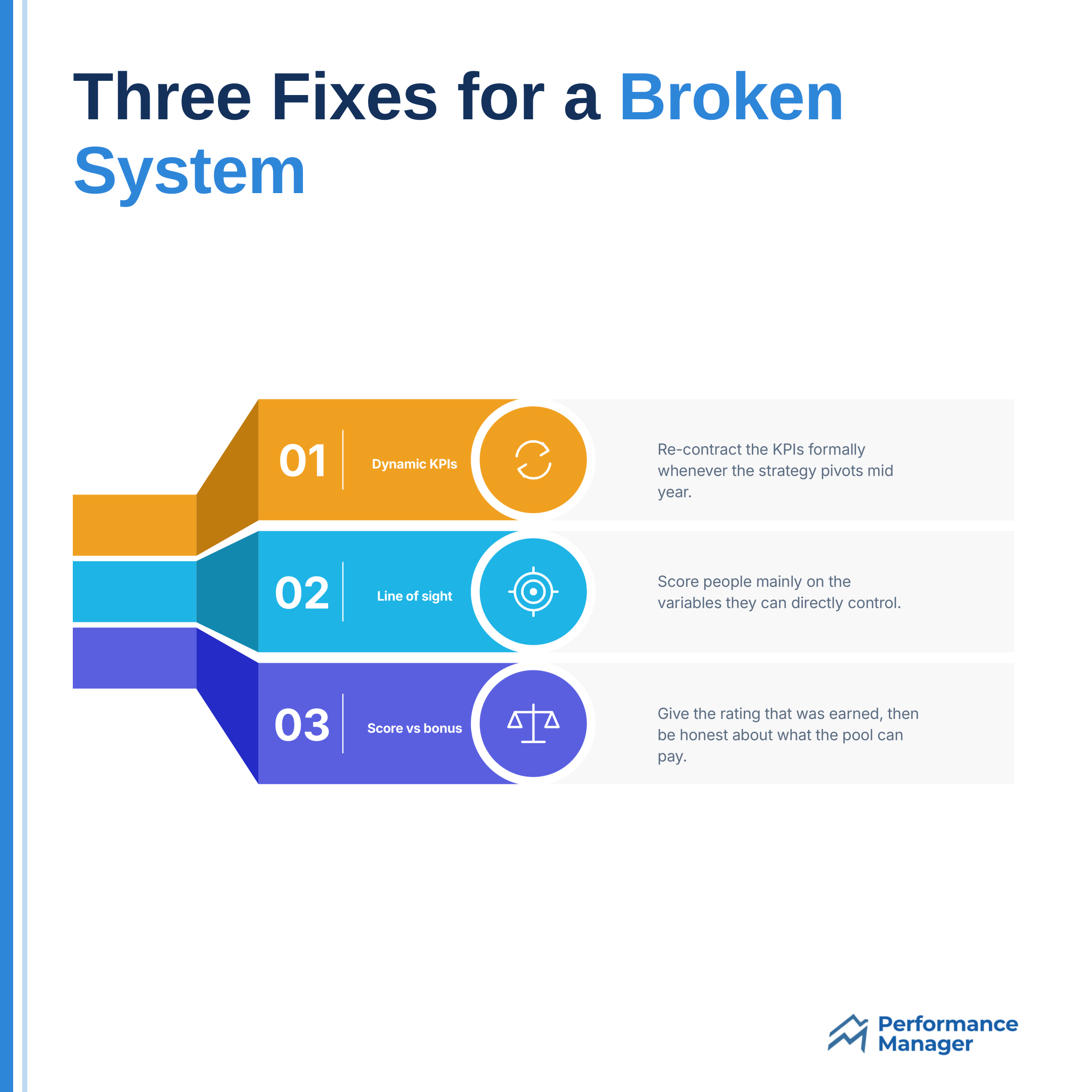
1. Embrace Dynamic Scorecards:
Strategic frameworks must be agile. If the macroeconomic environment forces a massive pivot in corporate strategy in Q2, the HR department must facilitate a formal 're-contracting' of KPIs for all affected staff. If you ask an employee to abandon their original goals to save the company, their year-end appraisal must reflect that new reality. You cannot judge a wartime general on peacetime metrics.
2. Fix the Line of Sight:
Stop punishing specialists for the failures of the executive suite or the sales team. While a small percentage of a bonus can be tied to corporate performance to encourage teamwork, the vast majority of an individual's appraisal score must be based purely on the variables they directly control. If a network engineer keeps the servers at 99.9% uptime, they deserve a top score, regardless of whether the company hit its revenue target.
3. Separate the Score from the Bonus:
If the company has a bad year and cash flow is tight, executives need to have the courage to be honest. Do not downgrade an employee's performance score to save money. Give them the 5/5 they earned, acknowledge their brilliance, and then honestly explain that the company cannot pay out the full bonus pool this year due to broader financial constraints.
An employee will respect a leader who says, 'You did exceptional work, you earned a top rating, but the company doesn't have the cash to pay the bonus right now.' They will forever despise a leader who says, 'We are dropping your score to a 3 because your communication style needs work,' when both know it's just about the money.
The Final Word
Performance management is supposed to be the engine of corporate growth. It is supposed to identify, nurture, and reward the talent that will build the future of the organization. But when it is manipulated, distorted, and weaponized behind closed doors, it becomes the fastest way to destroy organizational culture.
We need to demand better. We need performance frameworks that reflect reality, respect individual effort, and operate with absolute transparency. Everything else is just playing games with spreadsheets.
Over to You
Has your flawless performance ever been dragged down by the 'company multiplier'? Have you ever been graded against outdated 'Ghost KPIs' after a major strategic shift? Or have you ever had a manager invent a subjective behavioral weakness just to lower your rating so the company could save money?
Drop your experiences in the comments below. Let's see how widespread the spreadsheet sabotage really is, and let's start demanding a fairer system.