
Performance review weighting answers one question: how much of a person's overall score should come from results, and how much from everything else?
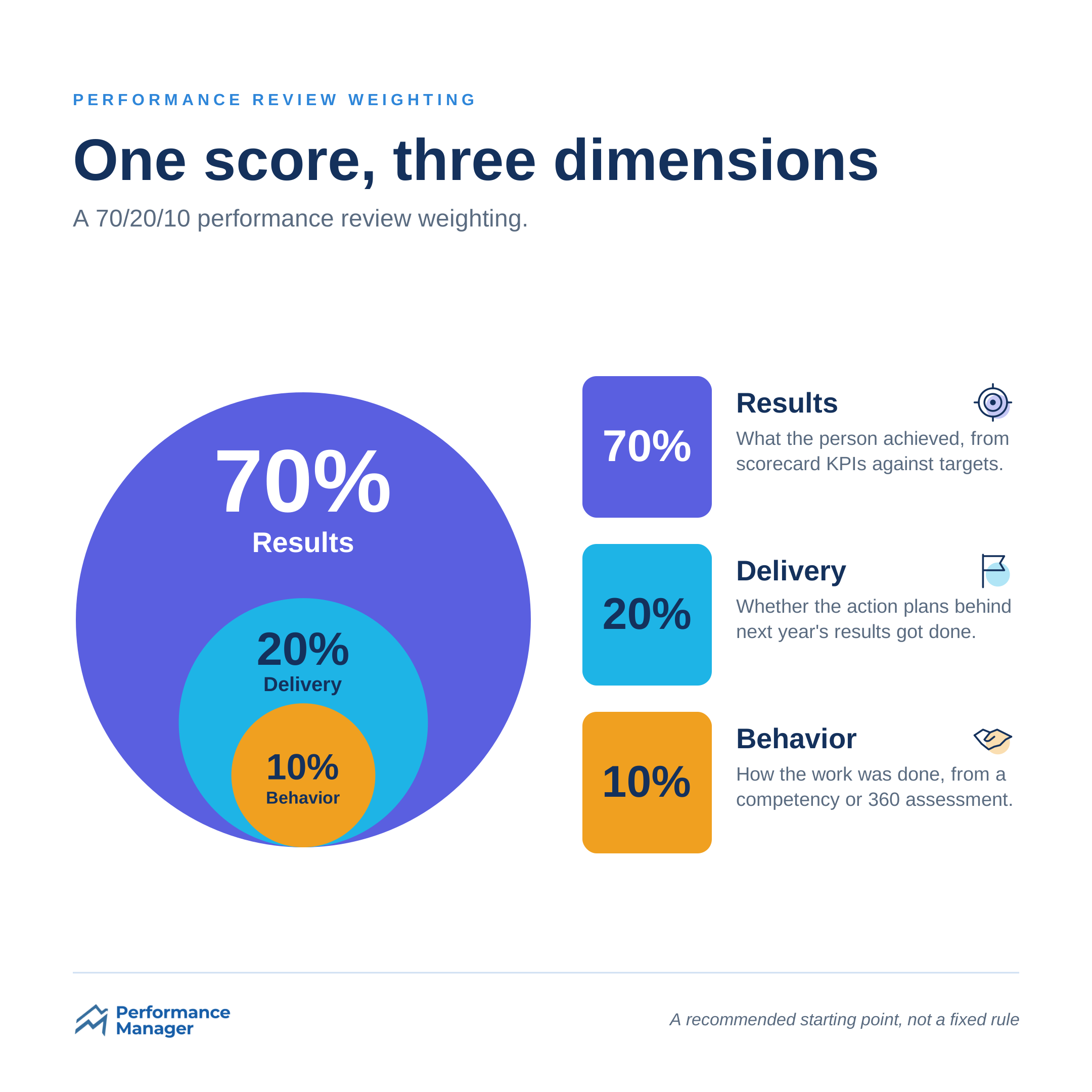
Performance review weighting is the share of an overall performance score assigned to each dimension of performance. A sound starting point is 70% results, 20% delivery of action plans and 10% behavior, agreed before the performance year begins.
The question matters because a score built only on targets treats two very different people as equals. One hits the number and also delivers the projects that will lift next year's results. The other hits the same number by cutting corners and making life harder for the team. This guide explains why a balanced score is fairer, what the research supports, and how to calculate and apply a 70/20/10 weighting.
What is performance review weighting?
Performance review weighting is the percentage of an overall performance score that each dimension of performance contributes. In a balanced score, results against key performance indicators (KPIs) carry the largest share, delivery of action plans carries a meaningful share, and behavior carries a small one. The weights add to 100% and are agreed in advance.
Three questions sit behind the three dimensions. What did you achieve? Did you deliver the work that drives future results? How did you go about it?
Table 1. The three dimensions of a balanced overall score
Dimension | The question it answers | Measured by | Weight |
Results | What did the person achieve? | Scorecard KPIs against base and stretch targets | 70% |
Delivery | Did they deliver the work that drives future results? | Progress on action plans, initiatives and deliverables | 20% |
Behavior | How did they achieve it? | Competency assessment or 360 degree feedback | 10% |
The 70/20/10 split is our recommended starting point, based on our consulting experience at Industrial Psychology Consultants (IPC). The split isn't a research finding and it isn't a fixed rule. The principle is that measurable results carry most of the weight, with real recognition for delivery and behavior.
Results carry 70% because results are what the strategy depends on. Scorecard measures with documented baselines and agreed base and stretch targets are also the most objective evidence a review has.
Delivery carries 20% because action plans capture the initiatives behind the numbers: launching a system, fixing a process, opening a market. Many initiatives take months to show up in results, so they behave like leading indicators. Weighting delivery tells people to invest in next year's results as well as this year's number.
Behavior carries 10% because ratings of behavior are more subjective than KPI results. A modest weight recognizes how the work was done without letting ratings outweigh measured performance. The full competency report stays useful for development, even though only a small share feeds the score.
Why shouldn't a performance score rest on results alone?
A results-only performance score treats two people who hit the same number as equal, even when one built next year's results and the other damaged them. Whatever the score leaves out, people learn to neglect. A balanced score keeps results in front while making delivery and behavior count.
Steven Kerr described the pattern in the Academy of Management Journal in 1975, in an article titled "On the folly of rewarding A, while hoping for B." His examples were reward systems that pay off one behavior while the rewarder hopes for another. A company hopes for teamwork and long-term thinking, pays for this quarter's number, and then is surprised by what it gets.
Narrow goals carry side effects of their own. Writing in Academy of Management Perspectives in 2009, Ordóñez, Schweitzer, Galinsky and Bazerman listed them: tunnel vision that neglects unmeasured work, a distorted appetite for risk, more unethical behavior and a corroded culture.
Kaplan and Norton made the same argument about whole companies when they introduced the balanced scorecard in Harvard Business Review in 1992: "What you measure is what you get." A balanced overall score applies that thinking to one person.
What does research say about weighting results and behavior?
Research on job performance supports scoring more than results. Supervisors' overall judgments draw separately on task performance, the core work of the job, and contextual performance, such as helping and cooperating. Research also shows that managers weight these dimensions differently unless told how, and that behavior ratings carry a large dose of the rater.
Borman and Motowidlo drew the distinction between task and contextual performance in 1993. Motowidlo and Van Scotter tested it a year later with supervisor ratings of 421 United States Air Force mechanics. Task performance explained 13% of the variance in overall performance beyond contextual performance, and contextual performance explained 11% beyond task performance. Both counted, independently.
Contextual performance also pays off for the person. Across two samples of Air Force mechanics, Van Scotter, Motowidlo and Cross found that contextual performance predicted career advancement and rewards over time.
Left to themselves, managers don't agree on the weights. Rotundo and Sackett asked managers in five jobs to rate hypothetical employee profiles. The weights varied from rater to rater: some managers put task performance first, and others put counterproductive behavior first. A published performance review weighting replaces each manager's private one.
Behavior ratings need a ceiling. Scullen, Mount and Goff found that a rater's idiosyncratic tendencies explained 62% and 53% of the variance in two large sets of performance ratings, against 21% and 25% for the performance of the person rated. A 10% weight recognizes behavior without letting the noisiest measure decide the score.
How do you calculate a weighted performance score?
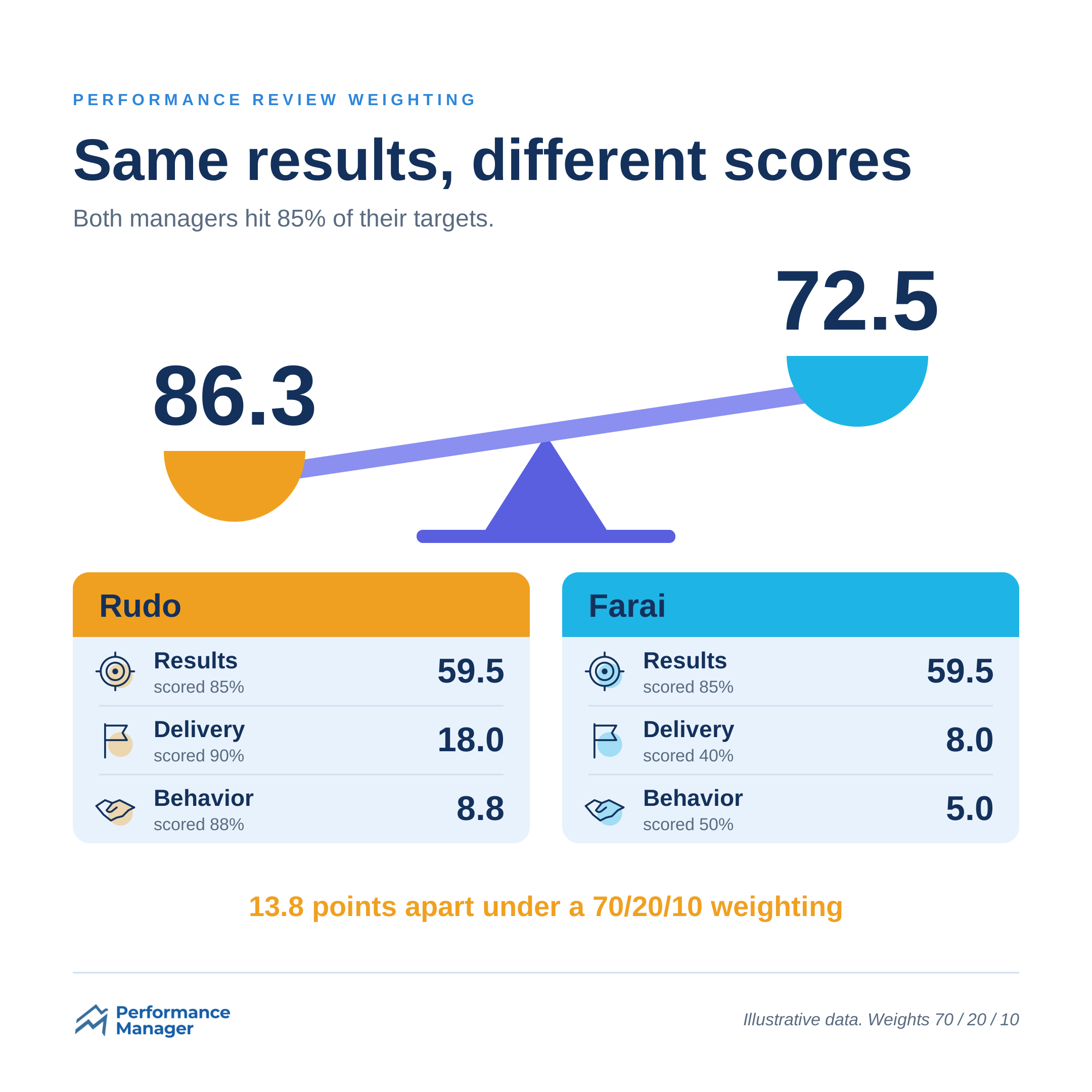
To calculate a weighted performance score, multiply each dimension's score by its weight and add the results. With a 70/20/10 weighting, a person who scores 85% on results, 90% on delivery and 88% on behavior earns 59.5 + 18.0 + 8.8, an overall score of 86.3.
Take two branch managers at a regional retailer, Rudo and Farai. The figures are illustrative. Both managers scored 85% on their scorecard KPIs.
Table 2. Same results, different overall scores (illustrative data)
Dimension | Weight | Rudo: score | Rudo: points | Farai: score | Farai: points |
Results | 70% | 85% | 59.5 | 85% | 59.5 |
Delivery | 20% | 90% | 18.0 | 40% | 8.0 |
Behavior | 10% | 88% | 8.8 | 50% | 5.0 |
Overall score | 100% |
| 86.3 |
| 72.5 |
Under a results-only review, Rudo and Farai both get 85. The weighted performance score separates them by 13.8 points. Rudo is building next year's results and working in a way the company values. Farai is hitting today's targets while falling behind on the initiatives and behaviors that will matter next year.
That gap gives Farai's manager something specific to discuss: which action plans slipped, and what the competency assessment says about why.
Does weighting always change the answer? No. A 2012 Society for Human Resource Management (SHRM) article quoted a SHRM Foundation report saying the added burden of weighting "has no practical impact" on results. When a person's dimension scores move together, that holds: any weighting gives much the same total. Weighting matters in cases like Farai's, where the dimensions disagree.
Should performance review weighting change by role?
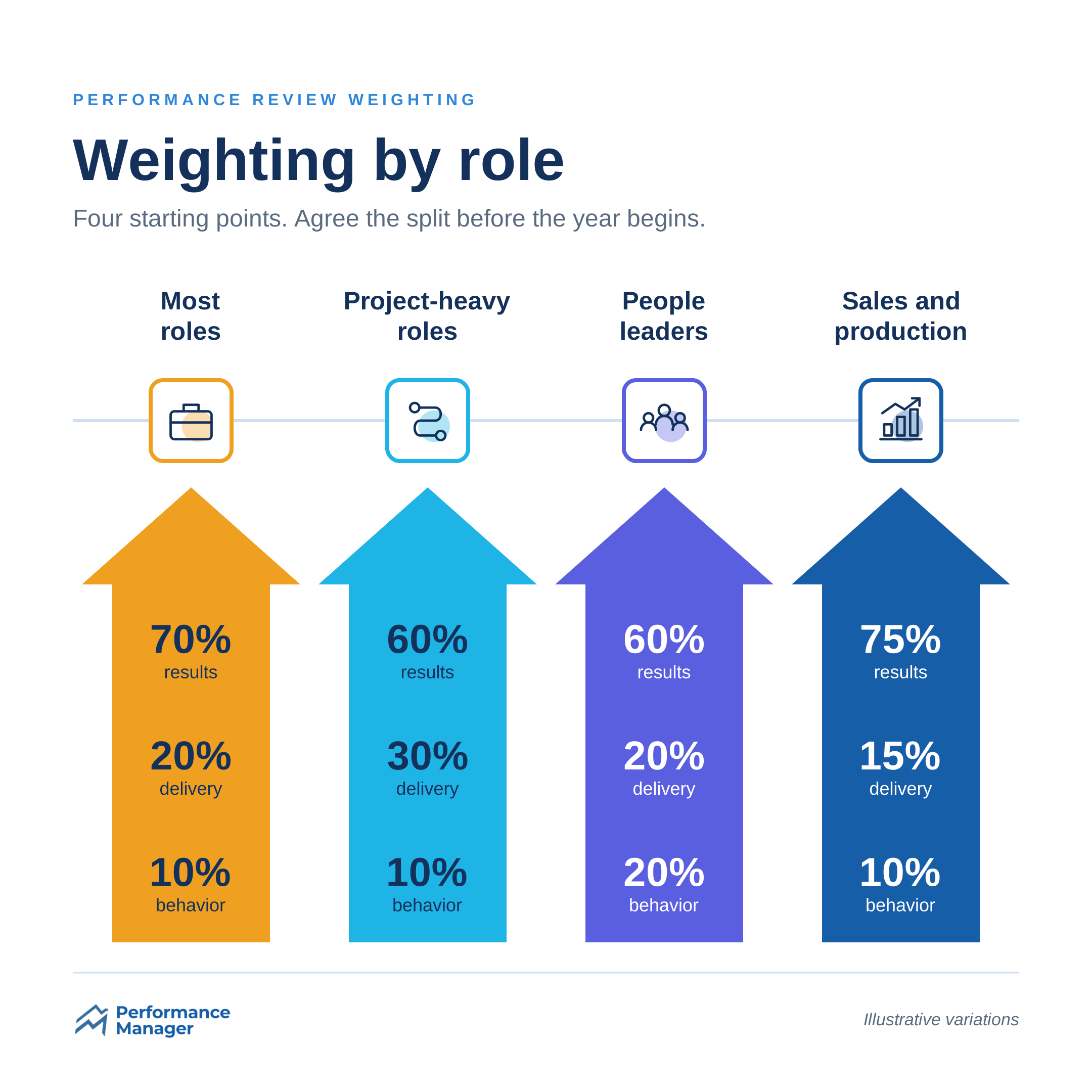
Performance review weighting should change by role when the role changes what can be measured. Project-heavy roles deserve more weight on delivery, people leaders more on behavior, and sales or production roles more on results. Agree any variation before the year begins and apply it to everyone in the same type of role.
Table 3. Illustrative weighting variations by role
Role type | Results | Delivery | Behavior | Reasoning |
Most roles (starting point) | 70% | 20% | 10% | Balanced emphasis on results, delivery and behavior |
Project-heavy or new roles | 60% | 30% | 10% | Results may lag while major initiatives are delivered |
People leaders | 60% | 20% | 20% | How a leader manages and develops others matters more |
Sales or production roles with clear output measures | 75% | 15% | 10% | Output is highly measurable and closely controlled by the role |
The splits in Table 3 are illustrations, not prescriptions. Weights inside the results dimension are a separate decision, and our guide to balanced scorecard weights covers how to divide those 70 points across individual KPIs.
How do you make a weighted performance review work in practice?
A weighted performance review works when you agree on weights before the year begins, each dimension has a clear measure, action plans link to the KPIs they support, behavior ratings come from a structured process, scores are calibrated across teams, and the manager explains each dimension before the total.
Agree the weighting before the year begins. Everyone should know from the first day how the overall score will be calculated.
Make each dimension measurable. KPIs need clear documentation and base and stretch targets. Action plans need deliverables, owners, and due dates. Competencies need behavioral descriptions that two raters would apply the same way.
Link action plans to the KPIs they support. A delivery score means most when each initiative is tied to the result it is meant to move.
Use a structured competency process. A competency or 360 degree assessment with protected anonymity and follow-up makes the behavior score credible.
Calibrate before finalizing. Compare scores across teams so the same standard applies everywhere, above all for the behavior dimension.
Explain the score. In the review conversation, walk through results, delivery and behavior separately before you show the total.
The hard part of a weighted performance score is rarely the arithmetic. It's the assembly. KPI results live in one spreadsheet, project status in another and competency ratings in a survey export, and someone reconciles all three by hand in the last week of the year. Performance Manager keeps the three inputs in one place through its Balanced Scorecard, Action Plans and Competency Assessments modules, so the review conversation starts from the same numbers on both sides of the table.
What goes wrong with weighted performance scores?
Weighted performance scores go wrong in four ways: an action plan repeats a KPI so one result is counted twice, action plans fill up with easy activities, behavior ratings drift upward without calibration, or the weighting is changed after results are known. Each one makes the overall score less believable.
Table 4. Four weighting pitfalls and how to fix them
Pitfall | What it causes | Fix |
Double counting | The same result is rewarded twice | Action plans capture the initiative behind a KPI, never the KPI itself |
Busywork action plans | A high delivery score with no movement in results | Meaningful deliverables linked to an objective |
Inflated competency ratings | Behavior scores drift upward and lose meaning | Clear behavioral standards and calibration across teams |
Changing the weighting mid-year | People stop trusting the whole process | Fix the split before the year begins |
Of the four pitfalls, changing the weighting mid-year does the most damage, because it tells everyone that the rules follow the results.
Frequently asked questions
What is a good weighting for goals and competencies in a performance review?
A good starting weighting is 70% for results against goals, 20% for delivery of action plans and 10% for competencies or behavior. Results carry the most because they are the most objective evidence. Shift the split by role, for example 60/20/20 for people leaders, and agree it before the performance year begins.
Should behavior count in a performance review?
Behavior should count in a performance review, at a modest weight. Motowidlo and Van Scotter's 1994 study found that supervisors' overall judgments reflect both task results and behaviors such as helping and cooperating. Because behavior ratings are more subjective than KPI results, a weight of about 10% recognizes how work was done without outweighing measured results.
Can you change performance review weightings during the year?
Change performance review weightings only at the start of a performance year, or when a person moves to a different type of role. Changing the split after results are known lets the weights follow the outcome, and people stop trusting the score. If a mid-year change is unavoidable, document the reason and apply it to everyone in the role.
What is the difference between results and delivery in a performance score?
Results are the outcomes a person achieved, measured by KPIs such as revenue, cost or customer satisfaction against targets. Delivery is whether the person completed the action plans and initiatives meant to move those KPIs, such as launching a system or opening a market. Delivery often shows up in results only the following year.
Conclusion
A balanced overall score accepts that performance is more than one number. Results take the largest share because the strategy depends on them and because they are the most objective evidence you have. Delivery rewards the work that produces next year's results, and behavior recognizes how the work was done without letting subjective ratings take over. Start with 70% results, 20% delivery and 10% behavior, adjust the split for roles where the evidence differs, and publish it before the year begins. Then run the numbers for two people on your own team who hit the same targets, and see whether the score tells them apart.
Measure what people achieve, what they deliver and how they work, and you will see the whole picture.