

Most disagreements at appraisal time are not really about performance. They are about the target.
Target setting is the act of deciding what level of a measure counts as good performance, and a target has two useful levels: a base, which reflects solid competent work in normal conditions, and a stretch, which is achievable with exceptional effort but should not be routine. Setting both lets an organization recognize good work without overstating it.
A well-chosen measure with a badly set target still produces scores that feel unfair, encourages people to game the numbers, and demotivates the people the organization most needs to keep. What follows is how to set base and stretch targets that are ambitious, credible and fair, with worked target setting examples and a checklist for managers approving 2027 scorecards.
Why the target matters as much as the measure
Organizations often spend a great deal of time choosing the right measures and very little time deciding what level of each measure should count as good performance. Yet the target is what turns a measure into a judgement. The same result can earn a strong score against one target and a weak score against another, so a carelessly chosen number can undo all the effort that went into designing the scorecard.
Measures still need to be well designed first. They should follow SMART principles and be properly documented with a definition, a data source, and a baseline. Once that groundwork is in place, the quality of the target becomes the deciding factor in whether people trust their scores.
What does the research say about setting targets?
Goal-setting research gives managers a useful starting point, and it points in two directions at once.
Edwin Locke and Gary Latham, summarizing 35 years of empirical work in American Psychologist, found that “specific, difficult goals consistently led to higher performance than urging people to do their best.” They also found the effect depends on commitment, and that commitment is stronger when people believe the goal matters and believe they can reach it. A target has to be challenging enough to lift performance and credible enough to be accepted.
The same research community has warned about what happens when goals are set badly. Lisa Ordóñez and colleagues, writing in Academy of Management Perspectives, argued that goals which are too narrow or too aggressive lead people to neglect what is unmeasured, take inappropriate risks, and in some cases behave dishonestly to hit the number. Note that this is a review and critique of the literature rather than a single experiment, but the mechanism it describes is well documented, and most managers will recognize it.
Kaplan and Norton put targets at the center of the balanced scorecard, arguing that each measure should carry a target reflecting the ambition of the strategy. Setting two levels is the practical way to reconcile the two lessons above. It keeps an achievable standard in place while still giving people something ambitious to aim at.
What is the difference between a base and a stretch target?
A base target is the result you would expect from solid, competent performance in normal conditions. Meeting it means the job has been done well. A stretch target is a more ambitious level that is achievable with exceptional effort, skill or circumstances. Reaching it should be possible, but not routine.
Separating the two helps supervisors in three ways. It allows them to recognize solid performance without overstating it, to reward exceptional performance clearly, and to have a more honest conversation when results fall short of the base. It also gives employees a clear picture of what “good” and “excellent” look like before the year begins, rather than after the appraisal.
Five ways to set a target
There is no single correct method, and most good targets draw on more than one.
Exhibit 1. Five approaches to setting a target
Approach | How it works | Works best when | Watch out for |
Historical trend | Projects the target from past performance, for example the average of the last two or three years | The process is stable and there is reliable historical data | Simply repeating past performance, including past problems |
Benchmark | Compares performance with peers, industry data or best practice | Comparable data exists and conditions are similar | Benchmarks from organizations with very different resources or markets |
Strategy-derived | Works backwards from the strategic objective to the level each measure must reach | The organization has a clear objective with a defined end point | Targets that add up on paper but ignore capacity |
Capacity-based | Sets the target from the people, money and systems actually available | Resources are fixed or tightly constrained | Using capacity as a reason never to stretch |
Negotiated | The manager and employee agree the target together, using evidence | Commitment matters and the employee understands the work best | Sandbagging, where low targets are proposed to make them easy to beat |
In practice, a target might start from the historical trend, be tested against a benchmark, be adjusted to reflect the strategy, and then be agreed with the person responsible for delivering it.
Target setting examples: three measures worked through
Exhibit 2 shows how base and stretch targets might be set for three different measures in a customer service team. The figures are illustrative, but the reasoning applies to most measures.
Exhibit 2. Setting base and stretch targets: an illustrative example
Measure | Direction | Baseline (2026) | Base target | Stretch target | Reasoning |
Customer satisfaction score | Higher is better | 78% | 80% | 86% | Base reflects a modest, steady improvement. Stretch matches the best quarter achieved in the last two years |
Average days to resolve a complaint | Lower is better | 6 days | 5 days | 3 days | Base removes known delays. Stretch depends on the new case system working as planned |
Complaints resolved at first contact | Higher is better | 55% | 60% | 70% | Base follows the historical trend. Stretch is set close to an industry benchmark |
For measures where lower is better, such as resolution time, the stretch target is a lower number than the base. Recording the direction of each measure avoids confusion when scores are calculated.
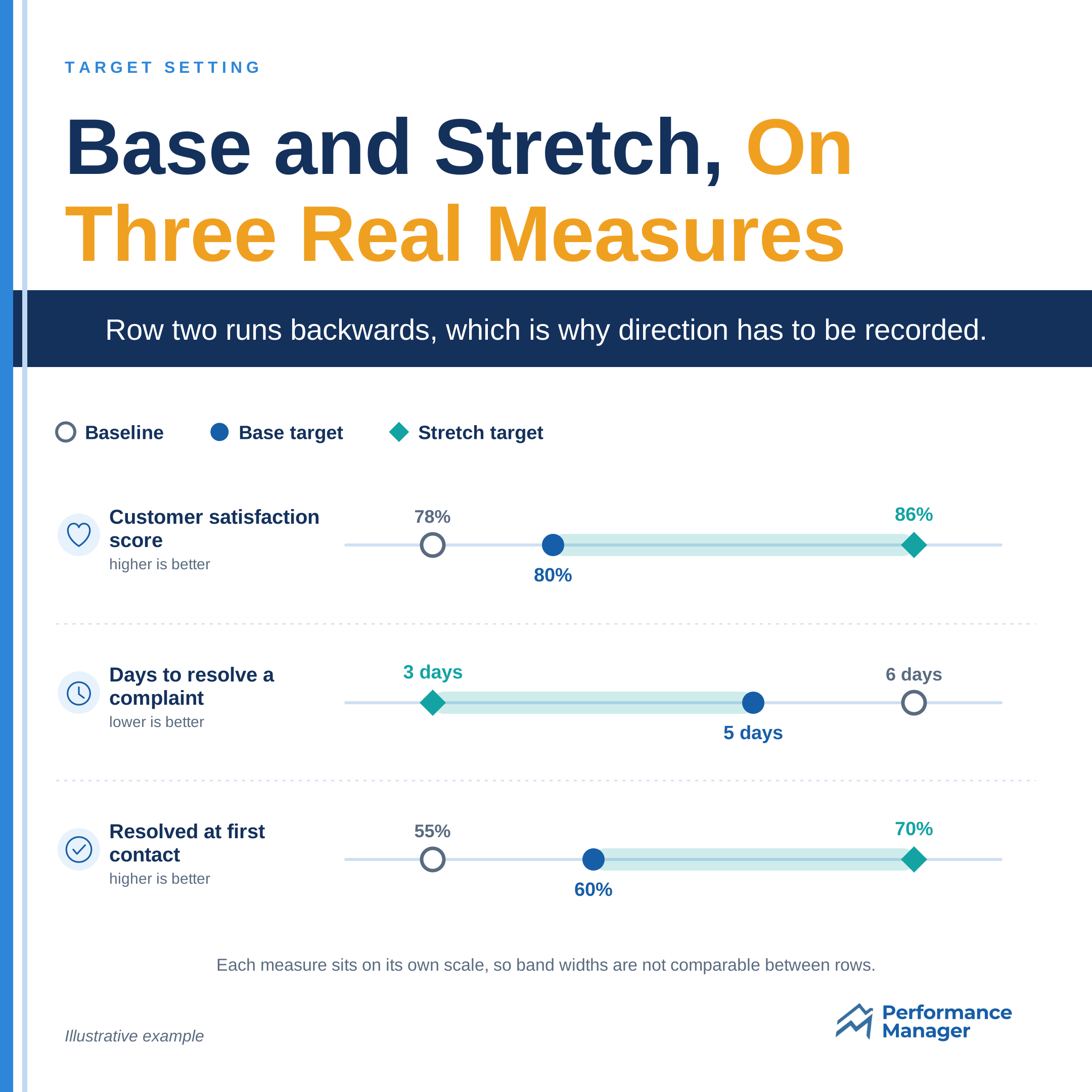
Three features of these target setting examples are worth noting. Each target starts from a documented baseline. The gap between base and stretch reflects how much is genuinely uncertain, being narrower where the process is predictable and wider where results depend on something new, such as the case system in the second row. And the reasoning is written down, which makes the target far easier to defend, or to revisit, later in the year.
What are the most common target setting mistakes?
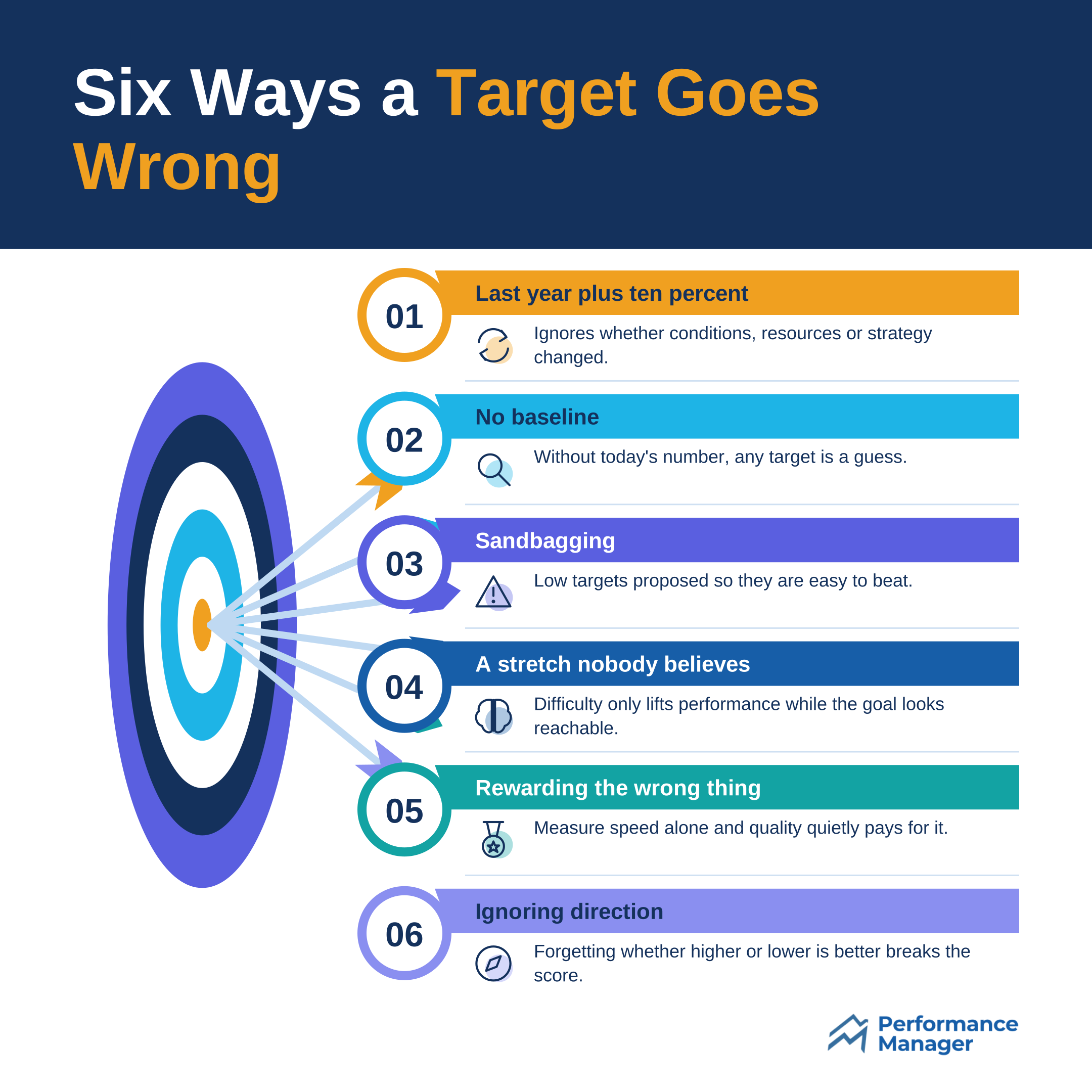
Six recur often enough to be worth naming.
Last year plus ten percent. Adding a fixed percentage to last year’s figure is quick, but it ignores whether conditions, resources or strategy have changed.
Targets without a baseline. If nobody knows the current level of performance, any target is a guess, and the resulting score is hard to trust.
Sandbagging. When targets are negotiated, people may propose deliberately low numbers. Asking for the evidence behind each proposal, and comparing it with history and benchmarks, prevents most of it.
Stretch targets nobody believes. A stretch target that everyone privately regards as impossible does not raise performance at all, because commitment depends on people believing the goal is attainable.
Targets that reward the wrong behavior. If a team is measured only on the speed of resolving complaints, quality suffers. Pair related measures, such as speed with first-contact resolution, so that winning on one cannot be achieved by losing on the other.
Ignoring direction. Forgetting to record whether higher or lower is better is a surprisingly common source of incorrect scores.
When to revisit a target during the year
Targets should be stable enough to be meaningful and not so rigid that they become irrelevant.
It is reasonable to revisit a target when something material has changed that nobody could have anticipated: a major shift in the economy, a change in regulation, or a significant change in the resources available to the team. It is not reasonable to revisit a target simply because performance is falling short of it. That distinction is the whole of the governance question, and it is worth stating out loud before the year starts rather than arguing about it in month eight.
Any change should be agreed by the same people who approved the original target, recorded with the reason, and applied before results are known wherever possible. Reviewing trend data through the year helps managers spot genuine changes in conditions early, rather than discovering them at appraisal time.
A checklist for approving targets
Exhibit 3. A ten-point target checklist
Before approving a scorecard, test each target against these ten points.
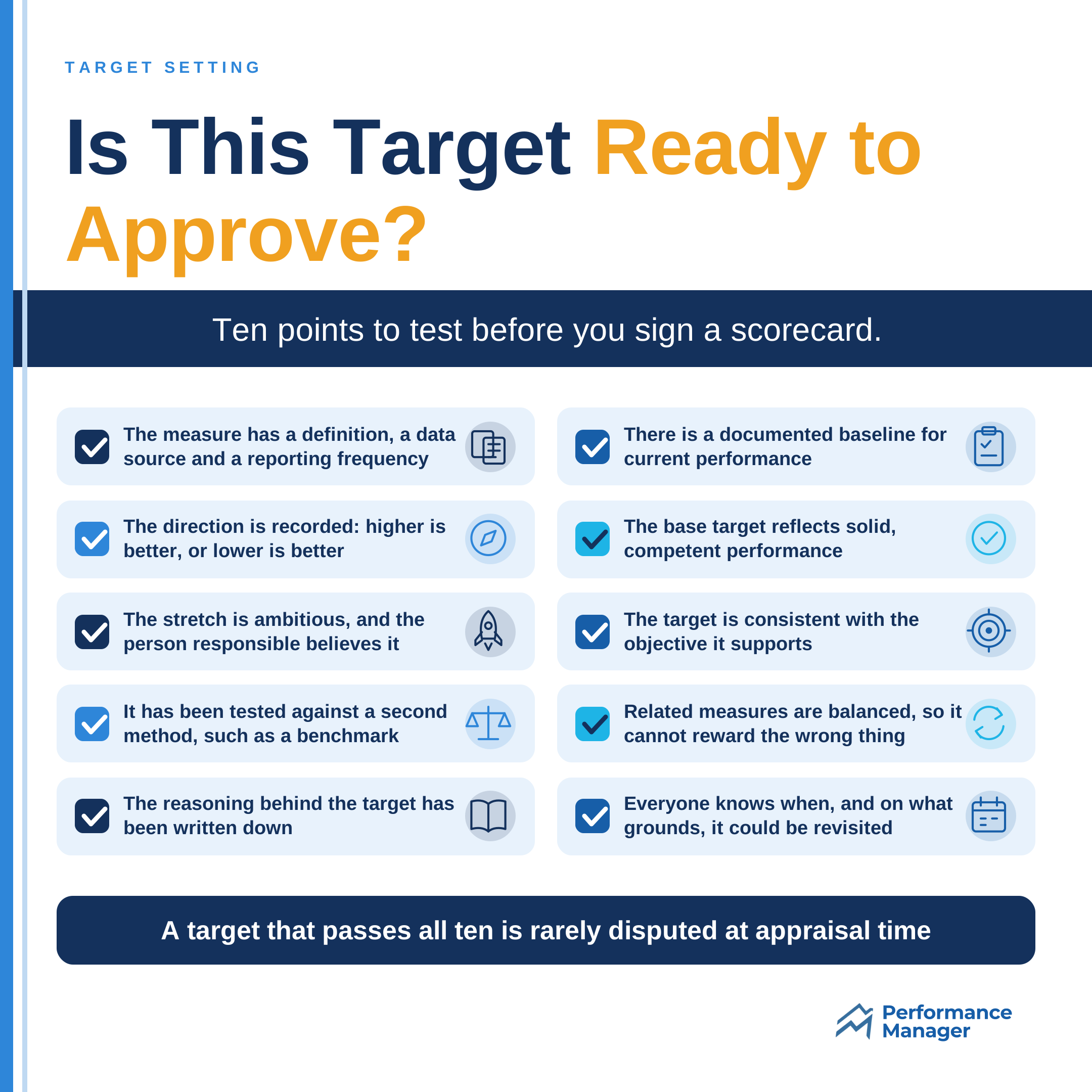
A target that passes all ten is far less likely to be disputed at appraisal time.
Points two, three and nine are the ones that quietly fail in a spreadsheet, because a baseline, a direction and a paragraph of reasoning have nowhere obvious to live and get dropped at the first copy-paste. Performance Manager holds a base target, a stretch target and the direction against every measure, so scores calculate the same way in month eleven as they did in month one. A spreadsheet can do it too, as long as there is only one of them.
Frequently asked questions
What is target setting? Target setting is deciding what level of a measure counts as good performance before the period begins. It turns a measure, which only reports a number, into a judgement about whether that number is good or bad. A complete target records a base level, a stretch level, the direction of the measure and the reasoning behind both.
What is the difference between a base target and a stretch target? A base target is what solid, competent performance looks like in normal conditions, and meeting it means the job was done well. A stretch target is achievable with exceptional effort or favorable circumstances and should not be reached routinely. Recording both lets a supervisor recognize good work and reward excellent work without conflating them.
How do you set a target when there is no historical data? Use a different method rather than guessing. A benchmark from comparable organizations, a target derived backwards from the strategic objective, or a capacity-based figure built from the resources actually available will all beat an invented number. Then set a wider gap between base and stretch than usual, because the uncertainty is genuinely higher, and plan to re-baseline once a year of real data exists.
Can a target be changed during the year? Yes, but only for a material change nobody could have anticipated, such as a regulatory shift or a significant change in resources. Falling short of a target is not grounds for changing it. Any revision should be approved by the people who approved the original, recorded with its reason, and made before the results are known.
Where to start
Good targets are specific, challenging and credible. Setting both a base and a stretch target lets an organization recognize solid performance and reward exceptional performance while keeping the standard fair. The most reliable targets start from a documented baseline, combine more than one method, record the direction of the measure, and are agreed with the person who has to deliver them. Write the reasoning down at the start of the year and the conversation at the end of it becomes far easier for everyone.
A fair target is one that people believe in before the year starts, not one they argue about after it ends.
Setting targets for 2027? Industrial Psychology Consultants helps organizations design measures, set targets that are both ambitious and defensible, and build scorecards people trust. Book a demo to see how base and stretch targets work in Performance Manager, or request a quote for scorecard design support.