
Every leader who has been near a strategic plan has a story they tell only after the second cup of coffee. It might be the offsite that agreed on everything and changed nothing, or the budget that quietly overruled the strategy, or the plan that was printed, bound and never opened again. This article collects ten of those experiences. We suspect you have lived through more than half of them, and we would like you to tell us which ones.
Why we are asking
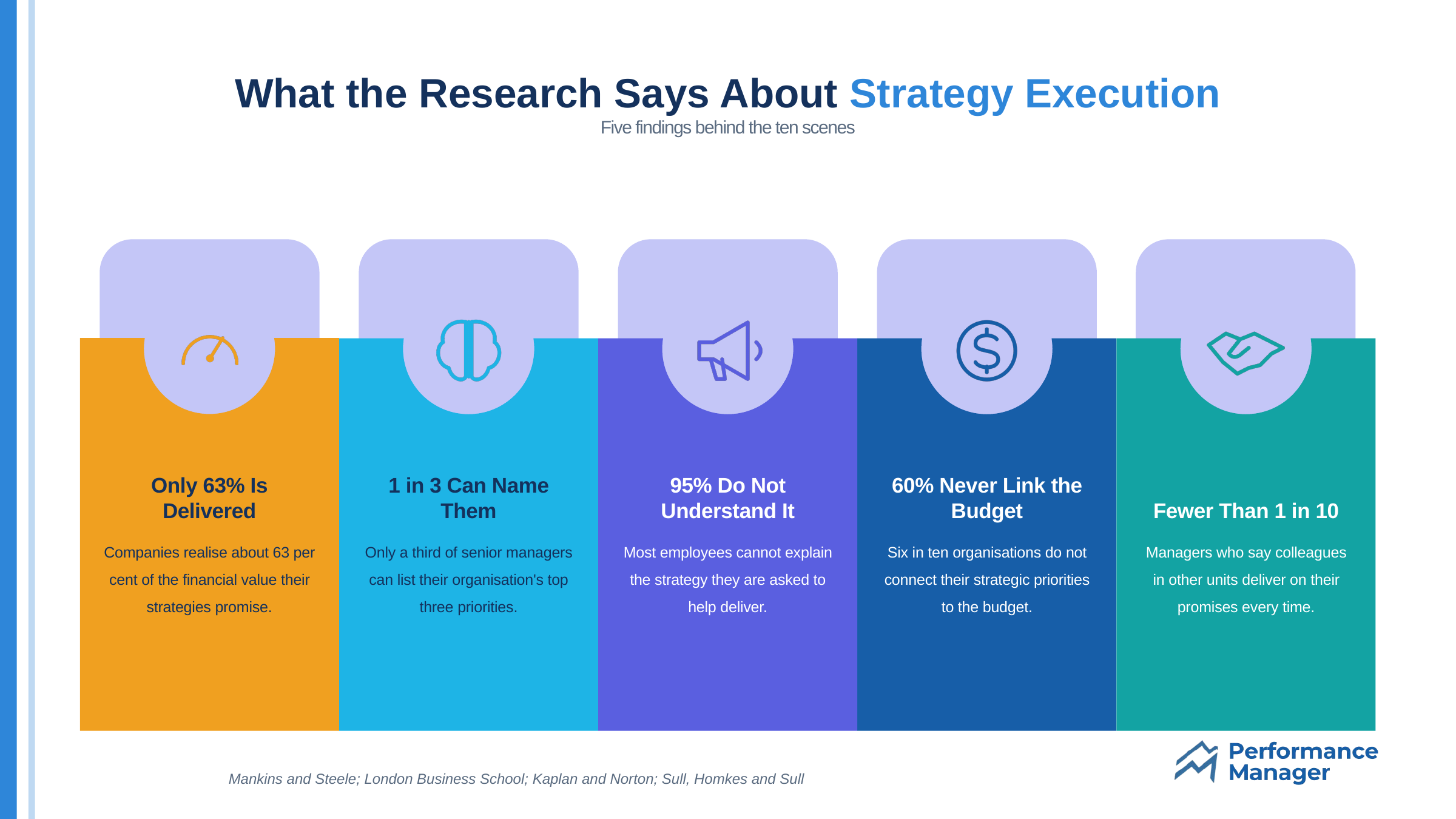
Strategy is usually written about as if it were a clean, rational process: analyse, decide, cascade, execute, review. Anyone who has actually done it knows that the real experience is messier, more political and often more frustrating than the textbooks suggest. The research supports that instinct. Mankins and Steele (2005) found that companies typically deliver only about 63 per cent of the financial value their strategies promise, and a study of more than 400 organisations found that only a third of senior managers could correctly name their firm’s top three priorities (London Business School, 2015; Sull, Homkes and Sull, 2015).
Numbers like these tell us that something goes wrong. They do not tell us what it feels like from the inside, or which problems hurt most. That is where we want your help. Read the ten scenes below, keep count of the ones you recognise, and tell us your number in the comments.
Part one: in the room where strategy is made
1. The offsite that agreed on everything
Two days at a lodge outside town. Flip charts on every wall. By the second afternoon, the leadership team has agreed on a vision, five pillars and fourteen strategic objectives. Everyone leaves happy, and nobody has given anything up.
What is really going on? Agreement came easily because no real choices were made. Strategy, as Porter (1996) argued, is as much about deciding what not to do as about what to do. A session in which every function keeps every priority it arrived with has produced a wish list rather than a strategy, and the trade-offs it avoided will reappear later as conflict over budgets and people.
Your turn: What is the hardest thing your organisation has ever chosen to stop doing as part of a strategy?
2. The plan written for someone else
The strategic plan exists because a funder, regulator, or board asked for one. It was drafted against a template, submitted on time, and approved. Internally, people still run the business the way they always have.
What is really going on. When the audience for a plan is external, it tends to be written to satisfy reviewers rather than to guide decisions. The result is a document that is complete in form but weak in substance, and one that managers have little reason to consult once it has done its job of being approved.
Your turn: Who was your last strategic plan really written for?
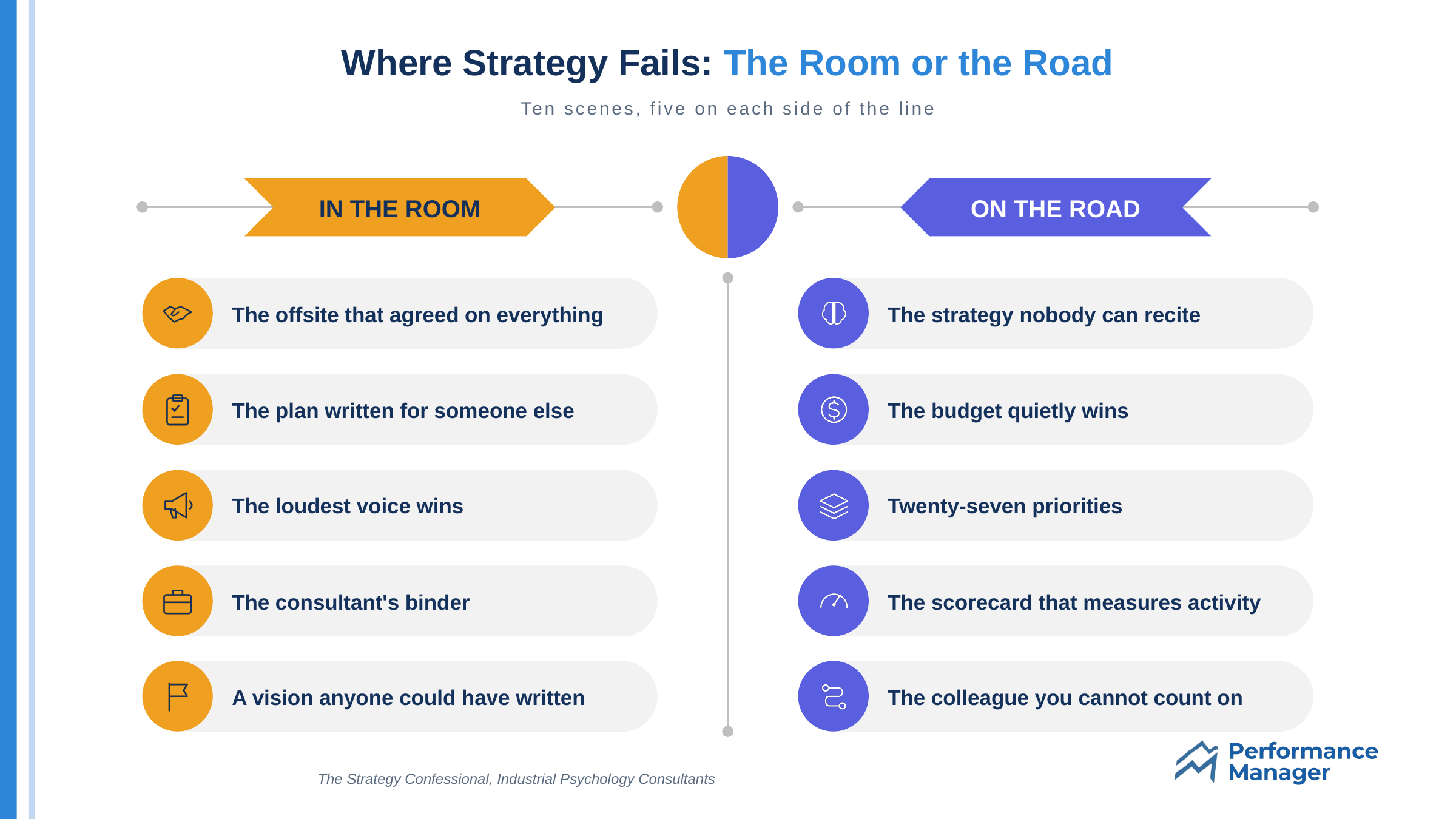
3. The loudest voice wins
The analysis has been done, the options have been compared, and the evidence points one way. Then the most senior person in the room says, “I hear all that, but my gut tells me…”, and the discussion is over.
What is really going on. Experience and judgement matter, and sometimes the gut is right. The problem arises when seniority ends the debate rather than adding to it, because people learn quickly that preparing evidence is pointless. Over time, the organisation stops bringing bad news and uncomfortable options into the room at all.
Your turn: Have you ever watched a strategic decision get made on rank rather than evidence? What happened next?
4. The consultant’s binder
An external firm ran the process, interviewed the executives and produced an impressive document with sharp graphics. Six months later, a manager asks who owns the strategy, and the honest answer is the consultants, who have since left.
What is really going on. Outside help can bring rigour, challenge and a fresh view. However, if the leadership team does not do the hard thinking itself, it rarely feels the plan is truly its own. Nobody is handed the job of owning it, and a strategy without an internal owner tends to fade as soon as the facilitators leave.
Your turn: Should consultants write strategy, facilitate it, or stay out of it altogether?
5. The vision statement that could belong to anyone
“To be the leading provider of innovative, customer-centric solutions in our region.” It is framed in reception, printed on lanyards and recited at induction. It would fit equally well on the wall of every competitor.
What is really going on? Martin (2014) argues that real strategy is a set of choices about where to play and how to win. A statement that any competitor could adopt without changing anything makes no such choice, so it cannot guide a decision. It feels safe precisely because it commits the organisation to nothing.
Your turn: Could your vision statement be pasted into a competitor’s annual report without anyone noticing?
Part two: on the long road to results
6. The strategy nobody can recite
Ask ten managers to name the organisation’s top three strategic priorities. You get ten different answers, several long pauses and at least one person who reaches for their phone to look it up.
What is really going on? This is far more common than most executives assume. In the London Business School research, only a third of senior managers could list their firm’s top three priorities, and even among those who had helped develop the strategy, the figure was only slightly more than half (London Business School, 2015). Kaplan and Norton (2005) went further, reporting that 95 per cent of employees in a typical organisation do not understand its strategy (Lagace, 2006).
Your turn: Without looking, can you name your organisation’s top three priorities right now?
7. The budget quietly wins
The strategy says the organisation will invest in digital channels and a new market. Then the budget round arrives, last year’s figures are rolled forward with a percentage added, and the new priorities receive whatever is left over.
What is really going on? When strategy and budget are prepared by different people on different timetables, the budget usually wins, because it is the document that actually releases money. Kaplan and Norton (2005) reported that 60 per cent of organisations do not link their strategic priorities to their budget (Lagace, 2006). In practice, the budget becomes the real strategy.
Your turn: In your organisation, which document wins when the strategy and the budget disagree?
8. Twenty-seven priorities
Each department added its own initiatives to the plan, and nobody wanted to say no. The result is a portfolio of twenty-seven priority projects competing for the same people, the same money and the same few hours of executive attention.
What is really going on. When everything is a priority, nothing is. Managers respond by quietly choosing their own priorities, which means the organisation’s real strategy is being set in hundreds of separate decisions rather than in the boardroom. Sull, Homkes and Sull (2015) found that strategies often unravel at exactly this point, where coordination across units breaks down.
Your turn: How many “top priorities” does your organisation have this year, and how many could it genuinely fund?
9. The scorecard that measures activity
The quarterly report is green from top to bottom. Workshops were held, policies were approved and systems were launched. Yet the results the strategy was meant to deliver have barely moved.
What is really going on. Activity is easy to count, so it often ends up on the scorecard in place of outcomes. Measures need clear definitions and a baseline, and a balance of leading and lagging indicators that show whether the strategy is working rather than whether people are busy. Otherwise, the report becomes an autopsy rather than a diagnosis.
Your turn: What is the most meaningless measure you have ever seen on a strategic scorecard?
10. The colleague you cannot count on
Your part of the strategy depends on another department delivering its part first. They have their own targets, their own boss and their own crisis this quarter. Your milestone slips, and your name is the one on the report.
What is really going on. Strategy rarely fails inside a single team. It fails at the handovers between teams. Sull, Homkes and Sull (2015) found that managers could rely on colleagues in other units to deliver all of the time in fewer than one case in ten (London Business School, 2015). Most organisations manage performance vertically, through objectives that cascade down a single line, while strategy depends on people working across those lines.
Your turn: Which hurts your strategy more: weak performance inside teams, or broken handovers between them?
Keep score
Count how many of the ten scenes you have lived through in your current or most recent organisation. Exhibit 1 suggests what your score might mean. It is meant to start a conversation rather than to serve as a diagnostic tool.
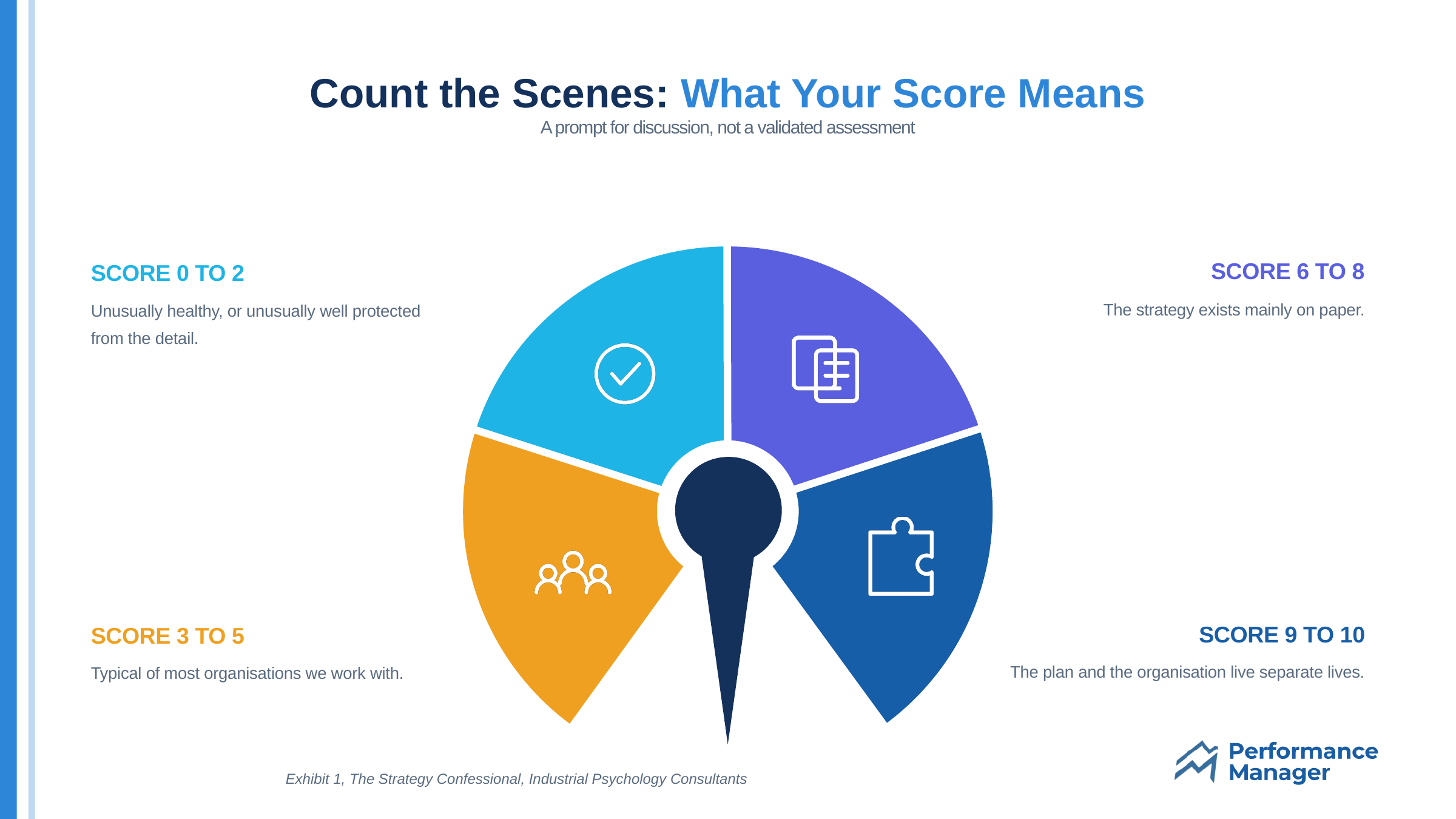
Exhibit 1. The strategy confessional scorecard
Your score | What it suggests | A question worth asking |
0 to 2 | Unusually healthy, or unusually well protected from the detail | Would people two levels below the leadership team give the same score? |
3 to 5 | Typical of most organisations we work with | Which one or two scenes are costing you the most, and does anyone own fixing them? |
6 to 8 | The strategy exists mainly on paper | Is the problem the strategy itself, or the way it is being managed? |
9 to 10 | The plan and the organisation are living separate lives | If the strategy disappeared tomorrow, how long would it take anyone to notice? |
The score bands reflect our own judgement and are offered as a prompt for discussion, not as a validated assessment.
Our provocation
Here is the claim we expect some readers to disagree with. Most strategies do not fail in execution. They fail in the room where they are made, and execution is blamed afterwards.
Look again at the ten scenes. The first five happen before a single initiative is launched, yet they shape almost everything that follows. A strategy that makes no real choices (scene 1), was written for an outside audience (scene 2), or belongs to nobody inside the organisation (scene 4) will struggle to be executed well, however disciplined the teams responsible for delivering it may be. Mintzberg and Waters (1985) observed long ago that the strategy an organisation actually pursues is shaped as much by what emerges along the way as by what was intended. If the intended strategy is vague, what emerges is simply the sum of everyone’s separate priorities.
There is a strong counter-argument, and we would like to hear it. Sull, Homkes, and Sull (2015) argue that many of the common beliefs about execution are themselves myths, and that coordination and agility during execution matter more than leaders assume. Perhaps the plan is never the problem and the real test is always what happens on Monday morning.
Most strategies do not fail in execution. They fail in the room, and execution takes the blame.
Join the conversation
We would genuinely like to hear from you, and the most useful comments are usually the most specific ones. Here are three ways to join in.
Three ways to respond Tell us your score. How many of the ten scenes have you lived through, and which one hurt the most? Tell us the scene we missed. What happens in strategy work in your organisation that is not on this list? Take a side. Do strategies mostly fail in the room where they are made, or on the road to results? Tell us why. We will read every comment and gather the most common experiences into a follow-up article. |
If you would rather not share your experience in public, you are welcome to send it to us privately. We will never name an organisation or an individual without permission.
Where to start Share this article with your leadership team and compare your scores. The differences between people’s answers are often more revealing than the scores themselves. If you would like help, Industrial Psychology Consultants facilitates strategy formulation and execution reviews. We help leadership teams make the hard choices in the room, link the strategy to the budget and the scorecard, and build the review rhythm that keeps the plan alive. 170 Arcturus Road, Harare, Zimbabwe | +263 242 481946-48 | ipc@ipcconsultants.com | ipcconsultants.com |
This article is part of our series on strategy. Earlier pieces looked at the orphaned alignment, the mid-point nobody marked, why operational efficiency is not a strategy, and the death of the static five-year plan